
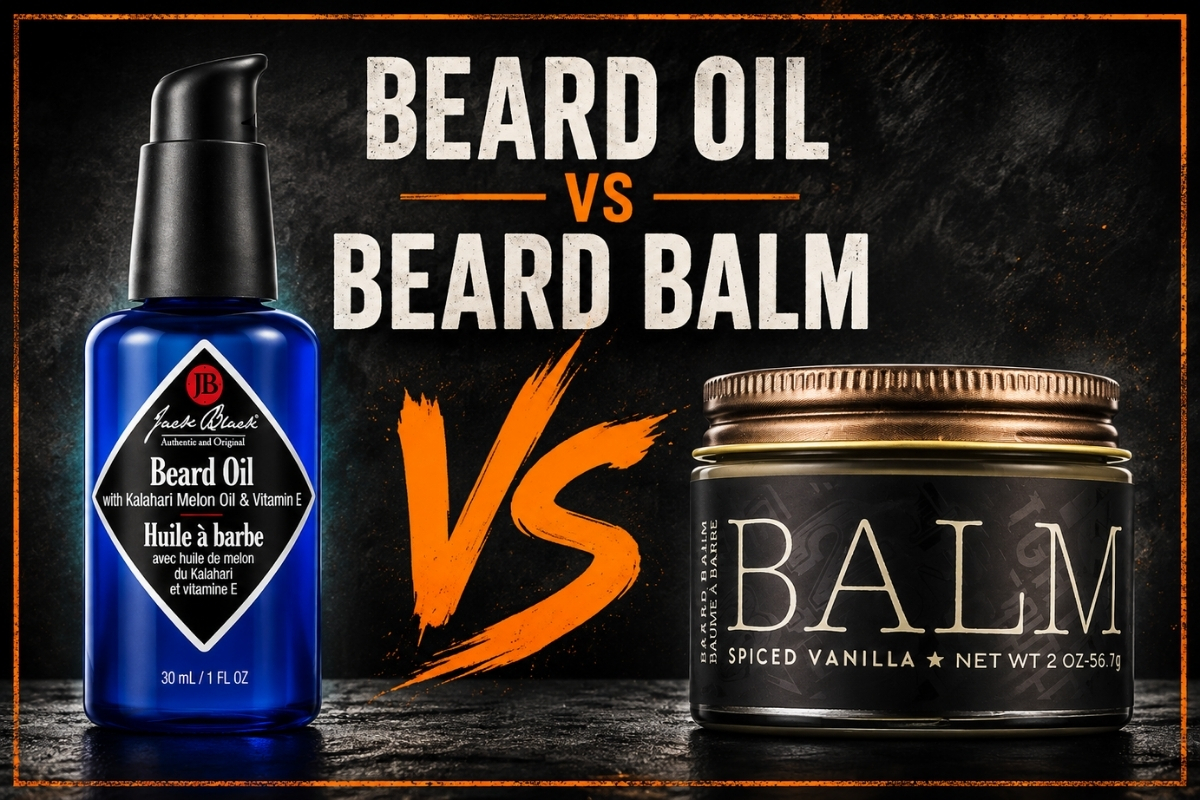
Beard oil vs beard balm should be a simple comparison. Then you start looking at what each one promises and the difference gets blurry fast. Both can sound useful, and neither name tells you exactly what your beard is going to feel like once the product is in.
That’s where I think this choice gets overcomplicated. You can end up buying the product that sounds more complete, or using both because that feels like the safer option, without really knowing whether either decision makes sense for your beard.
Before you make the choice, it’s worth getting clear on where balm and oil actually overlap and where they start behaving differently.

In this article
Beard Oil vs Beard Balm at a Glance
Beard oil and beard balm overlap more than they first appear. Both can condition the beard, but balm is thicker and leaves more weight behind. How much extra control you get from that depends on the formula.
| Beard Oil | Beard Balm | |
|---|---|---|
| Why you’d choose it | Conditioning with a lighter feel | Conditioning when you also want more weight or control |
| What it leaves in the beard | Very little styling structure | More weight; structure varies by formula |
| Skin beneath the beard | Commonly worked into the skin as well as the beard | Can also condition the skin, depending on the formula |
| Flyaways and control | Little meaningful styling control | Can help with flyaways; actual hold varies by formula |
| Typical formula | Primarily a blend of oils | Usually oils, butters, and waxes |
| Best starting point | When you want conditioning without much added weight | When you want conditioning plus more weight or some help controlling the beard |
I wouldn’t use beard length as the shortcut here. Oil can still make sense on a longer beard that already holds its shape well, while balm can be useful on a shorter beard that needs more help with flyaways. What matters more is how you want the beard to feel and behave once the product is in.
| Beard Balm vs Beard Oil |
| Ready to Choose? |
| Want conditioning without much added weight or styling control? |
|
See Jack Black Beard Oil → |
| Want conditioning plus a little more help taming and shaping the beard? |
|
See 18.21 Man Made Beard Balm → |
| Need both? Only layer them when the second product is adding something your beard still needs. |
| Beard Beasts may earn a commission when you buy through links on this page. |
The Real Difference Is How Much Weight and Control You Want
Conditioning is where beard oil and beard balm overlap, so softness alone isn’t a very useful way to choose between them. The real difference starts to show when you look at how much weight and control you want alongside that conditioning.

Beard oil usually adds very little styling control. Beard balm is thicker and, depending on the formula, can leave enough weight in the beard to help settle flyaways or keep the beard closer to the shape you brushed it into.
But that isn’t automatically the same as hold. Some balms are still mainly conditioning products, while waxier formulas can give you noticeably more control.
If your beard already looks the way you want after brushing, I wouldn’t move to balm just because it sounds like the more complete product. A thicker product only makes sense if you want the extra help it gives you.
Beard Oil Makes More Sense When You Want to Keep Things Light
If roughness or dry-feeling skin is what brought you here, beard oil is the simpler place to start. You’re trying to improve how the beard and the skin beneath it feel, not add more control.

Beard oil is worked through the hair and into the skin beneath it. Compared with balm, it’s lighter and adds little styling control, which makes it a better fit when you want conditioning without much extra weight. A softer beard may also be easier to brush or comb, but that’s still different from adding hold.
If that lighter conditioning approach is what you’re after, Jack Black Beard Oil is the one I’d recommend. It makes sense here because you’re getting a beard oil focused on softening and conditioning without trying to add styling control.
Keeping things light doesn’t make oil the lesser option. If the beard feels better and you weren’t looking for extra control in the first place, oil has done the job.
When Softness Isn’t the Only Thing You Want
Sometimes the beard already feels fine after conditioning, but you still aren’t happy with what happens after you brush it. Certain hairs lift away from the rest of the beard, or parts of it lose the shape you just gave them.

That’s the point where I’d start considering balm. You’re no longer asking the product only to improve how the beard feels. You also want some help keeping it where you put it.
If that sounds closer to what you need, I’d recommend 18.21 Man Made Beard Balm. It gives you the conditioning you’d expect from a balm, with some extra help taming and shaping the beard without pushing into strong-hold wax territory.
That level of control is enough for a lot of beards, but it won’t be enough for everyone. If you want a stronger balm, Honest Amish Heavy Duty Beard Balm is the type I’d look at because it’s made to give more control than a softer balm like 18.21. If hold is becoming the main priority, though, a beard wax may make more sense than pushing balm further than it’s meant to go.
The Word “Balm” Doesn’t Tell You How Much Hold You’ll Get
Two products can both be sold as beard balm and still behave quite differently. One may mostly condition the beard and tame a few stray hairs, while another can hold the shape firmly enough that you’ll notice the difference.
I wouldn’t try to predict that from the ingredient list alone. Seeing beeswax tells you it’s part of the formula, but it doesn’t tell you how much hold the finished balm will give you.
The brand’s own description is a better clue, but I still wouldn’t treat terms like light or high hold as exact measurements you can compare across every company. “Tames flyaways” tells you something different from a product that specifically promises styling hold.
If control matters to you, match that claim to what you actually need. The word “balm” tells you the type of product you’re looking at, not how firmly that particular formula will keep your beard in place.
You May Not Need Oil Under Your Beard Balm
There’s no rule that beard oil has to sit underneath balm. The two products already overlap as conditioners, and many balms contain oils and butters of their own. Some can also be worked into the skin beneath the beard, so oil isn’t automatically filling a gap the balm leaves behind.

Using both can still make sense, but I’d want a reason for keeping the oil in the routine. Maybe you prefer what oil does for the beard and skin but still need the extra weight or control of a particular balm.
In that case, layering has a purpose. Just start small rather than assume more of both will give you a better result.
That’s the test I’d apply. If balm already gives you the condition and control you want, I wouldn’t add oil underneath it just because that’s how a “complete” beard routine is supposed to look. Make the second product prove it belongs there.
Beard Oil vs Beard Balm: My Verdict
For me, beard oil vs beard balm comes down to whether conditioning is enough, or whether you also want the product to influence how the beard behaves afterward.
If you mainly want conditioning with a lighter feel and very little styling control, I’d start with oil. If you also want help settling flyaways or holding the shape you gave it after brushing, balm makes more sense. Just check the specific formula if hold matters, because the word “balm” doesn’t tell you how much control you’re getting.
I wouldn’t build the routine around using both. Start with the one that solves the problem you actually have. If it does the job, stop there.