
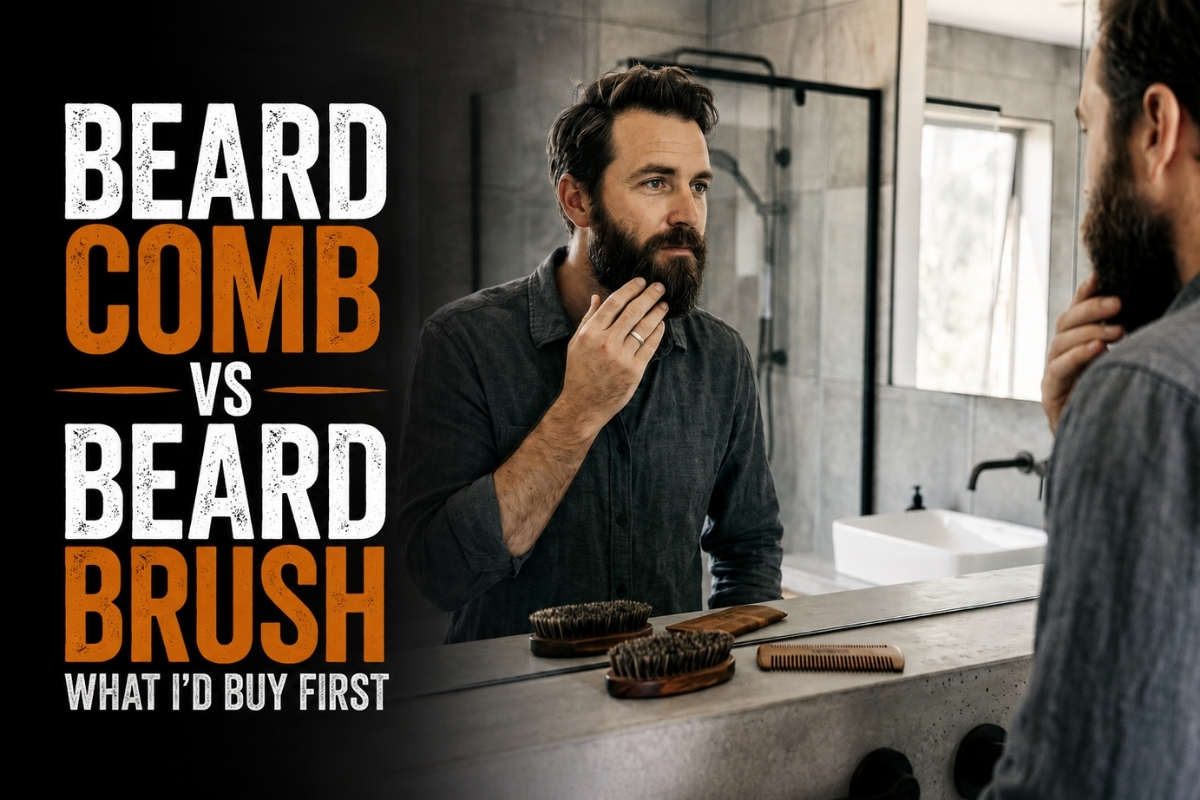
At first glance, a beard comb and beard brush seem to do much the same job. Both can help get a beard under control, but once you start using them, the difference is bigger than it looks.
Beard length, density, and what you actually need the tool to do can all change which one makes more sense.
One tool can solve the problem you’re dealing with, while the other ends up forgotten in a drawer despite being treated as a grooming essential. This beard comb vs beard brush comparison is not about crowning a universal winner.
It is about working out when a beard comb is the right call, when a beard brush makes more sense, and whether you need both.

In this article
A Beard Brush Moves More Hair at Once. A Comb Gets Between the Hairs
A beard brush and a beard comb both help manage your beard, but they work through the hair differently.

A brush makes contact with lots of hairs at once, with the bristles guiding larger groups in the same direction. A comb passes between smaller groups of hairs, giving you more separation and control over individual sections.
That difference matters more once you need to do more than guide the beard as a whole. A brush can still improve how the beard lies overall, but a beard comb is better when you need to work through tangles, isolate a section or control a specific area without moving most of the beard with it.
The spacing between the teeth changes how the comb feels as it moves through your beard. Wider teeth usually pass through thicker or denser growth with less resistance, while closer teeth give you more control but can catch more easily if the beard is already tangled. Even with differences in bristle length and density, a brush still works across a broader area of the beard than a comb.
For me, the important point is that extra precision does not make the comb the better tool. Sometimes you need control over a small area, and sometimes you want to move more of the beard in the same direction. Neither one is an upgrade on the other.
Your Beard Will Tell You When It’s Time for a Comb
I would not switch from a brush to a comb based on a fixed beard length. What matters more is whether your beard is starting to become harder to manage with a brush alone.

You might notice your fingers meeting more resistance as you run them through, hairs beginning to catch on each other, or certain areas becoming harder to separate. The beard can still look fine on the outside even while tangles are starting to form underneath.
That is when a comb starts to make more sense.
On a longer beard, do not pull the comb straight through every snag. Start near the ends and work gradually toward the face, easing through any tangles instead of forcing the teeth through them.
Tangles are not the only reason a comb can become useful. A longer mustache often needs more individual control, and a comb also helps when trimming because you can lift and separate a small section of hair before cutting it.
Density matters too. Two beards can be the same length but need different tools if one is much thicker and starts catching or tangling sooner.
When a Beard Brush Still Makes More Sense
Needing a comb does not mean the brush stops being useful.

Take a beard around half an inch long. If the hairs are sticking in different directions but are not catching or tangling, a brush usually makes more sense. At that length, the main job is getting the short growth lying better rather than working through tangles.
A brush can also work well as a finishing tool. After you have used a comb or worked product through with your hands, brushing can bring the hairs back together, settle stray hairs and improve how the beard looks overall. That is a different job from using a comb to separate and control smaller sections.
Curl pattern can change the recommendation too. A short, curly beard can start catching and tangling sooner than a straighter beard at the same length, while a straighter short beard can still be easy to manage with a brush. Treat half an inch as a useful example, not a fixed rule.
Do You Need Both a Beard Comb and a Beard Brush?
Not necessarily. I’d only buy both if each one has a clear, separate job in your routine.

If a brush already does everything you need on a shorter beard, there is little reason to add a comb.
On a longer beard, a comb can handle tangles, mustache control and preparing the beard for a trim. A brush earns its place alongside it if you also like using one afterward to settle the beard and improve how it looks once you have finished with the comb.
Before buying both, check what beard tools you already own and whether they are doing the job well.
My verdict on beard comb vs beard brush is simple. If your beard is short and mainly needs help lying better, I’d start with a brush. If it is catching, bunching, getting harder to work through or needs more control, I’d choose a comb instead.
For a long or dense beard, I’d usually buy the comb first.
Either way, I’d go by what your beard actually needs rather than buying tools because a grooming checklist says you should.