
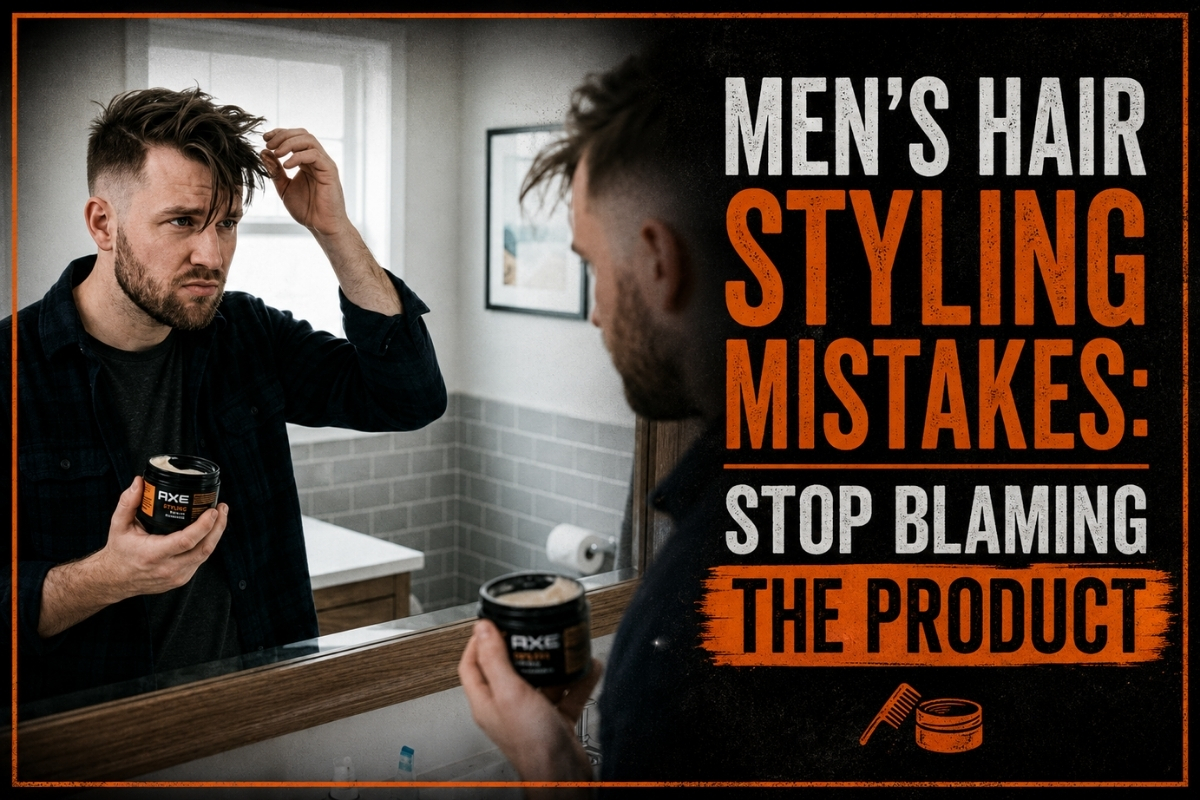
Most men’s hair styling mistakes get blamed on the product. When the fringe drops or the sides push out, another scoop of clay feels like the obvious fix.
Usually it just adds weight to a problem that started somewhere else, often long before anyone reached for a jar.
I’ve watched expensive clays get tossed after one use. The real trouble had started before the lid even came off. Blaming the label is just easier than questioning the routine.
Work backward through what you’re actually doing before you buy something stronger. Moving from medium hold to high hold only helps when strength was the missing piece to begin with, not a bad cut or weak preparation.

In this article
Product Can’t Rescue the Wrong Haircut
Product adds grip, separation, control, and shine. It can’t rebuild a haircut.

No amount of hair clay replaces the scissors or clippers needed for missing length or excess bulk in the wrong places.
A quiff needs real length through the front to rise and move back. A textured crop needs the top cut so the strands can actually break apart.
Too much weight through the sides, and they’ll push outward no matter what you put in them.
Men respond by buying stronger: a firmer paste, then a heavy clay, then enough hairspray to freeze the hair solid. That pins the problem down for a few hours while the proportions stay exactly as wrong as before.
I treat that repeated failure as the diagnosis. Front always falls? Sides always swell? Top won’t separate no matter what you try?
Another purchase was never going to fix it. Take a reference photo to your barber, but tell them what you actually do at home too, since the photo only shows the finished result.
Most of the Shape Should Be Built Before Product Goes In
A styling product should support a shape that already exists, not build one from nothing.
Two extra minutes with the dryer beats doubling the clay every time. Dry the hair flat first, then pile on product, and you’ll get something hard and overworked with none of the lift you wanted.
Damp hair redirects more easily because water temporarily disrupts some of the hydrogen bonds within each strand. As the hair dries in a new position, those bonds reform and help it hold that shape.
Start at the roots, since that’s where lift begins, and guide the hair with your fingers, a vent brush, or a round brush.

Building a quiff means lifting the front while aiming the airflow upward and back. Sweeping hair away from the face means drying it along that path instead of blasting from random angles.
Keep the dryer moving and never park heat against one spot. Frequent heat users should reach for a protectant and keep the temperature sensible.
Moisture also changes how product performs. Gel and some creams spread easily through damp hair and create more definition with less volume.
Clay and paste grip harder once the hair is dry or nearly there. Styling powder needs fully dry hair, since moisture makes it clump before it spreads.
By the time product touches the hair, the direction and basic shape should already be visible. I test that by checking whether the style holds for a few seconds on its own, with nothing in it at all.
Everything after that, hold, separation, final control, is just finishing what the dryer already started.
“High Hold” Tells You Less Than You Think
“High hold” is marketing, not a standardized measurement.
Each brand runs its own scale. Two formulas carrying the same rating can behave nothing alike: one might hold by drying into a firm film, another relies on waxiness, and a clay creates grip through waxes or oils combined with mineral ingredients.
I pay far more attention to how that hold gets created than the number on the container. It tells me more about how the hair will feel, move, and behave later in the day than any rating ever could.
Fine hair can collapse under a heavy wax no matter what “maximum hold” promises. A lighter paste or powder often supports the same hair without pressing the strands into flat sections.
Thick or coarse hair usually needs more cohesion than a dry powder provides, particularly when the style has to move in one direction. Curly or already dry hair can turn rougher under an aggressively dry clay.
The result you actually want matters just as much. A firm hair gel makes sense when you don’t want movement.
It makes no sense for a loose style you plan to adjust with your fingers all day. Shine, dryness, flexibility, restyling, and washout all matter alongside raw strength.
Choose based on your hair type and what you need it to do. The hold rating should confirm that decision, not make it.
Too Much Product Is Only Half the Application Problem
Scoop out a lump of clay, rub the hands together twice, then plant both palms directly onto the fringe.
The front gets nearly everything while the back gets whatever’s left over. What looks like too much product is often really just poor distribution.

Spread it across the palms and fingers until the clumps disappear. Work through the back and inner sections first, then use whatever remains on the front.
Reach through the hair with your fingers rather than smoothing everything across the surface, since coating only the outside locks those strands in place while the hair underneath falls away from the shape you wanted.
More product doesn’t buy proportionally more hold. Past a certain point, the extra weight starts fighting the volume built during blow-drying: fine hair collapses, thick hair turns heavy, stringy, and almost impossible to reshape.
I see this combination constantly, a greasy fringe paired with a flat back that won’t hold anything. It’s distribution failing, not necessarily quantity.
Start light, spread it properly, and judge the result before adding more.
Cowlicks Don’t Care About the Reference Photo
A cowlick isn’t hair that forgot how to behave. The follicles in that spot direct the hair along a fixed growth pattern.
That’s why the same area keeps returning to the same path no matter how strong the product feels. The crown, the front hairline, and the temples are usually where this causes the most trouble.

Product alone rarely beats it. I wet the roots fully, dry the hair across its usual path, then guide it into place as the moisture leaves.
Attack a dry cowlick with paste instead and you’ll usually just create a fixed patch that’s still trying to spring back underneath.
Heat and controlled drying can win you the day, but they can’t change the direction the follicles are set at. Humidity or water can bring the original movement straight back.
Some cowlicks calm down once there’s enough length for the hair’s own weight to help. Others behave better when the area is cut short instead.
That awkward in-between length is where most men lose the fight.
Reference photos rarely show any of this. The man in that photo has a different crown, hairline, density, and strand thickness.
Forcing his exact part or volume onto your own head can expose more scalp or split a section wide open.
A strong growth pattern is almost always easier to work with than to fight. Changing the part, adjusting the sweep, or using slightly more or less volume usually produces a better result, because you’re guiding the hair instead of losing the same argument every morning.
Yesterday’s Product Is Changing Today’s Result
Yesterday’s product becomes today’s base layer whether you meant for it to or not.
Fresh product lands over residue, scalp oil, sweat, and dry shampoo, with everything mixing together. A formula that behaved perfectly on Monday can feel greasy and useless by Tuesday for no reason related to the product itself.
If a new layer catches in some areas while the roots stay tacky, check what’s already coating the hair before blaming the bottle.
Some water-based gels and pomades can be reactivated with damp hands, provided the roots aren’t already oily or heavily coated.
Reactivating just moves around what’s already there. It might restore some hold. It removes nothing at all.
Stack enough applications and products start clumping or leaving white specks behind. Those specks aren’t automatically dandruff, they can just as easily be dried gel, styling powder, or two formulas that never layer well together.
Dry shampoo over heavy wax or pomade usually just thickens the mess.
I’d rather see a man wash out a sticky buildup than keep patting it down and hoping it eventually behaves. If the hair feels sticky before styling, or turns greasy again after nothing more than a water rinse, shampoo it properly before adding anything else.
Test a small amount on freshly washed hair before deciding the formula has actually failed, and if itching continues once the product is gone, think about irritation or a scalp condition rather than reaching for something new.
Beard Beasts Verdict
Most men’s hair styling mistakes are already taking shape before the product appears.
Poor weight distribution in the cut and careless blow-drying leave clay fighting a battle it was never going to win.
Here’s the real test: what’s the hair doing immediately after the dryer, before any product goes in?
Most of the shape should already be there, leaving the formula to handle grip, separation, and enough support for the day. Cowlicks, uneven density, and hairline quirks may still need the style adapted around them.
My verdict is simple. Use the smallest amount that gets the job done.
If your morning routine keeps growing with more wax, more powder, and more hairspray, that isn’t automatically a product problem, go back and fix the haircut, preparation, or formula instead.