
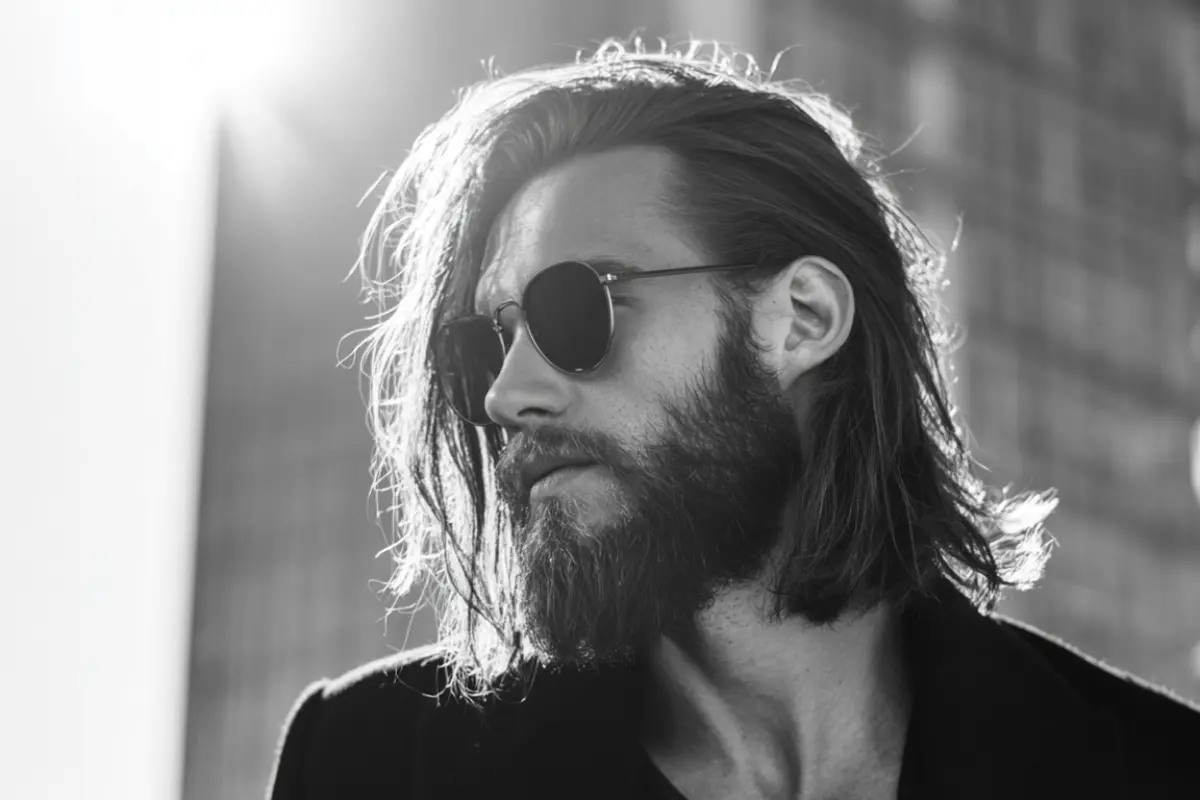
Men’s hairstyles for long hair are easier to get wrong than most men expect. Growing it is the straightforward part. Having it actually look like a hairstyle is considerably harder, and most men find that out somewhere around the eight-month mark when the novelty fades and the upkeep doesn’t.
Length without intention is just overgrown hair. Most men spend a year finding that out the hard way.

In this article
Men’s Hairstyles for Long Hair That Actually Work
Twenty-two styles, with honest notes on what each one actually asks of you.
Man Bun

The man bun works best between shoulder length and a few inches past it. Too short and there isn’t enough hair to hold the gather without it falling apart by midday. Too long and the weight starts pulling at the hairline, which becomes a real problem if you’re tying it back daily.
The issue most men don’t think about is tension. A tight bun pulled too high with a standard rubber band every day puts real stress on the roots at the temples. After several months of that you’ll notice the hairline there starting to thin. Use a fabric-covered hair tie, keep the tension lower than feels necessary, and leave it down when you’re not actively needing it up. The hair needs the break more than you need the style.
Top Knot

Higher than the man bun, usually smaller, and almost always paired with buzzed or tightly faded sides rather than left long all over. That contrast between the bare sides and the gathered knot on top is what gives it its look.
I’d say this works best on men with medium to thick hair. Fine hair doesn’t give the knot enough bulk to hold its shape through the day, and you end up retieing it every few hours rather than actually having it up.
One honest note: the top knot peaked around 2014 and it’s looked slightly behind the curve ever since. That’s not a reason to avoid it if it suits you, but don’t expect it to feel current.
Long Layered Hair

The most underused technique in men’s long hair and the one that makes the biggest difference. Layers remove weight from the mid-lengths and ends, which stops long hair from lying flat against the head and gives it movement.
Most men growing long hair skip the trim appointments because they don’t want to lose length. What they lose instead is shape. Hair that hasn’t been layered past shoulder length tends to look like a curtain. Layers every ten to twelve weeks don’t shorten it noticeably but they completely change how it moves.
Classic Ponytail

Simple, low maintenance, keeps the hair out of the face. Works from collar length upward.
The one thing nobody mentions: the height of the ponytail changes the face shape dramatically. A high ponytail lifts the face and adds length. A low ponytail adds width. On a round face, a low ponytail at the back of the neck makes the face look wider. On a long face, a high ponytail makes it look longer. Worth thinking about before you make it your go-to.
Half-Up, Half-Down

Half the hair tied back from the crown, the rest left loose. Works well at medium-long lengths where there isn’t quite enough to do a full man bun properly but there’s too much to leave entirely down without it getting in the face.
I’d call this the most practical style on the list for men who are still growing out. It gives the hair somewhere to go during the awkward in-between stage without committing to a full tie-up.
Loose Waves

Natural or product-assisted wave through long hair, left loose. This is the style most men picture when they start growing, and I’d argue it’s the most misleading on this list because the name describes an outcome rather than a method.
Straight fine hair needs a sea salt spray and diffuser combination to fake any real wave texture. Coarse straight hair needs more heat or a different product. Hair that already has natural wave or curl needs almost nothing, just moisture and left alone while it dries. Three completely different routines, one style name.
Viking Hair

Longer hair, usually past the shoulders, often combined with a beard, sometimes braided at the sides or the top. The reference point is obvious from the name.
Here’s the honest version: it looks best on men with naturally thick, slightly coarse hair that holds volume without much effort. Fine hair at this length goes flat and stringy rather than full and textured. If your hair doesn’t hold a braid for more than a few hours, this style is working against your hair type rather than with it.
Surfer Hair

Shoulder-length or slightly shorter, textured, tousled, looks like it dried after a swim.
Salt spray on damp hair, air dry, don’t brush it. That’s the whole routine. The problem is that surfer hair on truly straight fine hair requires daily effort to fake what wavy hair does automatically. If you’re spending twenty minutes recreating effortless hair, you’ve already lost the point of the style.
Shag Haircut

Heavy layering through long hair, textured ends, sometimes with a fringe. One of the more demanding cuts on this list to get right because the layering has to work with the natural growth direction rather than just cutting through it.
I’d be cautious about who cuts this one. A shaggy cut on straight hair done by someone more comfortable with short haircuts produces sections that end at different visible lengths without blending, and it takes four to six months of growing to fix the mistake. The barber needs to work with the natural fall of the hair, not just cut through it.
Messy Bun

A looser, more relaxed version of the man bun, with pieces left out and lower tension throughout. I’d recommend this over the standard man bun for most men simply because the lower tension is better for the hair over time and the relaxed look ages better than the tight version.
The key word is considered. A messy bun that just looks like you couldn’t be bothered is different from one that looks purposeful. The difference is usually about which pieces you leave out and where they fall.
Long Textured Hair with Bangs

Length kept past the shoulders with a fringe at the front. The fringe creates a strong facial frame that changes everything about how the length behind it looks.
The practical issue nobody warns about is maintenance speed. I’d budget for a fringe trim every three weeks, not four. At long-hair length it grows out of position faster than the rest because the shorter length means even a few millimetres of growth visibly changes where it falls. Let it go and it stops framing the face and just hangs.
Long Hair with Middle Part

A centre part with the hair falling on either side. The curtain style that came back around 2020, partly because lockdowns let hair grow past the point of no return, and has held up better than most trend magazines predicted it would.
I’d try it for a week before committing. It works best on oval and longer face shapes. Round or wide faces often find the centre part emphasises width rather than adding length, and a side part is usually a significantly better option for those shapes. Six months of a daily parting habit is hard to undo once the hair has a strong memory of falling one way.
Long Straight Hair

Straight hair kept long and left loose. On thick, healthy hair this looks strong. On fine hair it tends to go flat and thin without a volumising product worked through damp hair before drying.
The hard truth is that straight hair shows damage faster than any other texture at long lengths. A split end that’s invisible on wavy or curly hair at the same length becomes obvious on straight hair because there’s nothing else going on to distract from it. I’d say this is the one long style where the condition of the hair matters more than the cut itself, and where skipping a trim appointment has the most visible consequence.
Long Slick Back

Hair pushed straight back from the forehead, held with a medium to high hold product. At long lengths the hair has real weight and movement that shorter slicked styles don’t.
A water-based pomade is the right product here, not a wax or oil-based one. I’d avoid anything oil-based at this length specifically. Water-based holds through the day and washes out cleanly at night. Wax and oil build up on the scalp and through the hair, and after four or five days of daily application without a proper shampoo wash it starts looking greasy by mid-morning.
Long Hair with Undercut

Long on top, shaved or very short on the sides and back, with a hard disconnection rather than a fade. The contrast is severe and specific.
The top needs to be long enough to fall over the shorter sides, ideally past shoulder length. Under that and the contrast looks unfinished rather than sharp. The grow-out phase is also rougher than most men expect. A fade softens as it grows. An undercut doesn’t. It’s just a line between long and gone, and that line gets more obvious every week.
Long Hair with Fade Undercut

The softer version. Same long top but the sides blend gradually into shorter lengths rather than disconnecting hard. More forgiving to grow out and suits a wider range of face shapes than the disconnected version.
I’d point most men toward this over the hard undercut unless they’re specifically after the more aggressive contrast.
Long Curly Hair

Curls at full length. The most maintenance-intensive style on this entire list, not because of the styling but because of the conditioning.
Long curly hair is extremely prone to dryness and breakage because the natural oils from the scalp have a much harder time travelling down a curly strand than a straight one. By the time hair reaches past shoulder length, the ends are often receiving almost no natural moisture at all. A leave-in conditioner and a regular deep conditioning treatment aren’t optional at this length. I’d say if you’re not doing at least one of these consistently, you’re not maintaining long curly hair, you’re just growing it out while it slowly deteriorates.
Long Dreadlocks

Locs formed through natural matting or with the help of a loctician, at lengths from shoulder to well past the back. Not a style you decide on and achieve quickly. Natural locs take twelve to eighteen months to lock and form their shape, and that’s just the initial stage. Full maturity, where the locs are dense, stable, and low-maintenance, is closer to two to three years depending on hair type and method.
I’d say this is the most committed style on the list by a significant distance, and I mean that practically rather than culturally. It’s also the hardest to reverse if you change your mind, since unlocking mature dreadlocks is possible but usually damages the hair significantly in the process. Before starting, be honest about whether this is a years-long decision or a phase. The hair will know the difference before you do.
Shoulder-Length Hair with Soft Waves

The shortest length on this list, just at or slightly past the shoulders, with a soft wave either natural or product-assisted. A manageable entry point into long hair that doesn’t require the full grow-out commitment of most other styles here.
This is the one I’d suggest to most men who want long hair but don’t want to commit to years of growing and maintenance. It works across most hair types and most face shapes, and the soft wave stops it from looking shapeless without asking much from the daily routine.
Long Hair with Beard

A full beard paired with long hair. Both carry real visual weight and both need to be actively maintained, because the combination of neglected long hair and a scraggly beard looks like a decision to give up rather than a style decision.
I’d put the beard at a minimum of two to three weeks of growth if you’re pairing it with long hair. Stubble next to long hair looks unfinished in a way it doesn’t next to a short back and sides, because the length of the hair sets a higher grooming expectation that a few days of growth doesn’t meet. A short boxed beard or a full beard with defined lines works. Light stubble usually doesn’t.
Man-Bob

Jaw to shoulder length, more precisely shaped than simple shoulder-length hair. The bob gives long hair a defined finish that most other long styles don’t bother with, and that shape is what separates it from hair that just happens to be this length.
One of the more underrated men’s styles on this list. It lands at a length that’s actually manageable, looks purposeful from every angle, and doesn’t require the daily effort that many longer styles do.
Long Hair Has to Be Cut, Not Just Grown
The most common mistake I see with men’s long hair is treating the grow-out as the project and the haircut as the enemy.
Regular trims don’t shorten long hair in any meaningful way if done correctly. Every ten to twelve weeks, taking half an inch to an inch off the ends removes the split and damaged section that would otherwise travel up the shaft and cause breakage higher up. Skipping trims for a year to preserve length almost always results in hair that looks thinner and more damaged at the length you finally reach than it would have if you’d trimmed it throughout.
Long hair also needs layering to have shape. Uncut, unlayered long hair lies flat, looks heavy, and has no movement. A layered cut through the mid-lengths changes everything about how long hair behaves, and it adds no extra time to the morning routine.
The Ends Tell the Truth
If the ends of long hair look frayed, translucent, or like they’re thinning to a point, the hair hasn’t been maintained properly.
Split ends start at the tip but they travel. Leave them long enough and the split works its way up the shaft, meaning the eventual trim has to go higher than it would have if the split had been caught earlier. This is the mathematical argument for regular trims that most men ignore until they’re looking at their hair wondering why the last two inches look so different from the rest.
Conditioning matters more at long lengths than at short lengths. A leave-in conditioner through the mid-lengths and ends after washing, not applied to the roots, keeps the ends flexible enough to resist splitting.
Tying It Back Does Not Hide a Bad Cut
A man bun or ponytail on badly cut long hair still looks like badly cut long hair, just gathered up.
The ends still show. The texture still shows. The layers, or lack of them, still determine how the hair falls around the face and neckline even when the bulk of it is tied up. I’ve seen men assume that tying their hair up covers the fact that it hasn’t been cut in two years. It doesn’t. If anything, tying back hair that hasn’t been shaped properly shows the unevenness more clearly because the gathered shape makes the irregular lengths and damaged ends more obvious.
A tied-back style requires good underlying hair just as much as leaving it down does.
The Beard Beasts Verdict
Men’s hairstyles for long hair reward attention and punish neglect more visibly than short hair does. A bad short haircut grows out in four to six weeks. A neglected long style takes months to fix, and the fix usually involves losing the length you spent a year building.
Trim it regularly. Condition the ends. Get layers cut in before you think you need them. Pick a style that matches what your hair actually does rather than what you watched someone else’s hair do in a video.
And if it doesn’t look like a hairstyle after twelve months of growing, it probably needs a cut more than it needs another month.