
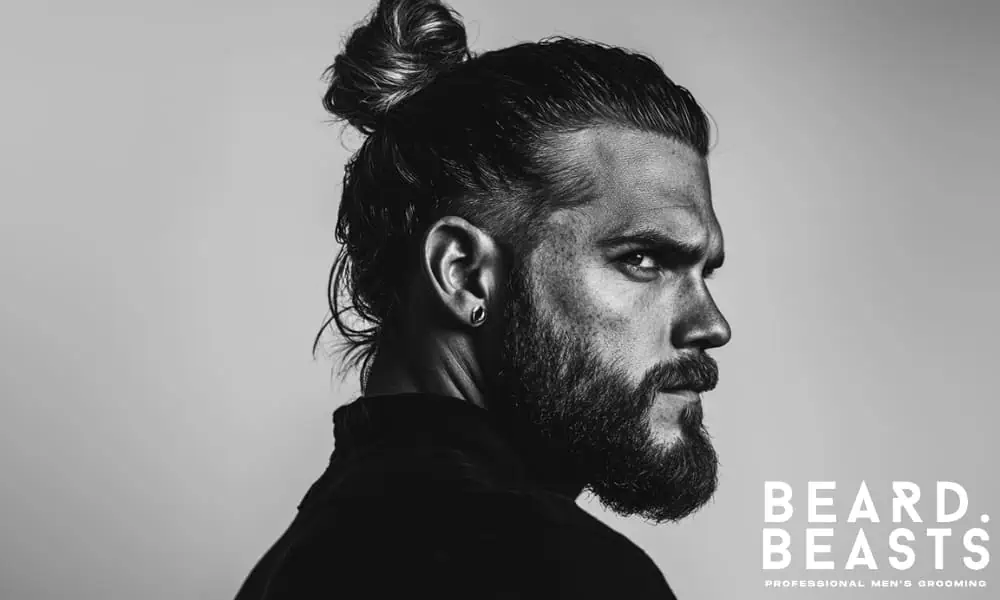
Most men blame the bun when a man bun looks bad. The bun is the easiest part of this whole style. Gather it, tie it, done. What actually decides whether it looks intentional or thrown together is the length underneath it, the tension it’s tied with, and what’s happening on the sides while it’s up.
Get those three things wrong and no bun technique fixes it.

In this article
Best Man Bun Hairstyles for Men
Eight versions below, each solving a slightly different problem with length, tension, or contrast.
Classic Full Man Bun

All the hair gathered and tied at the crown, no fade or undercut underneath. The safest starting point and the one that puts the most pressure on hair length, since there’s nothing else in the cut doing visual work if the bun itself looks thin or sparse. Length requirements are covered in detail further down, but this is the version where getting that length right matters most.
Low Man Bun

Tied at the nape rather than the crown. Lower tension on the hairline than a high bun, and it suits men who want the practicality of tied-back hair without the height of a traditional top knot.
I’d recommend this specifically for men who tie their hair back daily rather than occasionally, since the lower position puts less strain on the same few inches of hairline that a high bun stresses every single day.
Messy Man Bun

Looser tension, pieces left out at the front or sides on purpose. This version is more forgiving on length than the classic bun, since the intentional looseness hides some of the thinness that a tight, polished bun would expose at shorter lengths.
Half-Up Man Bun

Only the top section gathered, the rest left down. The practical answer for men who are between lengths, long enough on top to tie something but not long enough for a full bun. It also puts far less tension on the hairline than a full bun does, since only a portion of the hair is under load.
Undercut Man Bun

Sides and back shaved or faded short, only the top long enough to gather. This is the version that needs the least overall length, since you’re only growing out the top section rather than the whole head. Most men who try this underestimate how long the top actually needs to be relative to a full man bun. You still want real length up there, the shaved sides just mean you’re not growing the rest of the head to match it.
Curly Man Bun

Natural curl adds volume to the bun that straight hair at the same length doesn’t have. A curly man bun at eight inches can look fuller than a straight one at ten, purely because of how much the curl pattern adds visual density.
The trade-off is control. Curly hair tangles more in the hair tie and takes longer to gather cleanly, so budget more time for the actual tying process than you would with straight hair.
Man Bun with High Fade

Maximum contrast between the high fade sides and the man bun. This pairs well with the undercut logic above but takes it further, and it’s the version I’d point most men toward if they want the bun to look like an actual style choice rather than just tied-back hair.
Braided Man Bun

A braid running into the bun rather than a simple gather. Needs more length than most versions here, generally 12 inches or more depending on where the braid starts. The braid itself also puts more tension on the scalp than a simple gathered bun does, since braiding pulls at multiple points along the part rather than one point at the base. I’d treat this as an occasional style rather than a daily one for that reason alone, regardless of how long the styling actually takes.
Most Bad Man Buns Are Tied in the Wrong Place
Bun placement changes more than most men think. Too high, and the tension concentrates directly on the hairline at the crown and temples, which is exactly where traction alopecia shows up first. Too low, and the bun can look like an afterthought rather than a real style choice.
Traction alopecia is real, not an exaggerated warning. It’s hair loss caused by sustained pulling at the follicle, and the frontal and temporal hairline, the exact area a high, tight bun stresses daily, is the most commonly affected zone. Caught early, it’s reversible once the tension stops. Left unaddressed for months or years, the follicle damage can become permanent.
I’d vary the bun position across the week rather than tying it in the same spot every single day. A low bun a few days, a higher one other days, or simply leaving it down entirely on days you don’t need it up. The hairline gets a break from repeated stress at the same point, which is the actual prevention method, not switching to a “gentler” tie that’s still pulling on the same spot daily.
Hair Length Decides Whether the Bun Works Yet
Six inches is the number that gets repeated everywhere as the man bun minimum, and it’s technically accurate but it undersells how thin a bun looks at that length.
At six to eight inches, expect a bun about an inch or two in diameter. That’s workable, but it’s the size that looks skimpy rather than substantial, especially on fine hair where there’s less density to add visual bulk. At ten to twelve inches, the bun looks like a proper style rather than the minimum viable version of one. Past twelve inches, size stops being the constraint and tying technique becomes the main variable.
Density matters as much as length here. Thick hair at eight inches can look more solid than fine hair at ten, since the extra strand count fills out the bun regardless of length. If your hair is fine, I’d wait for the longer end of the range before committing to a full bun rather than tying one the moment you technically can.
The Sides Matter More Than Men Think
A man bun with no thought given to the sides just looks like long hair that got tied back out of necessity. A man bun with tapered, faded, or undercut sides looks like an actual haircut.
The contrast the sides create does real work framing the bun, especially at shorter overall bun sizes where the bun itself doesn’t have much visual weight to offer on its own. A fade or undercut gives the eye somewhere else to land, which takes pressure off the bun looking impressive purely by itself.
I’d say this matters most for men in the six-to-ten-inch range specifically. Once the bun itself is large enough to be a strong visual anchor, the sides matter less. Below that, they’re doing a lot of the work the bun can’t do yet.
The Beard Beasts Verdict
Man bun hairstyles for men work when the length actually supports the bun size you’re going for, the tension varies enough to protect the hairline, and the sides are cut with some intention rather than left to grow out alongside the top.
Get the length right for the bun size you actually want, not the minimum you can technically get away with. Then don’t tie it the same way in the same spot every single day. That’s the detail that actually protects the style long term, not the specific bun technique you use.