
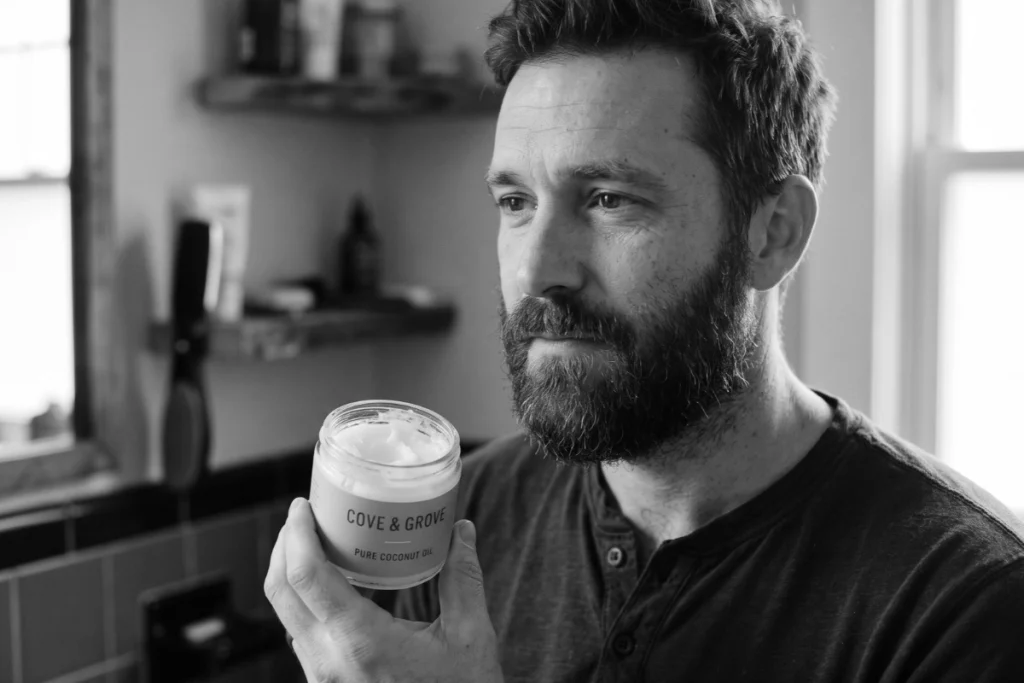
If you believed every beard tip online, a jar of coconut oil would be all you’d ever need. Softer facial hair, better growth, healthier skin. It sounds almost too good to be true.
But is coconut oil good for your beard, or have some of its benefits been exaggerated? There’s actual research behind coconut oil, although what the studies found and what people claim it does for beards aren’t always the same thing.
Before you start applying it into your facial hair, there are a few things I’d want you to know, particularly if you’re hoping it will solve a problem your usual beard care routine hasn’t fixed.
In this article
What Coconut Oil Actually Does for Your Beard
Coconut oil can be useful if your beard feels dry, coarse, or difficult to manage. A small amount can soften the hairs, make them easier to comb, and reduce some of the friction that causes damage during grooming.

There’s some proper research behind this, too. Coconut oil is rich in lauric acid, and its fatty acid structure helps it penetrate the hair shaft rather than simply sitting on the surface. A 2003 study found that coconut oil reduced protein loss from hair when applied before or after washing.
That matters because hair can lose protein through everyday damage, particularly repeated washing and rough handling. Protecting the hair shaft may help reduce breakage and keep existing hairs in better condition.
There’s one important limitation, though. The research was conducted on scalp hair, not beards. We can’t assume the results are identical for facial hair, although the findings give us a reasonable explanation for why coconut oil may help condition it.
For a longer, coarse beard that feels rough or catches in your comb, I think coconut oil is worth considering. Just don’t expect a big change overnight. It can make existing hair feel softer and easier to manage, but how much difference you notice will depend on your beard and how you use it.
Does Coconut Oil Help Beard Growth?
There’s no convincing evidence that coconut oil makes your beard grow faster, thicker, or fills in patchy areas.

A lot of the confusion comes from how your beard looks and feels after using it. If the hairs are less prone to breaking, they may retain more length over time. That can make your beard look fuller, but it doesn’t mean you’ve suddenly started growing more facial hair.
A 2022 scientific review found limited evidence that coconut oil improves hair growth. Most of the available research also concerns scalp hair rather than beards, so claims about faster facial hair growth are even harder to justify.
You might also come across claims that coconut oil boosts testosterone or increases blood circulation enough to stimulate beard growth. There’s no good clinical evidence supporting either claim.
If your cheeks have always been patchy, applying coconut oil won’t change your natural growth pattern or create new hair follicles.
If you’re buying coconut oil specifically to grow a thicker beard, I’d save your money.
Can Coconut Oil Help Beard Itch or Dandruff?
If the skin beneath your beard feels dry and tight, coconut oil might help it feel more comfortable. It can help the skin retain moisture, although the research on this isn’t specific to beards.

Flakes need a closer look. Dry skin can flake, but persistent dandruff accompanied by redness, itching, or greasy-looking scales may be seborrheic dermatitis. This common skin condition involves inflammation and a naturally occurring yeast called Malassezia.
You might have heard that coconut oil has antifungal properties. While some laboratory research supports antimicrobial activity, there’s no convincing evidence that applying coconut oil to your beard treats seborrheic dermatitis. A dermatologist may recommend a medicated treatment, such as ketoconazole, instead.
I would consider a little coconut oil for occasional dryness if your skin tolerates it. But if you’re constantly brushing flakes off your shirt, part your beard and look at the skin underneath. Persistent redness or irritation deserves proper attention rather than another coat of oil.
Who Should Avoid Coconut Oil on Their Beard?
If you’re prone to acne or regularly get pimples beneath your beard, I’d avoid using pure coconut oil on your face. It can clog pores and contribute to breakouts, particularly if your skin is already oily.

Beard length makes a difference, too. With short stubble, more of the oil reaches your skin rather than the facial hair. A longer, coarser beard gives you more hair to work it through, although that doesn’t eliminate the risk of clogged pores.
Sensitive skin deserves some caution as well. Coconut oil isn’t automatically irritating, but even natural products can cause unwanted reactions. Redness or itching after applying it isn’t something to shrug off as your skin simply getting used to the oil.
Not every pimple-like bump is caused by a skincare product, either. If bumps appear along your neckline after shaving or trimming, ingrown beard hairs could be the problem. Changing oils won’t fix a shaving-related issue, so it’s worth paying attention to when and where those bumps appear.
If coconut oil is making your skin worse, stop using it before trying another leave-in oil. If you still need to condition your facial hair, a non-comedogenic rinse-out beard conditioner may be a better option. Persistent breakouts are worth getting checked by a dermatologist.
How to Use Coconut Oil on Your Beard
Before applying coconut oil to your beard, it helps to understand the different types. Virgin coconut oil has a noticeable coconut scent, while refined coconut oil is usually more neutral.

Both can turn solid in cooler temperatures. Fractionated coconut oil stays liquid because it’s processed differently, so it shouldn’t be assumed to have exactly the same hair-conditioning properties as regular coconut oil.
For application, start with a clean, dry or slightly damp beard. If you’re using solid coconut oil, warm a tiny amount between your palms until it melts, then work it gently through the facial hair, paying particular attention to the drier areas.
Spread it through your beard evenly, and check how the hair feels before adding more. You want your beard to feel softer and easier to manage, without a greasy finish. If it looks unusually shiny or feels oily to the touch, you’ve used too much.
Coconut oil can be left in the beard, or used before washing and then removed with a proper beard wash.
There’s no set schedule to follow. If your beard still feels soft the next day, leave it alone. Apply more when the hair actually needs conditioning rather than treating coconut oil as something you must use every morning.
Pure Coconut Oil vs. a Beard Oil Blend: Which Would I Choose?
For everyday beard care, I’d choose Cremo Cedar Forest Beard Oil over pure coconut oil. It’s specifically made for beards and combines several carrier oils, including jojoba, argan, avocado, and coconut oil itself.

That’s an important distinction. Choosing a dedicated beard oil doesn’t necessarily mean avoiding coconut oil. You’re getting it as part of a blend rather than using it on its own.
If you just want to try a pure coconut oil, Viva Naturals Organic Extra-Virgin Coconut Oil would be my pick. It’s cold-pressed, unrefined, and contains just one ingredient. For a longer, coarse beard, that simple approach may appeal, although it’s a general-purpose coconut oil rather than a product formulated specifically for beards.
The downside is convenience. Regular coconut oil can turn solid in cooler temperatures and may feel heavier than a blended beard oil. Cremo comes ready to apply with a dropper, making it a more practical choice for regular grooming.
There is one thing I’d consider before buying Cremo, though. Its Cedar Forest formula contains scented ingredients, including cedarwood, spruce, and eucalyptus oils. If fragrance tends to irritate your skin, I’d skip this particular blend and choose a fragrance-free beard oil instead.
And if you already have a beard oil that leaves your facial hair soft and your skin comfortable, I wouldn’t replace it just because someone recommends coconut oil. There’s little sense in buying another grooming product when the one you have is already doing its job.