
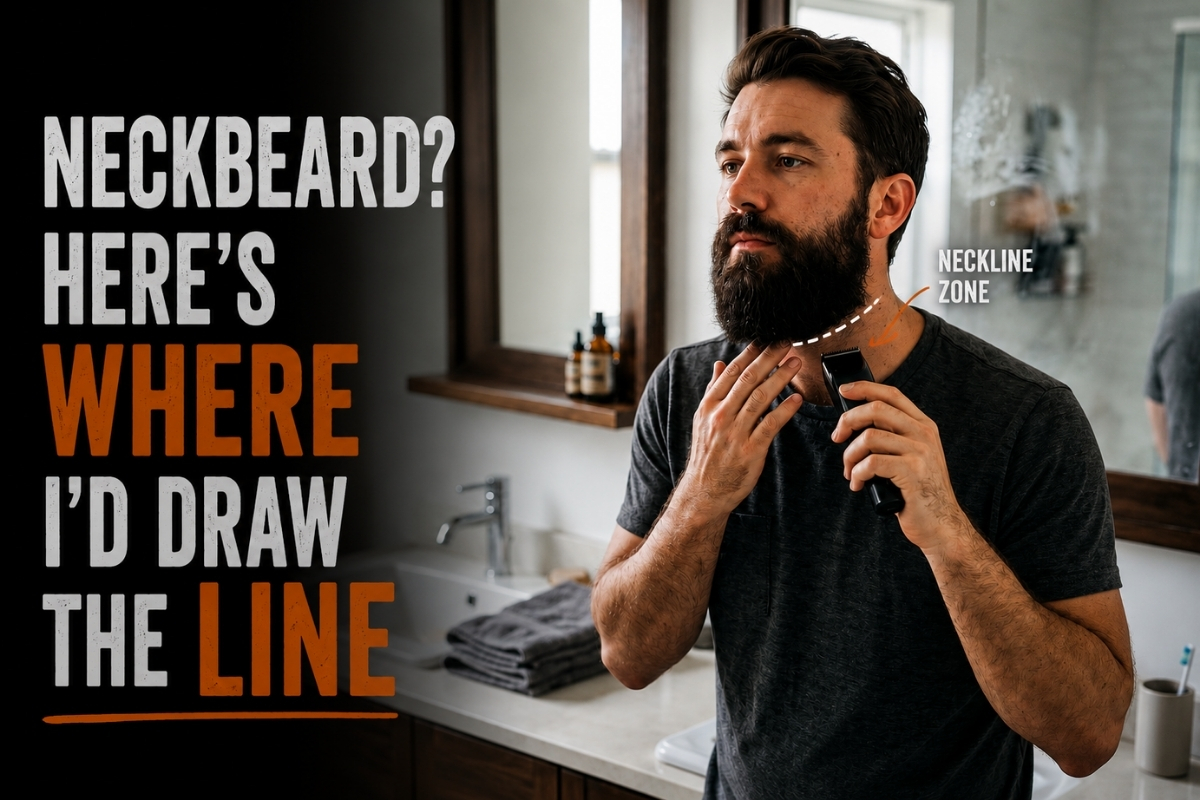
A neckbeard can make a decent beard look worse than it really is. You might have strong growth through the chin and jaw, but once the hair underneath starts spreading too far down the neck, it can throw off the whole shape.
The tricky part is that not every neckbeard comes from the same problem. Some men naturally grow much more strongly under the jaw, while others simply haven’t found a beard neckline that works with their growth.
Those two situations can look pretty similar in the mirror, but they don’t need exactly the same response. Treat them as though they do and it’s easy to start removing hair that was never really the problem.
If you’re trying to work out how to fix a neckbeard, I’d first look at where your beard is actually growing before deciding what needs to come off.

In this article
What Is a Neckbeard?
A neckbeard is facial hair that grows heavily across the neck or a beard that has been allowed to extend too far below the jaw without a defined neckline.

Having beard hair on your neck doesn’t automatically mean you have a neckbeard. Plenty of normal beard growth extends underneath the jaw. The issue is whether that hair keeps running farther down the neck than you want or becomes the dominant part of the beard.
Sometimes it’s mainly a grooming problem. You may have solid growth across the cheeks, chin and jaw, but if the hair on your neck is left untouched, it can start dominating how the beard looks from the front and side.
Other men naturally grow much more densely beneath the jaw and across the neck than they do on the cheeks. Facial hair doesn’t grow with equal density across every part of the face, so stronger neck growth can simply be part of your natural pattern. Trimming can control where that beard finishes, but it can’t move the density higher up your face.
The word neckbeard is also used as an insult or stereotype online, but that’s not the meaning that matters here. From a grooming point of view, we are talking about where your facial hair grows and whether the neck growth is overpowering the beard above it.
The first thing I’d work out is whether your beard simply extends too far down your neck or whether most of your natural density actually grows there. Those two situations need different fixes.
Where Should Your Beard Neckline Sit?
For most beard styles, I’d keep the neckline under the jaw, not directly on the jawbone and not far down the front of the neck.

The lowest part will normally be somewhere beneath the center of the chin, with the neckline curving upward toward the areas below your ears. I wouldn’t rely too heavily on fixed finger-width measurements because neck length, jaw shape and beard growth vary too much for one measurement to work perfectly on everyone.
What matters more is how much beard you leave beneath the jaw. That hair gives the lower beard some depth when you look at it from the side. Take the neckline right up onto the jawbone and a decent beard can end up looking thinner than it should.
Go too low and you create the opposite problem. The growth farther down the neck starts drawing more attention than the beard around the chin and jaw.
Beard length changes how obvious the neckline needs to be too. With shorter facial hair, you can normally see the line more clearly. As the beard gets longer, the hair underneath may cover more of that area naturally, so there’s less reason to chase an aggressively high neckline.
Given the choice, I’d rather leave slightly too much underneath than remove too much. A lower line can still be adjusted, while hair shaved away from beneath the jaw has to grow back.
How to Fix a Neckbeard Without Shaving Too High
The easiest way to make a neckbeard worse is to attack everything below the jaw at once. The goal isn’t to expose the jawline. You’re removing the growth that’s dragging the beard too far down the neck while keeping the hair that contributes to the shape above it.

Start with the hair you’re certain falls below the neckline you want. Remove that obvious neck growth, step back, and look at the beard properly before going any higher.
Check it from the front, but don’t stop there. Turn your head and look at the side because that’s where an overly high neckline often becomes much more obvious.
Be particularly careful under the chin. That area contributes a lot of the visible depth of the lower beard, and taking the line too high there can leave the beard looking thin even when it still looks fine straight on.
You don’t have to shave everything below the neckline completely smooth either. A trimmer can give you enough separation if that’s the finish you prefer. If you use a razor, use proper shaving lubrication and follow the direction of the hair growth, particularly if your neck gets irritated easily.
What I’d Use: If you want one trimmer for controlling the neckline and maintaining the rest of your beard, I like the setup of the MANSCAPED The Beard Hedger. The adjustment wheel gives you 20 length settings from 0.5 mm to 10 mm, which is much more useful here than constantly swapping guards when you are working around different parts of the beard. It won’t replace a razor if you want the neck completely smooth, but for controlled trimming, it makes a lot of sense.
Check MANSCAPED The Beard Hedger on Amazon
There’s another mistake worth watching for: assuming every heavy-looking lower beard needs a higher neckline. Sometimes the line itself is already in roughly the right place and the hair immediately above it has simply become too bulky. Taking some length out of that area can improve the shape without pushing the neckline farther upward.
Both sides are worth checking, but I wouldn’t chase perfect symmetry. Beard growth rarely matches exactly from left to right. A tiny difference between the two sides is normally less noticeable than removing good growth trying to make them identical.
Once you’re finished, look at the beard from the side again. You still want enough hair beneath the jaw to give the lower beard some depth.
If that area suddenly looks exposed or hollow, you’ve gone past fixing the neckbeard and taken the neckline too high.
What If Your Beard Mostly Grows on Your Neck?
When that stronger lower-face growth pattern applies to you and your cheeks stay comparatively sparse, a better neckline can improve the beard, but it can’t solve the whole problem.

You can stop the growth extending too far down the neck, yet trimming alone will never build cheek density that isn’t there. If you keep moving the neckline around and the beard still looks bottom-heavy, that’s a good sign that the growth pattern itself is now the bigger issue.
With some usable cheek growth, I’d control the denser lower beard before automatically taking everything shorter. Keep the neck and lower jaw from becoming significantly longer than the sides, while giving the cheeks enough length to make the most of the coverage you have.
That extra cheek length can sometimes overlap small gaps and make the beard look fuller from normal viewing distance. It doesn’t increase the number of hairs growing there, so there’s a limit to what length can hide.
Truly sparse or barely connected cheeks call for a different decision. Instead of preserving weak cheek growth purely because you want a full beard, look at where the beard actually grows well. Strong chin and mustache growth may give you much more to work with in a goatee or another chin-focused style.
I’d avoid trying to compensate by simply growing the neck longer. Extra length underneath does nothing for the missing coverage higher up and can make the difference between the two areas even more obvious.
Once the neckline is under control, the bigger question is the beard style itself. Work with the density you actually have instead of expecting neckline work to turn neck-heavy growth into strong cheek coverage.
Verdict: Should You Keep or Shave a Neckbeard?
If by neckbeard you mean facial hair that has simply been allowed to keep growing down your neck, my recommendation is to trim or shave that excess growth rather than leave it as part of the beard.
That doesn’t mean trying to make everything below your jaw completely bare. The point of defining the neckline is to separate the beard from the growth you don’t want on the neck, not to remove useful hair just to create a higher line.
When the neck is naturally your strongest area, neckline work will only take you so far. Work with the better-growing parts of your beard and choose a length or style that suits that pattern instead of letting the neck get progressively longer to compensate for weaker cheeks.
You can keep a neck-heavy beard intentionally if that’s honestly the look you want. But if your goal is to make the best use of your jaw and the beard growth you already have, it’s not the direction I’d choose.
So I wouldn’t keep an accidental neckbeard. Establish a sensible neckline, preserve the growth that helps the beard underneath the jaw, and shape the rest around where your facial hair actually grows best.