
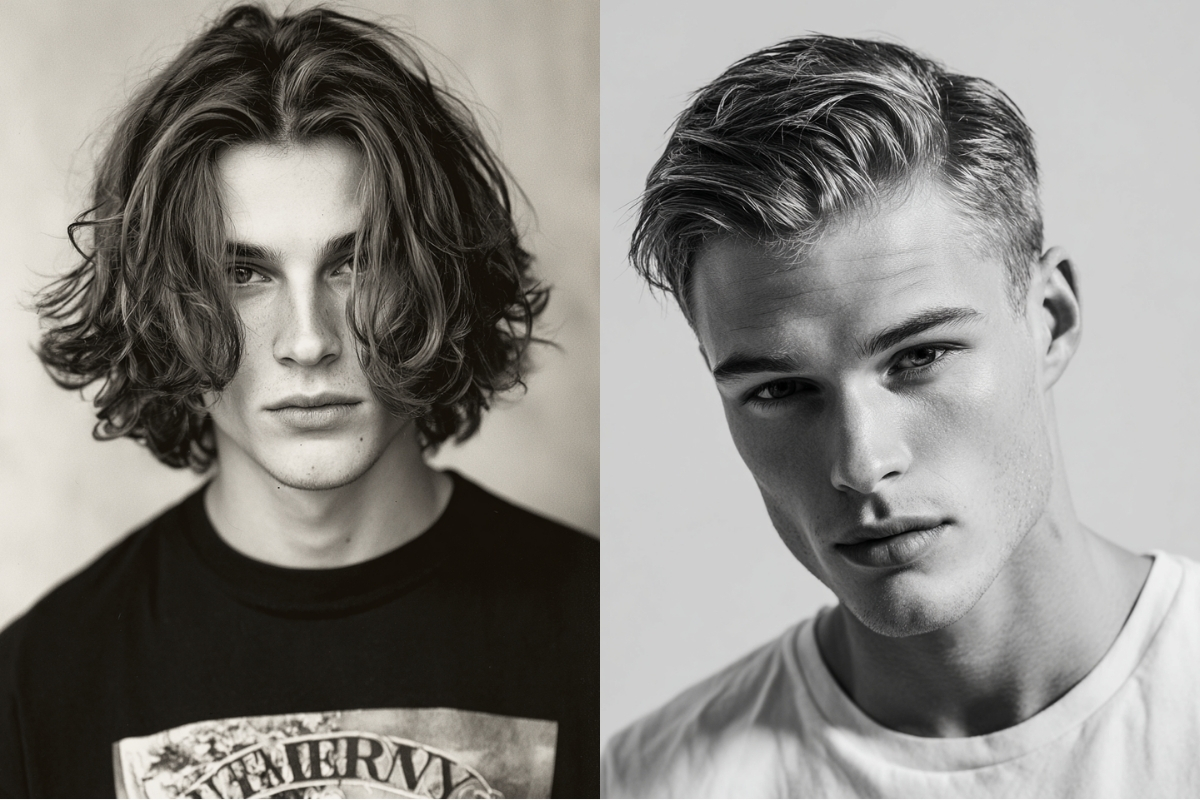
A side part vs middle part looks like a small decision. It isn’t. It changes the whole look.
The part affects where the hair moves, how much of the hairline shows, how wide the sides look, and whether the style feels controlled or forced. Get it wrong and you’re not fighting a bad haircut, you’re fighting your own hair every single morning.
That’s where men get caught out. They choose the part because it’s trending, not because their hair actually wants to move that way.
Here is how to choose between a side part vs a middle part without ending up with a style your hair fights every morning.

In this article
A Side Part Gives the Hair More Direction

A side part works because it gives the hair somewhere to actually go.
That sounds simple, but it matters.
Instead of the front falling wherever it wants, the hair moves across one way. The shape has more direction, the top looks more intentional, and the style is easier to manage without forcing every strand into place.
That’s why I’d usually recommend a side part for most men.
It works well when the hair naturally wants to fall left or right. You aren’t fighting the growth pattern as much. You’re using it.
That can make a big difference if your hair is thick, stubborn, or awkward around the front.
A side part can also be more forgiving if your hairline is uneven or your density isn’t perfect. Because the hair moves across instead of splitting evenly down the middle, it gives you more room to work with what you have.
That doesn’t mean every side part needs to look stiff or old-fashioned.
It can be loose, textured, low, high, messy, or more controlled depending on the cut. The important thing is that the hair has a clear direction.
For me, that’s the main advantage.
A side part helps the haircut look more organized without needing the hair to behave perfectly on both sides.
A Middle Part Needs the Right Length and Density

A middle part forgives nothing. That’s the whole warning right there.
That’s the part men often underestimate.
You aren’t just splitting the hair down the middle and hoping it works. Both sides need real length, usually 3 to 4 inches on top at least, to actually fall instead of just splitting apart, and both sides need enough density so the part doesn’t expose more than you wanted.
That’s where a middle part can go wrong fast.
If the front is too short, it can stick out or fall awkwardly. If the sides are too bulky, the haircut can start looking wide instead of relaxed. If the hairline is uneven or the front is thinning, a middle part can make it more obvious.
That doesn’t mean middle parts are bad.
On the right hair, they can look good. Medium-length hair, natural movement, decent density, and a front that falls evenly can all make a middle part work.
But it asks more from the haircut.
A side part can hide small problems because the hair moves across one way. A middle part puts more of the hairline, forehead, and density on show.
For me, that’s the main warning.
A middle part can look relaxed, but it isn’t always the easier choice. It only looks effortless when the hair is actually built for it.
Face Shape Changes the Answer

Face shape matters. Just don’t turn it into a science project.
The bigger mistake is copying a part that looks good on someone else without asking what it does to your own face.
A side part usually works better if your face is rounder because it gives the hair more direction instead of adding extra width on both sides. It can make the haircut feel more controlled through the front and sides.
A middle part can work on round faces too, but it needs enough length and movement. If it falls too flat or pushes too much hair out to the sides, it can make the face look wider.
For longer faces, I’d be careful with too much height.
A high side part with volume can stretch the face even more. A middle part can work better here if the hair has some width and doesn’t hang too flat.
Square faces usually have more room.
A side part can make the haircut look more controlled, while a middle part can soften the overall look if the hair has enough length.
If your forehead is large or your hairline is starting to move back, I’d usually lean side part first.
A middle part leaves the forehead and hairline with nowhere to hide. A side part gives you more room to move the hair across, control the front, and avoid exposing everything at once.
For me, face shape should guide the choice, not make the decision on its own.
Your hairline, density, length, and natural fall still matter more than any face shape rule.
Hair Type Matters More Than the Trend

Forget what’s trending. Your hair type decides this, not Instagram.
That’s where a lot of men go wrong.
A middle part might look good in a photo, but if your hair doesn’t fall that way naturally, you’ll spend every morning trying to force it into place.
Straight hair can work with either part, but it needs the right length. A side part is usually easier to control. A middle part can look too flat if the hair has no movement or the front isn’t long enough.
Wavy hair is often better for a middle part because the movement helps both sides fall with more shape. But if the waves kick out too much around the sides, the haircut can start looking wide fast.
Curly hair can work with a middle part too, but it needs enough length and the right cut. If the curls are too short on top, the part can look forced instead of natural.
Fine hair is usually safer with a side part.
A middle part can expose density problems faster because it splits the hair evenly and puts more attention on the front. With a side part, you usually have more room to move the hair where it looks better.
Thick hair gives you more options, but it can also create problems. A middle part can look good if the sides are shaped properly, but if the hair puffs out too much, the whole cut can look bulky.
For me, the part that suits you is usually the one your hair fights the least.
Trends matter less than that.
The Beard Beasts Verdict
The whole side part vs middle part question usually comes down to one thing: start with a side part, most men should. It’s easier to control, more forgiving, and works with more haircuts, especially if your hairline is uneven or your density isn’t perfect.
A middle part can still look good, but it asks more of you. You need real length through the front, decent density on both sides, and hair that actually wants to fall that way, otherwise it exposes the hairline or leaves the style looking forced.
The mistake is choosing the part because it’s trending. Choose a side part for more direction and control. Choose a middle part if your hair actually has the length, movement, and density to carry it.
Either way, the part should follow what your hair actually does, not the other way round.