
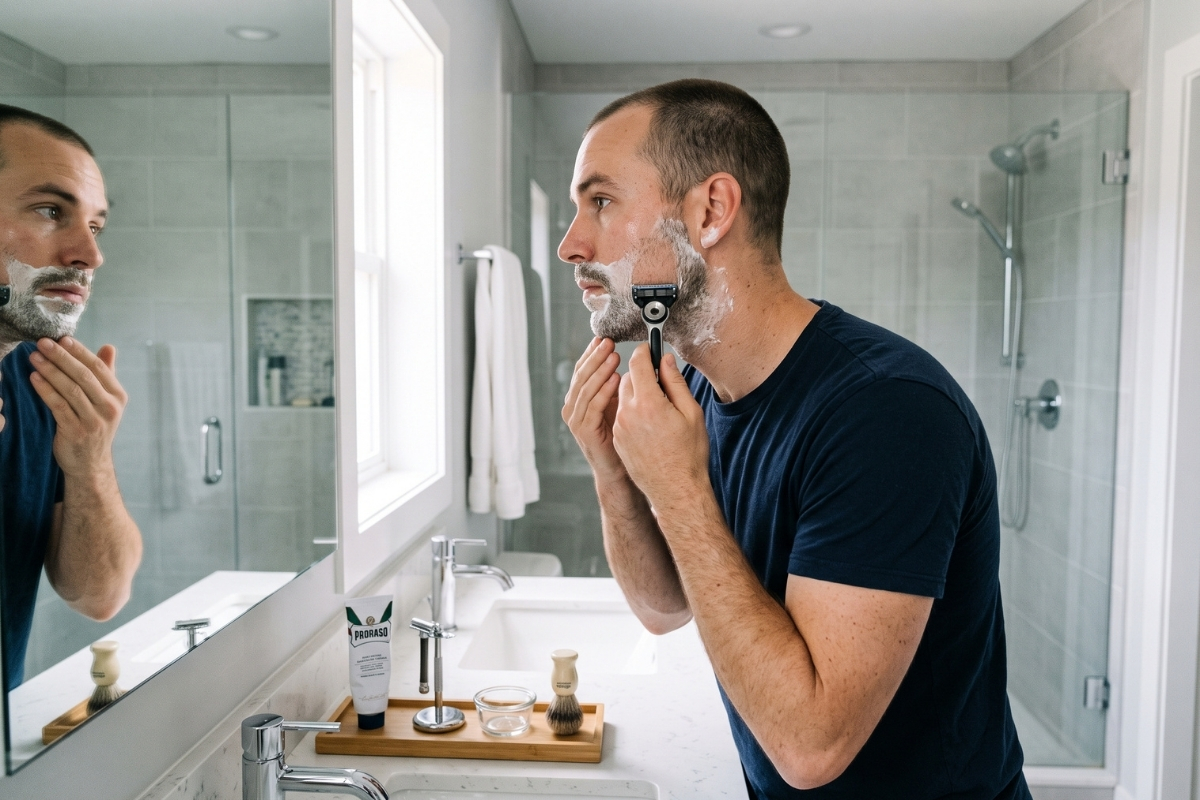
If you want to know how to get a close shave, pressing harder isn’t the answer. Going over the same patch again and again can leave you with more irritation without giving you a closer result.
The difficult part is that extra closeness can come with a trade-off.
A pass that makes the skin feel smoother immediately may not be worth much if it leaves you irritated afterward. I’d rather get very close with a shave I can repeat comfortably than force every last bit of texture away. The goal is the closest result your skin handles well, whatever the razor is technically capable of.

In this article
Your Beard Needs to Be Easier to Cut Before You Start
A close shave gets harder when beard hair is dry and stiff. Hydrated beard hair takes less force to cut, so thoroughly wetting the stubble is doing more than making the shave feel nicer.

Shaving after a warm shower is an easy way to do that, but you don’t have to time every shave around one. At the sink, spend a little time wetting the beard with warm water rather than giving your face a quick splash and immediately reaching for the razor.
Then work the shaving cream through the stubble instead of just spreading it over the surface.
The water is doing much of the softening, while the lather helps keep the hair hydrated and gives the razor more slip over the skin.
Anything beyond that is optional. A hot towel can make the prep more comfortable, and a pre-shave product may help the razor glide more easily, but neither is necessary for a close shave. Warm water and a good layer of lather are doing the important work here.
Work Out Which Way Your Beard Grows
It’s easy to assume all facial hair grows downward, but it often changes direction across different parts of the face. The neck and jaw are especially unpredictable, with hair sometimes growing sideways or even upward in small patches.

Short stubble makes those changes easier to feel. Run your fingertips over the area in different directions. Moving with the grain usually feels smoother, while going against it feels rougher.
Across the grain means shaving across the direction the hair grows rather than directly with or against it. That does not always mean moving the razor sideways. If the hair on part of your neck grows sideways, an across-the-grain pass may actually run upward or downward.
This is why you should not assume one razor direction will work across your whole face. A downward pass may be with the grain on your cheeks but across or against it somewhere on your neck.
Work out those changes before you start trying to shave closer. Once you know how each area grows, you can choose the direction of each pass instead of guessing.
Don’t Try to Get Completely Smooth on the First Pass
The first pass should remove most of the stubble, not leave your face completely smooth. Trying to get everything in one go usually means more pressure and more strokes over the same skin.

Start with the grain, keep the pressure light, and use short controlled strokes. Rinse the razor as hair and lather build up so the blade keeps moving through the stubble properly.
Once that first pass is done, apply fresh shaving cream before going over the skin again. The first layer has already been removed with the razor, so going back over bare skin gives you less glide and more chance of irritation.
If you still want a closer result, move across the grain next. Then stop and check the shave before deciding you need another pass.
You do not need the skin to feel completely smooth in every direction for the shave to be close. If there is only a little resistance when you rub against the grain, that may be a better stopping point than continuing until the skin starts to feel irritated.
Going Against the Grain Can Get Closer, but I Wouldn’t Treat It as the Goal
Shaving against the grain can make the face feel smoother because you are cutting the hair in the opposite direction to its growth. The trade-off is that some men get more irritation or ingrown beard hairs when they shave this way.

If you already deal with razor bumps, I would be especially cautious around the neck. That is an area where a closer result may not be worth the soreness or bumps that show up afterward.
If you still want to try an against-the-grain pass, reduce the stubble first with the earlier passes and apply fresh lather again. Keep the pressure very light and avoid repeatedly going back over the same spot just to remove the last bit of texture.
You also do not need to shave against the grain across your whole face. One area may handle it well while another becomes irritated every time, so treat those areas differently.
If a certain patch keeps ending up sore or bumpy after shaving against the grain, stop one pass earlier there. A slightly less smooth result is a better trade if your skin stays comfortable.
If Your Shave Still Isn’t Close Enough, Check the Technique Before the Razor
If your shave still feels rough, look at where the problem is happening before blaming the razor. A few stubborn patches usually point back to growth direction or technique, while tugging across larger areas makes me think more about blade condition or beard preparation.

If the same patch keeps getting missed, check the grain there again. Hair around the neck and jaw can change direction over a very small area, so a stroke that works well right beside it may not be working with that patch in the same way.
Pay attention to how the razor feels too. If you have to press harder or the blade starts tugging, it may be time to replace it. I would change the blade when the shave noticeably gets worse rather than following a fixed number of uses.
If the shave feels comfortable but you can still feel more stubble than you want, that points to closeness rather than irritation. Make sure the beard was well hydrated, then use an across-the-grain pass where needed before assuming the razor itself is the issue.
Only after that would I start questioning the razor system. Cartridge razors and safety razors can both give a close shave, and more blades do not automatically mean a better result. If your current razor feels comfortable and cuts the stubble well, replacing the whole thing may not improve anything.
What I’d Do for a Close Shave
My verdict on how to get a close shave is simple: start with the grain, then go across the grain if you still want more closeness. If that gets you close without leaving the skin irritated, I’d usually stop there.
Against the grain is optional. Use it only on areas that handle it well rather than treating it as the required final step of every shave.
For me, the best result is a shave that gets very close without causing problems afterward. If that means leaving a little texture when you rub against the grain, I’d take that over redness, bumps, or soreness.