
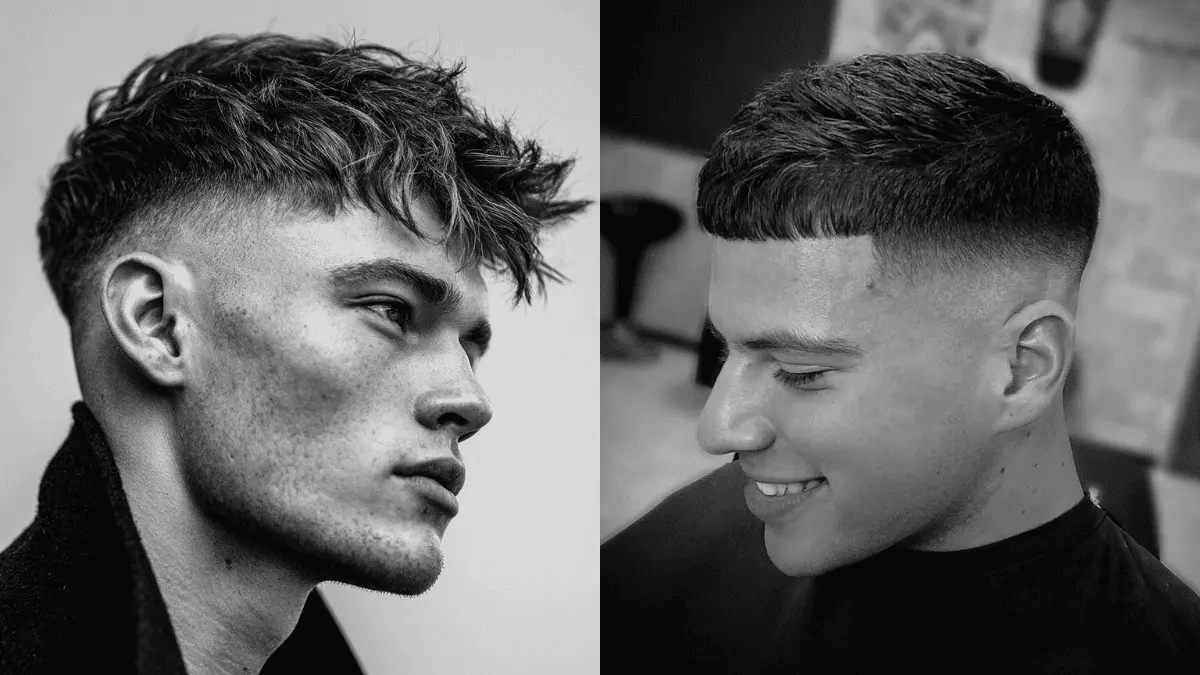
The textured crop vs French crop debate confuses a lot of men because, at first glance, they look very close. Short sides. Hair pushed forward. Fringe across the forehead. Scroll through enough haircut photos and it starts looking like the same cut with slightly different styling.
It isn’t.
The difference sits in the build of the top, the fringe, and how the hair is cut to behave once you leave the chair. One is built around separation, movement, and point-cut texture. The other is built around a straighter front line, a flatter top, and tighter structure.
Understand that early, and you stop making vague requests at the barber. I’ve seen too many men ask for a crop and end up with the wrong one.
Note: Some of the images below were generated with AI to help illustrate the haircut more clearly.

In this article
What a Textured Crop Looks Like in Real Life

A textured crop haircut is built around visible layering and breakup through the top. The sides stay short, usually faded or tapered, while the top is cut into choppy sections that push forward with some lift and separation. It should not sit like a flat lid.
That is the point.
A good textured crop has grit. The fringe is softer, more broken, and rarely sits in one hard line. You should see small irregularities through the front, a bit of air between strands, and enough point-cutting to stop the shape feeling blunt. With the right matte finish, it looks current without trying too hard.
This is usually the better choice when you want short hair to have movement instead of just shape.
What a French Crop Looks Like in Real Life

The French crop is tighter and more condensed.
The sides stay short here too, but the top is cut more evenly, with less visible layering and less breakup through the front. It sits flatter, reads neater, and leans more on outline than texture.
The defining feature is the fringe. Straight. Blunt. Controlled.
That front line does most of the work. It gives the cut a firmer edge across the forehead and makes the whole shape feel more deliberate. Where the textured crop feels relaxed, the French crop feels disciplined. Where the textured crop wants movement, the French crop wants order.
That is why men confuse them in photos. In real life, the difference shows up fast.
Textured Crop vs French Crop: Key Differences
When men search textured crop vs French crop, they are usually trying to work out why two similar-looking cuts feel completely different in real life.
Here is what separates them:
| Feature | Textured Crop | French Crop |
|---|---|---|
| Top Texture | Heavily layered with visible separation and broken strands | Cut more evenly with minimal separation |
| Fringe | Soft, irregular, slightly jagged edge | Straight, blunt line across the forehead |
| Volume | Slight lift through the front and crown | Flatter, tighter to the head |
| Styling Appearance | Matte, separated finish | Neater, compact finish |
| Grow-Out Pattern | Blends gradually and keeps shape longer | Fringe grows heavy and drops forward |
| Barbering Technique | Point-cutting and texturising for movement | Blunt cutting for sharper lines |
| Overall Feel | Modern, relaxed, textured | Structured, classic, controlled |
Here’s the blunt truth.
The textured crop shows separation and lift. The French crop leans on a blunt front line and tighter structure.
One feels looser.
The other feels stricter.
In photos they can overlap. In person, they do not.
Fringe Is Where the Difference Shows
If you are trying to tell these cuts apart, stop looking at the fade and start looking at the fringe.
On a textured crop, the fringe is broken and irregular. It is usually point-cut so it does not fall in one straight line. You get softness through the edge, small gaps, and a front that feels more natural without looking messy.
On a French crop, the fringe is far cleaner and more blunt. It creates a hard front line across the forehead and makes the cut feel tighter from the moment you look at it.
That front edge changes the whole haircut.
A broken fringe softens the front and gives the style more flow. A blunt fringe sharpens the outline and makes the cut read as more controlled. Similar direction. Completely different presence.
If you are unsure which cut you are looking at, check the fringe first. It never lies.
Which One Is Easier to Maintain?
Neither is difficult, but one is definitely more forgiving.
The textured crop grows out better. The layering helps hide uneven growth, and the broken fringe does not suddenly become a problem once it gains a bit of length. Even after a few weeks, it still tends to look intentional. Fuller, yes. Softer, yes. But still workable.
The French crop is stricter. That blunt front line looks sharp when it is fresh, but once it starts gaining weight, the whole cut changes. The fringe drops, the edge softens, and the haircut loses the thing that made it strong in the first place.
A French crop usually needs a trim every three to four weeks if you want it looking sharp. A textured crop can stretch a bit longer if you do not mind more movement on top.
If you hate frequent trims, textured wins.
If you like cleaner lines and do not mind upkeep, French stays tighter.
Which One Suits More Men?
The textured crop suits more men. I do not think that is even controversial.
It works better on hair with slight wave, natural movement, or decent density because it uses texture instead of trying to suppress it. It is also more forgiving if the front is not perfect. Minor unevenness, weaker spots, or a hairline that is not razor-sharp can often be handled better with a softer, broken fringe than with a blunt front edge.
The French crop is more selective. It usually looks strongest on straighter, denser hair that can support a clean front line without going wispy. If the fringe lacks weight, the shape can look weak fast. If the hairline is already struggling, that blunt edge can draw attention to the problem rather than hide it.
So if you want the simple version:
Most men are safer with a textured crop.
A French crop suits fewer men, but on the right one, it looks excellent.
What to Ask Your Barber For
This is where a lot of men get it wrong.
Do not just ask for a crop and hope the barber reads your mind.
If you want a textured crop, say you want short sides with a top that is point-cut and texturised for movement. Say you want visible separation through the top and a softer, broken fringe rather than a blunt one.
If you want a French crop, ask for the top to be cut more evenly with less visible breakup and a straighter, heavier fringe across the front. That front line is what makes the cut.
Those details matter. Without them, it is easy to ask for one and leave with the other.
Textured Crop vs French Crop FAQ
If you are still weighing up the difference, these are the questions worth clearing up before you commit to either cut.
Is a textured crop the same as a French crop?
No. They are related, but they are not the same cut. The textured crop uses layering, separation, and point-cut texture to create movement. The French crop uses a blunter fringe and a more uniform top to create a tighter shape.
Which one grows out better: textured crop or French crop?
The textured crop grows out better. The layering helps hide uneven growth and the fringe stays more forgiving. A French crop loses its sharpness faster because the blunt fringe gains weight and drops forward.
Which is better for thinning hair?
Usually the textured crop. It is more forgiving and better at disguising small density issues through the front. A blunt French fringe can expose weakness if the hairline is already thinning.
Which face shapes suit textured crop vs French crop?
Oval and square faces can wear both well. If you have a longer face or higher forehead, a French crop can shorten it visually because of the straight fringe. If your face is rounder, a textured crop often works better because the broken front edge feels softer and less width-heavy.
Beard Beasts Verdict: Textured Crop vs French Crop
If you are stuck between a textured crop vs French crop, here is the real answer.
The textured crop is about movement, separation, and a bit of grit through the top. It is more forgiving, suits more men, and usually grows out better. For most readers, it is the safer recommendation.
The French crop is about structure. Strong front line. Flatter build. Cleaner shape. It can look sharp when it suits the hair and face, but it asks for more precision and usually more upkeep.
Neither is bad.
But they are not interchangeable.
If you want visible texture, a more modern feel, and something easier to live with, choose the textured crop.
If you want a tighter shape, a blunt fringe, and a more controlled finish, choose the French crop.
One leans relaxed.
The other leans precise.
The right choice comes down to whether you want your haircut to move or hold its line.