
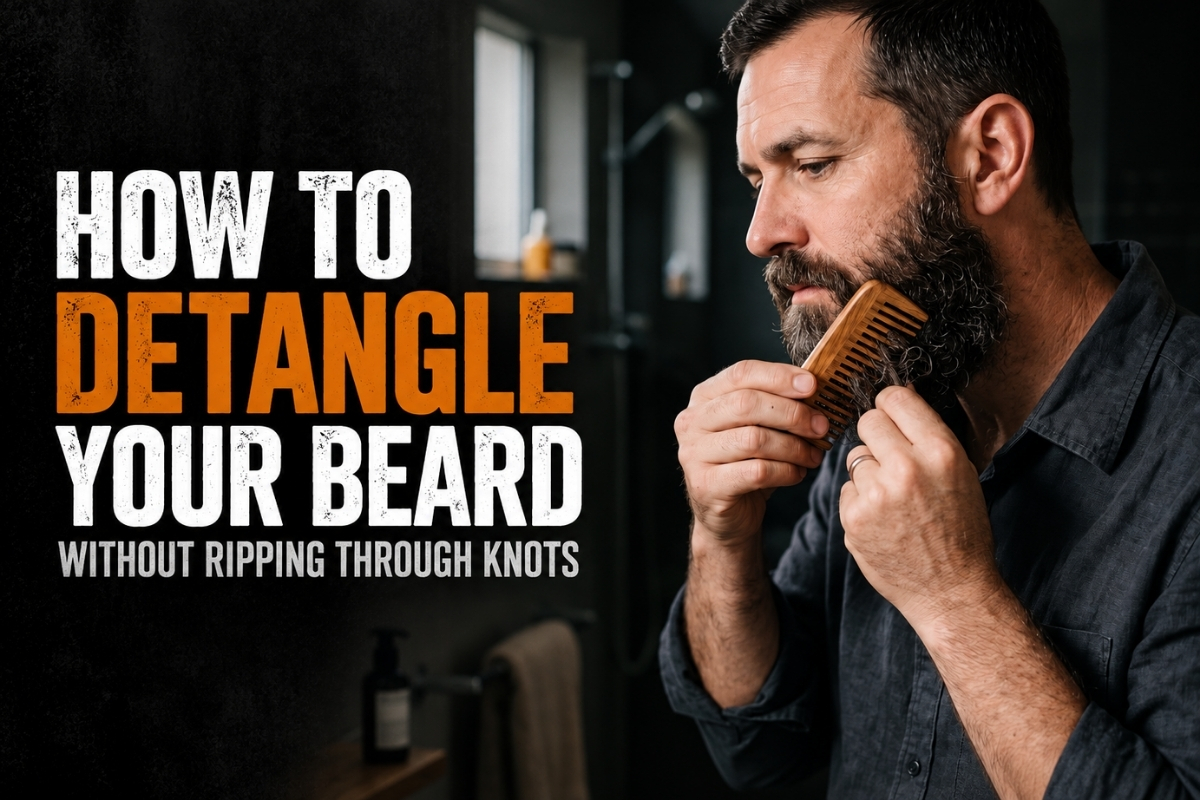
If you’re trying to work out how to detangle your beard, especially when you’re dealing with tight beard knots, the first thing to work out is what’s caught. A few hairs twisted together need a different approach from a larger tangled section.
A tangled beard also doesn’t automatically need more product. Sometimes your fingers are enough. Other times the hair needs a little more slip before a comb can move through it comfortably.
The aim is to separate the hairs that are caught without putting unnecessary tension on the rest of the beard. Once you approach it that way, most tangles become much easier to deal with.

In this article
How to Get Beard Knots Out of Your Beard Without Pulling Harder
If your beard has knots or tight tangles, forcing a beard comb through them can pull on the hair and increase the chance of breakage. The goal is to loosen the tangled section, not drag every strand through at once.

Start with your fingers. Find the area that’s catching and gently separate the hairs around the knot before bringing in a comb. With a larger tangle, working on a smaller section at a time gives you much more control than trying to pull a comb through the whole beard.
When you do use a comb, begin near the ends rather than starting at the roots and pulling straight down. Once the lower section moves freely, work a little higher and repeat. That way you deal with one snag at a time instead of pushing several tangles together.
If the beard hairs feel rough and keep catching on each other, add a little moisture or conditioning before you carry on. You only need enough to make the hair easier to work through. Adding more isn’t going to make the knot disappear.
When the comb catches, stop and go back to the tangled area.
I’d rather loosen the knot from its edges with my fingers than repeatedly put tension on the same hairs. A tight beard knot often needs to be worked apart gradually, especially when longer or curlier hairs have wrapped around each other.
Once it feels loose, run your fingers or a wide-tooth comb through that section again. If you still find the same catch, there’s probably a smaller part of the tangle left to separate.
Should You Cut Out a Beard Knot That Won’t Come Loose?
Sometimes a beard knot still won’t come apart, even after you’ve loosened as much as you can with your fingers and added a little moisture or conditioning. I wouldn’t reach for the scissors straight away.

A tight knot can look worse than it is.
Separating the hairs around the outside may reveal that only a few strands are holding everything together, and those may still come loose with a little more careful work. There’s a point where continuing to tug at the same area stops making sense, though. If a small knot remains tightly caught after everything around it has been separated, trimming the minimum needed can be more sensible than repeatedly stressing the surrounding hairs.
Isolate the knot first and make sure you can clearly see what you’d be cutting. Keep it away from the skin before using beard grooming scissors. If the knot is tight against your face, buried inside a dense section, or you can’t tell exactly where the tangled hairs end, I wouldn’t start snipping blindly.
And if you keep having to cut knots from the same area, that becomes a different problem. The useful question then is why those hairs keep tangling rather than how to remove the latest knot.
Wet or Dry: Which Is Better for Detangling?
I wouldn’t treat this as a strict wet-versus-dry rule. What matters more is whether the hairs can move past one another without a lot of pulling.
If your beard detangles easily when dry, there’s no reason to wet it first because you think you’re supposed to. When dry hairs feel rough and keep catching, a little moisture can make the individual strands easier to separate.
I’d be more cautious with a beard that’s dripping wet.
Wet hair can stretch more easily under tension, so softness isn’t a reason to drag through a stubborn knot. If you’re detangling after washing, remove the excess water first and work on the beard while it’s damp rather than soaking.
The better choice is whichever condition lets you separate the hairs comfortably. Dry is fine when it works. Add a little moisture when the beard needs the extra slip.
Comb, Brush, or Fingers: What Works Best for Beard Knots?
For one tight beard knot, I’d start with your fingers. They give you more control over individual hairs and make it easier to separate the knot without dragging the surrounding section along with it.

A wide-tooth beard comb makes more sense when a larger area is tangled. The extra spacing gives the hairs more room to pass between the teeth while you work through the section gradually. If you were buying one tool mainly for detangling, I’d choose a wide-tooth beard comb with smooth teeth.
Once the larger tangles are gone, a finer-tooth comb comes into its own. It can pick up smaller catches, but I wouldn’t make it the first tool I push into a heavily tangled beard.
A beard brush has a different job.
It’s useful for general grooming, guiding the beard, and removing loose shed hairs, but a lot of bristles can catch a lot of hairs at once. For a stubborn knot, fingers and then a wide-tooth comb give you much better control.
Why Beard Knots Keep Forming
Beard knots usually come from several things working together rather than one obvious mistake. Length is part of it because longer hairs have more opportunity to cross over, twist around neighboring strands, and eventually tighten together.
Texture changes how that plays out. Curly beard hairs can bend back across one another rather than hanging in roughly the same direction. Rough-feeling strands can also create more friction as they move against neighboring hairs.
Everyday friction can make those smaller tangles tighter.
Rubbing the beard hard with a towel, sleeping with it pressed against a pillow, pulling clothing over it, or regularly rubbing the same area can all shift hairs across one another. Loose shed hairs are easy to overlook. A hair that has already shed can stay trapped inside a longer or denser beard and become wrapped around hairs that are still growing instead of simply falling away.
Hair that feels particularly rough or lacks enough conditioning may also catch more easily when strands cross. If knots repeatedly appear in one part of the beard, I’d pay attention to that pattern. The area may be getting more friction, curling back into itself, or trapping more loose hairs than the rest.
How to Stop Beard Knots Coming Back
Once you’ve worked the knots out, the goal is to stop small tangles from tightening again.
How you handle the beard after washing is one place to start. Rubbing hard with a towel can twist and tangle the hairs together, so I’d press out the excess water and let the towel absorb it rather than scrubbing through the beard.
Longer beard hair also needs enough conditioning to stop it feeling rough and catching on itself. Beard oil is mainly for the skin underneath and may help the beard feel softer, but I wouldn’t keep adding more oil every time it tangles. If the hair itself still feels rough or hard to manage, a beard conditioner or beard butter may make more sense.
It also helps to deal with small tangles before they tighten. That doesn’t mean constantly combing the beard. The point is simply not to ignore an area that’s starting to tangle until several hairs have worked themselves into a tighter knot.
Loose shed hairs can also get trapped in a longer beard and become part of a tangle. Running your fingers, comb, or brush through the beard helps remove them before they wrap around other hairs.
If one part of your beard keeps tangling, focus on what is happening in that area instead of changing your whole routine. It may simply need gentler handling, more conditioning, or less rubbing.
Why Your Beard Keeps Snagging After You Detangle It
If the knots are gone but your beard still catches in the same places, you may not be dealing with another hidden tangle.

Look at where the beard keeps catching. If your fingers or comb move through most of the section easily but keep snagging near the ends, check those hairs before detangling the whole area again. Rough, frayed, or split ends can catch on nearby hairs and make the beard feel tangled even when the knot itself is gone.
Your fingers can help you tell the difference. With a knot, several hairs usually feel tangled together. Rough ends may come apart, but they can still catch again when they rub against nearby hairs.
I wouldn’t assume that every snag means damaged hair.
A curlier part of the beard can naturally catch more, especially when the hairs bend back into each other. What matters is whether you’ve already separated the hairs and the same spot keeps catching again.
If the same area keeps snagging and the ends look rough or split, a small trim may help more than repeatedly combing through it. The aim is to remove the problem ends without taking off more length than you need to.
What I’d Do With a Tangled Beard
The main mistake I’d avoid is using more force every time the beard catches. I’d first find the hairs that are actually tangled and work on that area rather than repeatedly combing through the whole beard.
You also don’t need to add more products every time the beard tangles. If the hairs already separate easily, your fingers and a comb may be enough. If they feel rough and keep catching, a little moisture can make them easier to work through.
Scissors would be a last resort for a knot that genuinely won’t come apart. Only consider trimming it if you can clearly separate the knot from the rest of the beard and keep it safely away from the skin.
If the same area keeps tangling or catching again, I’d look at why it keeps happening. Friction, curl pattern, trapped shed hairs, rough ends, or the condition of the hair may all play a part, so repeatedly detangling the same spot without addressing the cause is unlikely to solve much.