
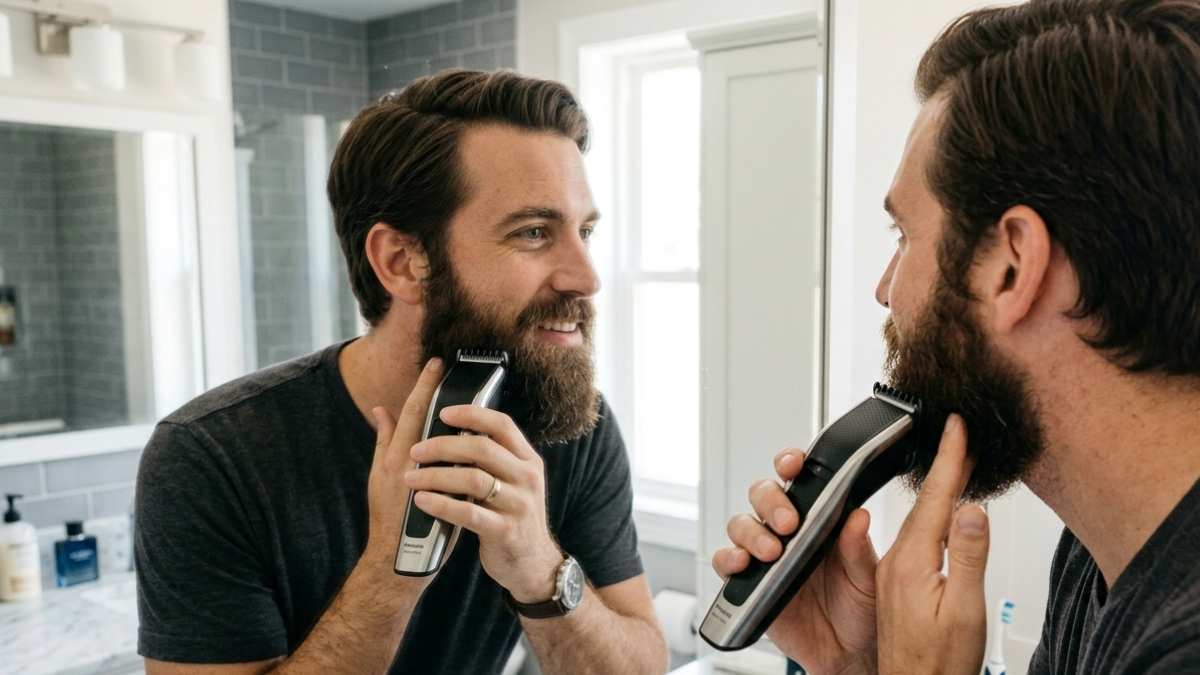
Most beard trimming mistakes happen when you take off more facial hair than you meant to.
A few hairs stick out, one side looks slightly different, or the neckline seems uneven. Instead of dealing with the actual problem, you start cutting into parts of the beard that didn’t need any change.
Before I pick up the trimmer, I decide what I’m trying to fix. If the problem is small, the correction should be small too.

In this article
Trimming Your Beard Before It’s Completely Dry
A wet beard looks longer and straighter than it does when dry. Waves and curls are pulled down, so the shape you see after a shower can be misleading.

I never decide the final length while the beards still wet. As it dries, the hair lifts and moves back into place. This is especially noticeable if your beard is coarse, curly or wavy.
Towel-dry your beard, then let it dry fully before trimming. A hair dryer is fine on low heat, just style the beard into its usual shape before you judge the length.
Don’t trim straight after brushing every hair down. Wait a few minutes and let the beard return to its usual shape.
It’s better to deal with one stray hair later than to take too much length from a beard that was still wet.
Fixing a Trim You Cut Too Wet
If the beard was still wet when you trimmed it, resist the urge to fix it with more trimming. Cutting on top of a wet-trim mistake almost always takes off more than you meant to.
Let it dry fully and take another look before deciding anything. It’s rarely as short as it looked right after the cut.
I’d give it a week before touching it again. The length you’re missing will come back faster than you think.
Chasing Perfect Symmetry Until Both Sides Are Too Short
Your face isn’t perfectly even, and your beard will rarely grow the same on both sides. One cheek may be thicker, while the hair on the other side may lie flatter.

The mistake is trying to make both sides identical. You trim one side, take a little more from the other, then keep correcting until both are shorter than you wanted.
I judge the beard as a whole, not hair by hair. Neither side should look noticeably longer or heavier, but they don’t need to match perfectly.
Step back from the mirror before cutting again. What looks uneven up close may look completely fine when you see the full beard.
Once the overall shape looks right, leave it alone. Small differences are normal.
Backing Off an Over-Corrected Symmetry Fix
If you’ve been correcting one side against the other for a while, stop and step back from the mirror completely. Put the trimmer down for a day if you have to.
Judge the beard as a whole again once you’re not staring at one section up close. Most of the unevenness that felt urgent up close stops mattering at a normal viewing distance.
Let both sides grow out evenly before you touch either one again.
Trimming the Sides Too Short
The sides give your beard much of its shape. Cut them too close and the beard can start looking narrow, even with plenty of length at the chin.

This often happens when a few beard hairs stick out and the whole side gets shortened. Those hairs may need trimming, but the rest of the growth may not need touching at all.
I always reach for scissors or a longer guard to deal with the strays first. Running a short guard through the entire side can take away far more than needed.
This matters most on longer beards. If you cut the sides too close, the beard can become too chin-heavy and lose its shape from the front.
Work in small stages and check the beard from more than one angle. Remove the hairs that stick out without cutting all the side growth close to the face.
Growing Back Sides That Are Too Short
Once the sides are too short, leave them alone and let the rest of the beard catch up. Trimming other areas to match will only make the whole beard shorter.
Beard oil helps here, not because it speeds up growth, but because it keeps the shorter sides looking healthy while they fill back out.
Give it a month or two before judging the shape again.
Cutting Too Much Length to Fix a Few Stray Hairs
The bottom of a beard rarely ends at one perfectly even length. The mistake is shortening the whole beard to fix a couple of longer strands instead of trimming just those hairs.

Check the overall length first. If most of the beard already looks right, there’s no reason to shorten it because a few hairs hang lower than the rest.
Trim the obvious strays one at a time with scissors or the corner of the trimmer. I’d rather spend a few extra minutes doing that than take length off the whole beard.
Longer beards often have fewer hairs at the lowest point, so any extra-long ones stand out more. Remove those hairs first, then step back and look at the beard again.
Most of the time, that small change is enough.
If You Took Off More Length Than You Meant To
Stop trying to fix it by cutting more length off the rest of the beard to match. That’s how a small mistake turns into a much bigger one.
Leave the length alone and give it time to catch up. A beard oil or balm can help it look fuller in the meantime.
I’d rather live with an inch of unevenness for a month or two than keep cutting to chase a match that isn’t there yet.
Trimming the Neckline Too High
A neckline cut too high can make your beard look smaller and expose too much skin beneath the jaw.

This usually happens when the trimmer follows the jawline too closely. It may look tidy from the front, but it removes hair that helps the beard look stronger beneath the chin.
The neckline belongs on the upper neck, not directly along the jaw. As a rough guide, it usually lines up with the top of the Adam’s apple. Its exact position depends on the length of your beard and the shape of your neck.
A short beard can carry a slightly higher line. A longer beard usually needs more growth underneath, especially when you’ve left extra length at the front.
Check the beard from the side before cutting further. If the line cuts deeply into the hair beneath the chin or leaves a large bare area behind the jaw, it’s been taken too high.
When I’m unsure, I leave the neckline slightly lower. You can always adjust it after seeing how the beard looks from the front and side.
Bringing Back a Neckline That’s Too High
If the neckline ended up too high, leave it alone and let it grow back out. Shaving further up to fix it only makes the bare area worse.
Wait, then recut the line properly instead of guessing at where it used to be.
Starting With a Guard That’s Too Short
A short guard can remove more length than expected, especially if your beard is thick. By the time you notice, one section may already be shorter than you wanted.

I start with a longer guard and work down only when needed. I’ll usually start at a 6 or 8 and drop a size at a time instead of jumping straight to a 3.
Taking off a little more is easy, while a short first pass can leave one area noticeably shorter than the rest.
The same guard can also give a different result across your beard. Dense hair on the chin may still look full, while lighter growth on the cheeks can quickly look thin.
Curly and wavy beards need extra care. The guard can pull the hairs straighter as it moves through them, then they lift back into place and appear shorter afterwards.
Make one pass, brush the beard back into its normal position and see how it looks before changing the guard.
Guard numbers are only a starting point. How the beard looks after the first pass should decide whether you go shorter.
Recovering From a Guard That Went Too Short
When a short guard catches you out, don’t try to blend it by taking more off the rest of the beard. That just spreads the damage instead of fixing it.
Let the short section fill back out and use a longer guard everywhere else in the meantime, so the difference is less obvious.
Next time, start a size or two longer than you think you need.
Trimming the Cheek Line Too Low
Your natural cheek line is rarely straight, and it doesn’t need to be. Cutting too far into it can make the beard look thinner and remove useful growth from the sides.

A few longer hairs above the line are often the real problem, but the fix ends up lowering the entire cheek line instead. Those hairs may need trimming, but the main cheek growth may already be in the right place.
Start by removing only the obvious strays. This matters even more if your cheeks are lighter, because taking away a small amount of growth can make them look much thinner.
I’d keep the cheek line as high as the natural growth allows without leaving random hairs far above it.
Tidy the line you already have rather than creating a new one lower down.
Letting an Overcut Cheek Line Recover
When the cheek line gets cut too low, back off completely and let the area recover before you touch it again. Trying to fix it right away almost always means cutting it lower still.
Give it real time, not just a few days. A cheek line needs several weeks of growth before there’s enough there to reshape properly.
I’d rather wait it out than end up with a cheek line that keeps creeping down every time I try to fix it.
Common Questions About Beard Trimming Mistakes
What’s the biggest beard trimming mistake?
Taking off too much length in one go. Chasing symmetry, over-correcting the sides, and cutting a few stray hairs all come back to that same instinct: cutting until everything matches instead of leaving it alone.
Should you trim a beard wet or dry?
Dry. A wet beard stretches longer and flatter than it really is, so you end up cutting more than you meant to. I always trim once the beard has air-dried and settled back into its normal shape.
How often should you trim your beard?
That depends on the style, but most men do better with a light trim every one to two weeks rather than waiting a month and cutting everything at once.
Can a bad beard trim be fixed?
Usually, yes. Most bad trims recover fastest when you stop trying to correct them further and just give it time.
How long does it take a beard to grow back after cutting too much?
It depends on your growth rate, but most men see meaningful length again within four to six weeks. I wouldn’t judge the shape again until at least the two-week mark.
Beard Beasts Verdict
Beard trimming mistakes are rarely caused by a lack of effort. They usually happen because you judge the beard badly before the cut, or take off too much hair once trimming begins.
A good trim should work with your growth rather than force every area into the same length and shape. The two sides can differ slightly, the neckline should suit the beard length, and a few stray hairs are never worth more than a quick trim.
In my experience, knowing what not to cut is one of the most important parts of trimming a beard. Once good length or natural growth has been removed, no trimmer can fix it in the moment. Most of it grows back out in time, and knowing when to stop and let that happen is the real skill.
Know what each cut is meant to fix, take off only what’s needed and stop when the beard looks better.