
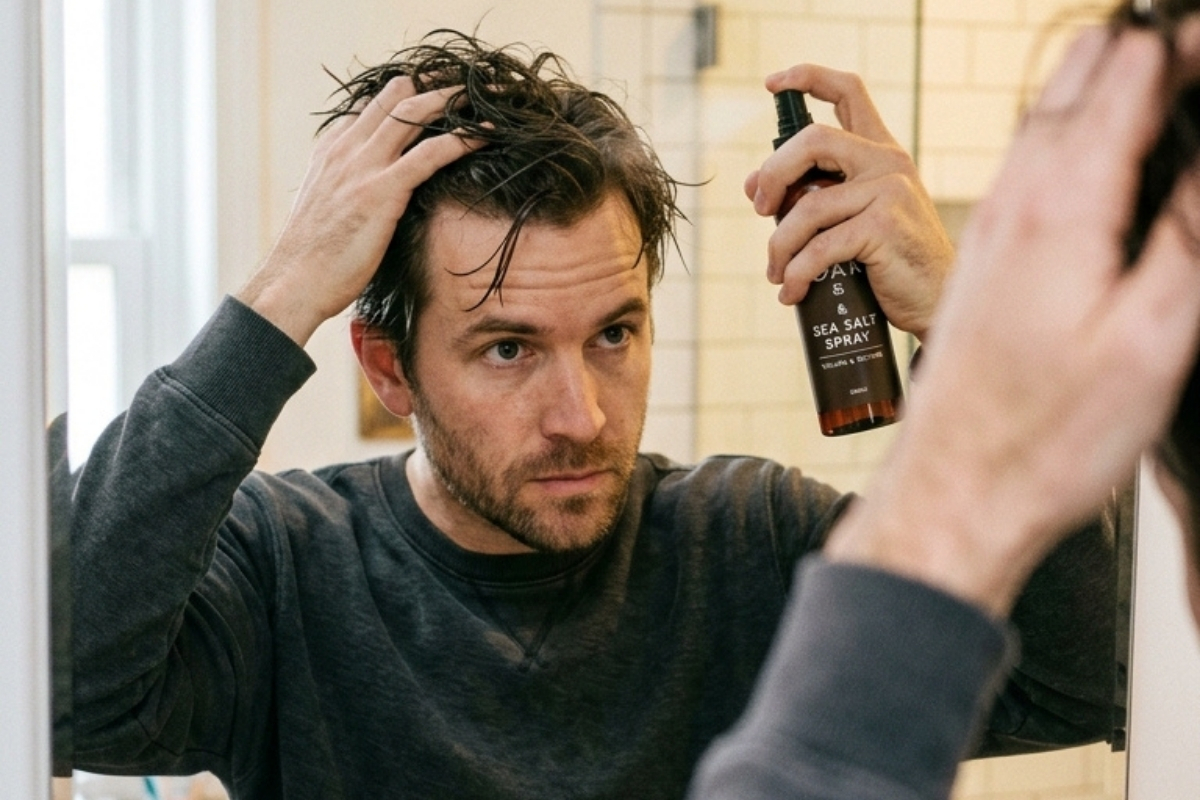
The benefits of sea salt hair spray sound convincing instantly. A few sprays and the hair behaves completely differently, which is exactly why men assume more must mean better.
I don’t judge it by that first burst of texture. I judge it by what the hair looks and feels like hours later, once the style’s actually settled.
That’s where an actually useful product and an overhyped bottle split apart.

In this article
Sea Salt Spray Adds Texture by Making Hair Less Smooth

Sea salt spray works by stripping softness out of freshly washed hair. That’s the whole trick.
Hair that feels too smooth won’t hold a shape. It falls flat, slides back into place, loses the separation a textured finish actually needs. Sea salt spray roughs up the surface just enough to make the strands stay apart instead of collapsing into each other.
Men call that result “thicker hair.” It’s not. No new density showed up. No new strands grew overnight. The hair just behaves differently, which can trick the eye into thinking it’s fuller.
That trick works on movement-built cuts, textured crops, loose fringes, short quiffs, medium-length styles. Flat, controlled cuts get almost nothing out of it.
Amount decides whether the result looks intentional or accidental. Too much, and the strands turn stiff, overly separated, visibly dry.
The second the roughness outshines the style itself, you’ve gone too far.
Fine Hair Usually Gets the Most Obvious Benefit

Fine hair responds fast. A tiny texture increase changes the whole shape of the style, no exaggeration needed.
On short and medium cuts, a light application keeps the front lifted and stops the top collapsing five minutes after you leave the shower. Works best on hair with real density but zero natural body.
The biggest improvement shows up on flat hair, not actually thinning hair, two very different problems. Sea salt spray can’t replace lost density. It can make healthy fine strands hold their position better, that’s the ceiling.
The margin for error here is razor thin. Overdo it and the hair pulls into narrow sections, exposes more scalp, and leaves the finish stiff and dry.
Two or three light spritzes. That’s it. Soak the hair and you’ve already lost. Judge the result once it’s dry, fine hair usually needs just enough to support the shape, not enough to make the texture the main event.
It Can Make Natural Waves and Curls Look Better

Sea salt spray works best when the hair’s already got some bend to work with.
Wavy hair? A light application sharpens the shape, stops freshly washed strands collapsing into one soft, boring layer. Scrunch it through while damp and the natural pattern shows up clearer as it dries.
Don’t buy it as a curl creator, though. Straight hair gains roughness and separation. It doesn’t suddenly grow curls.
Curls need extra care. The same formula that gives waves more hold can leave drier curls frizzy, brittle, unhappy. Use less. Or mix in a light cream or leave-in so the hair holds onto some moisture.
Sea salt spray should reveal movement that’s already there, not manufacture it. Curl pattern getting frizzier or harder to control? Use less, or grab something with more moisture in it instead.
The Matte Finish Is Useful Until the Hair Starts Looking Dull

Sea salt spray cuts the shine that makes freshly washed hair look too soft, too polished.
Works well on the same texture-focused cuts already covered, anywhere separation matters more than gloss. The whole look relaxes, stops looking so obviously “styled.”
Matte isn’t automatically the win, though.
Men keep spraying, chasing more texture, then wonder why the hair suddenly looks dusty and lifeless. Dark hair exposes this fastest, any pale residue or excess dryness shows up loud and clear.
A good matte finish still moves. Controlled, not coated. Textured, not starved.
Leave some life in the finish. Flatten every bit of shine and the hair stops looking textured and starts looking tired instead.
Sea Salt Spray Usually Needs Help to Finish the Style

Sea salt spray gets marketed like a few sprays can build and hold an entire style on its own. Rarely true. That’s not where it does its best work.
Apply it to damp hair before blow-drying. Hold the bottle six to eight inches away, not rammed against the scalp. It’ll add lift, direction, and enough structure to stop the hair dropping flat the second it dries. This is how I actually use it.
Shape’s there? A small amount of hair clay, paste, or cream locks in the control and staying power the spray never had.
Air-dried styles play by different rules. Naturally wavy hair, a looser medium cut, sea salt spray alone might be all you need when movement’s the goal, not a locked-in finish.
Weak hold isn’t a “spray more” problem. Extra product just roughs the hair up further without buying you any real control.
Sea salt spray does its best work before the finishing product goes in, not instead of it.
The Main Drawback Is Dryness, Not Lack of Hold

Sea salt spray gets blamed for weak hold constantly. Wrong target. Dryness is the real problem.
It works by stripping softness out of the hair. Fine, in moderation. Overuse it, or grab a formula loaded with salt and alcohol, and the hair turns coarse before you’ve even picked up a brush.
Bleached, curly, naturally dry hair shows this fastest. Those hair types already run short on moisture, so repeated use leaves the ends brittle and the scalp uncomfortable.
Use less before you switch products entirely. Sea salt spray doesn’t have to live in every routine just because it worked once. A conditioning formula might help, but the real test is how the hair holds up after several uses, not one.
Feeling harder to manage? Dry at the ends? Uncomfortable scalp? Take a break. Piling more product on top just buries the problem, it doesn’t fix it.
Texture isn’t a win if the hair loses its condition to get there.
Beard Beasts Verdict
The benefits of sea salt hair spray are real. It’s just not a fit for every head of hair, and pretending otherwise is how bottles end up half-used in a drawer.
I rate it highest when a cut needs extra structure without a heavy finish. Small amount, easier styling. Large amount, the product’s suddenly all anyone notices.
For most men, it’s the step before the styling product, not a substitute for it. Very dry, bleached, or tightly curled hair? The trade-off might not be worth it.
Use it because it improves how the haircut behaves. The moment you’re fighting the dryness it caused, that’s your answer, move on to something else.