
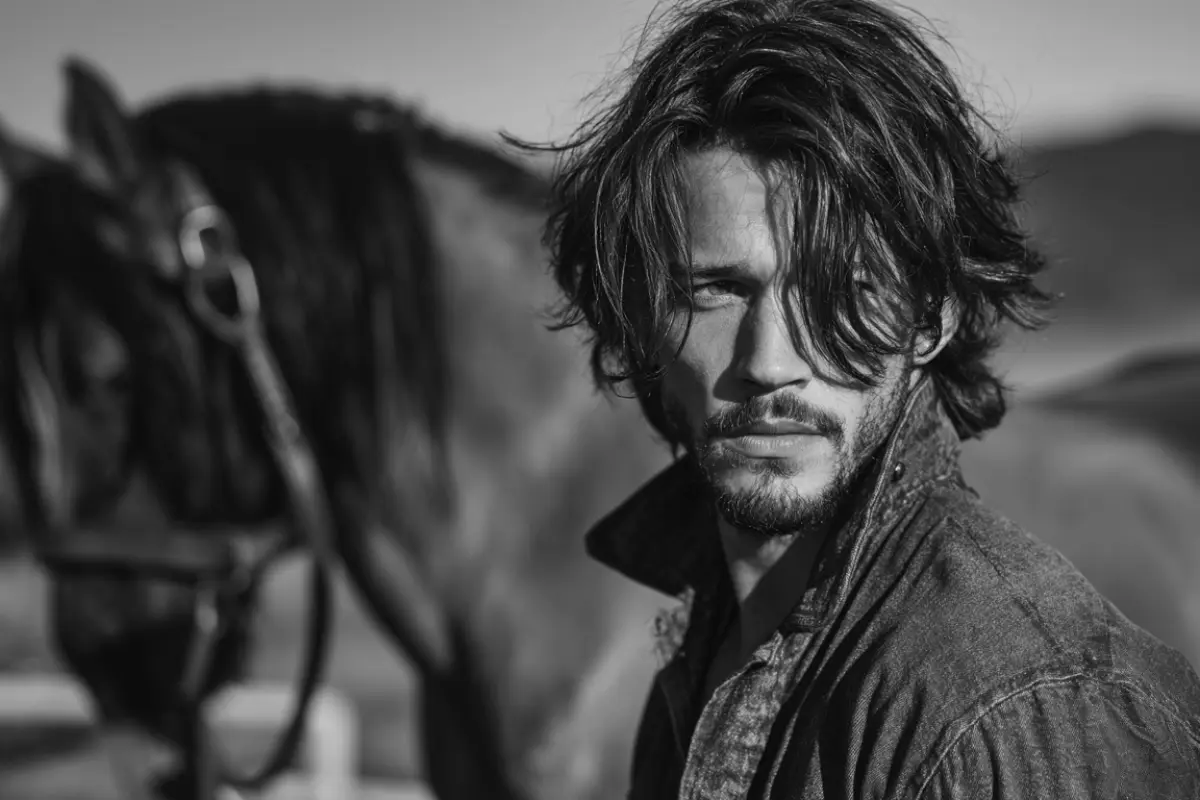
A cowboy haircuts go wrong the second they start looking like costume hair. You know the look. The guy in the hat whose every strand is placed, the whole thing screaming that he spent an hour in front of a mirror getting Western.
That’s not it.
The versions that actually land have length, movement, and a bit of roughness, but they still look like they grew on the head of the man they belong to. His hair, cut well.
So here’s the test I’d hold every style on this list to. If the cut needs loads of styling to look right, it probably isn’t a good cowboy haircut in the first place. Western hair should move, handle a hat, look right a few weeks after the cut, and still look decent on a day you didn’t touch it.

In this article
Cowboy Haircut Styles for Men
Eight cowboy hairstyles that actually work, and what each one needs from you to look right rather than rented.
Low Taper Flow

This is the best all-rounder on the list, and the one I’d point you to before anything else. You keep length through the top and back, the taper cleans things up around the ears, and the whole cut stays loose enough to behave under a hat and fall back into shape when it comes off.
It suits almost everyone, which is rare. Straight, wavy, thick, medium, it all works as long as there’s enough length up top for the hair to actually flow. The taper is doing something clever, too. It gives you a clean edge around the ears and neck without committing to a hard fade, so the cut reads tidy up close but still looks relaxed from a few steps back.
This is the one I’d push if you want something Western but you’re nervous about looking like you raided a costume rail. It’s the safe landing. If you only try one cut off this page, make it this one.
Rough Rider Waves

Built for wavy hair, and the entire point is movement rather than a clean, finished shape. You’re not chasing symmetry here. You want the waves doing their own thing, falling where they fall.
The make-or-break is weight. The bulk needs thinning out without flattening the wave pattern, because heavy wavy hair just collapses into a shapeless lump. Done with a light hand, it moves all day and looks better the messier it gets.
Textured Quiff With Shadow Fade

The quiff is the one cut here most likely to tip into trying-too-hard, so the rule is simple. Keep the height loose and a bit undone. The second you pile in product and build a stiff wall at the front, it stops reading Western and starts reading nightclub.
The shadow fade does the heavy lifting on the sides, keeping them tight and clean while the top stays soft and movable. Matte product only. A loose quiff you can run your fingers through beats a sculpted one every time on this style.
Soft Mullet Cut

This is the cowboy mullet with the confidence turned up. Real length at the back, falling past the jaw, the kind that moves when you turn your head and catches the wind on purpose. It commits. There’s no pretending this is anything other than a mullet, and that’s the appeal.
What keeps it on the right side of the line is the word soft. The length is there, but it’s broken up and feathered rather than hanging in one heavy slab, so the back flows out of the layers up top instead of dropping onto your neck like a curtain. Get that transition right and the length reads intentional, a bit rock and roll, never like a wig.
This is the version I’d actually trust to look good rather than looking like a dare, and it’s the one for the guy who wants people to know exactly what he’s going for.
Modern Rancher Crop

Western feel, none of the growing-out. It’s short and textured, so the grit has to come from the cut, which means asking for a point-cut top rather than a blunt one. Survives a hat, forgives a lazy morning, asks almost nothing of you.
Slicked-Back Western Cut

Best on thicker hair with enough body to hold a backward sweep, and the one rule that matters most is shine. Keep it down. A matte or low-sheen finish reads rugged and worn-in, while glossy and wet-looking tips the whole thing into a different decade and a different vibe entirely, more boardroom than ranch. Reach for a matte clay or a low-hold paste over a shiny pomade, and let a bit of natural texture break up the slick so it doesn’t look lacquered.
Cowboy Curtains

A strong option for medium-length hair, with one firm condition attached. The front has to fall naturally on its own. Curtains live or die on whether the part and the fall are working with your hair’s natural direction.
Force them into place with a round brush and a blast of heat and you’ll get about twenty good minutes before the whole thing separates and flops into a mess. If your hair doesn’t want to part down the middle, this isn’t your cut, and no amount of product will change that.
Layered Shoulder-Length Shag

For the guy with enough hair to carry genuine length, and the longest commitment on the list. This is the closest thing here to proper outlaw hair, the kind that looks born under a hat.
It lives entirely on the layers. Cut right, the layers keep the weight moving and stop the length from dragging the whole shape down. Skip them, or hand it to someone who doesn’t understand long hair, and you end up with a heavy, flat curtain hanging off your head with no life in it. Worth finding someone who cuts long hair often before you commit to this one.
Texture Matters More Than Height
Cowboy hair has to move. That’s the part most people get wrong when they’re chasing the look, because they reach for height and product when they should be chasing texture and flow.
Stiff, frozen, built-from-the-roots hair is the enemy here.
A quiff can work, but only a loose one that falls a little. Waves are almost made for this style because they bring their own movement to the table before you’ve done anything. Straight hair is trickier and needs smart layering rather than a fistful of product to fake the texture it doesn’t naturally have.
Match the cut to what’s on your head. Thick hair wants weight removed so it doesn’t lie there like a helmet. Fine hair is the opposite problem, and over-layering it leaves you with sad, wispy bits and no body at all.
Then there’s the product question, and this is where a lot of guys undo good work. High-shine pomade makes the cut look polished and groomed, which is the exact opposite of what you’re going for. Matte cream, a light clay, or a bit of salt spray makes far more sense. The cut should be carrying most of the look on its own. Product is there to help it along, not to do the whole job.
The Hat Test Decides Everything
Here’s the thing that gets skipped in every cowboy hair guide I’ve read. A cowboy haircut has to survive a hat, and that single fact changes how you should judge every cut on this page.
Tall, stiff quiffs collapse the moment a brim presses down on them.
Heavy fringes get crushed flat. Too much product turns greasy and messy under there fast, and you’ll feel it before you see it. And remember that the sides, the back, and your neckline all stay on show below the brim, so those have to read clean even when the top is hidden.
The real test is what happens when the hat comes off. Good cowboy hair falls back into shape on its own. It doesn’t need a bathroom and ten minutes to recover.
The messed-up idea matters here too. Wind, sweat, a hand dragged through it on a hot afternoon, none of that should wreck the cut. If the haircut only looks right in the window before the hat goes on, it was never really a cowboy cut.
The Back Needs Length, Not a Tail
The back is where cowboy hair gets its attitude. Push it too far and the same back turns the whole thing into costume hair, so this is a balance worth getting right.
A bit of length back there gives the cut its Western character.
A soft nape beats a hard tail every time. You want the back to connect into the top and the sides, growing out of the haircut rather than hanging off the bottom of it like an afterthought. A little length adds character. Too much takes over and starts doing all the talking. The best version of this looks like it happened naturally over months, not stuck on for the weekend. The back should add attitude, never become the entire haircut.
The Beard Beasts Verdict
A cowboy haircut should look natural, not themed, and that’s the whole game right there.
The best version has enough length to move, enough shape that it never reads as a mess, and enough restraint to stop short of fancy dress. Those three things have to hold at once, which is why the good ones look effortless and the bad ones look like they got dressed for a part.
Get those right and you don’t need the hat to sell it. The hair does that on its own.
A good cowboy haircut should look like it belongs on you, not like you borrowed it for the weekend.