
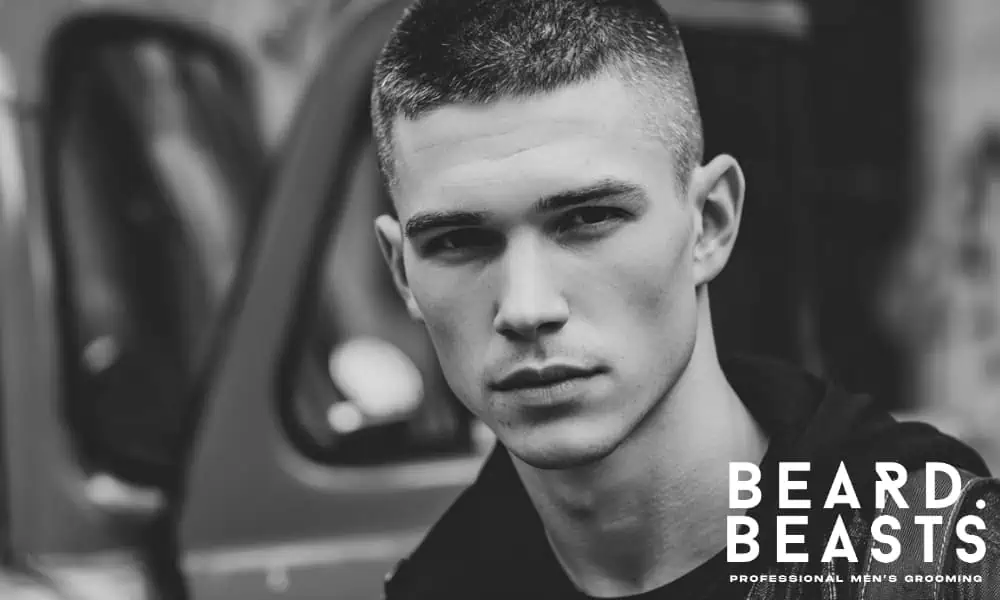
The crew cut isn’t a single haircut. It’s a family of cuts that share a basic structure, short sides with a longer, shaped top, and differ in almost everything else. Length, fade height, texture on top, how the front is handled, whether there’s a part, all of these change the character of the cut so significantly that a classic crew cut and a modern textured crew cut with a skin fade are barely the same thing.
That range is the point. Most men pick “a crew cut” and get whatever the barber defaults to. Knowing which version you’re asking for is the difference between a cut that suits you and one that just looks short.

In this article
The Best Crew Cut Hairstyles for Men
Twenty-eight versions below. The list is useful, but the three sections at the bottom are where the real advice is. Most crew cut guides stop before they get there.
Classic Crew Cut

Short, even length on top with a natural taper on the sides and back. No fade, no hard part, no texture product. The defining feature is that the hair on top is cut to follow the natural contour of the head, tapering slightly shorter toward the crown.
This is the one that works on almost every head shape, and I’d start here if you’ve never really committed to a crew cut before. The taper does the heavy lifting without you having to think about it.
Modern Crew Cut

The same basic structure as the classic but with a skin fade on the sides and texture worked into the top. The skin fade creates more contrast than the classic’s natural taper, and the texture on top stops the cut from looking uniform and flat.
The trade-off is maintenance. A skin fade shows regrowth within ten days, while a natural taper can go four weeks before it needs refreshing. Most men choosing the modern version underestimate that difference until they’re looking at a grown-out fade two weeks after the appointment.
Short Crew Cut

Top kept close, usually under half an inch, sides faded or tapered tight. There’s almost nothing to style at this length, which is fine if that’s what you want. But it also means the sides have nowhere to hide. If the fade is sloppy, that’s the whole haircut.
Long Crew Cut

Top kept at an inch or more, sides faded or tapered. At this length the cut transitions between a crew cut and a textured crop depending on how the front is handled. The longer the top, the more important the front section becomes. A long crew cut with the front left the same length as the crown looks flat and heavy. A long crew cut with the front section slightly longer and directed forward or to the side looks like a real haircut.
High Fade Crew Cut

A high fade starting near the temple or above, leaving a sharp separation between side and top. If you’ve got a round face, skip the high fade. Taking that much hair off the sides draws the eye straight to the width of the top, and wide heads look wider. A mid or low fade keeps some weight at the temple and handles those shapes considerably better.
Messy Crew Cut

A crew cut where the top is styled loosely rather than combed flat or spiked up. The failure mode here is the product choice. Anything with shine or strong hold turns the messy version into something that looks like a bad version of a spiky crew cut rather than intentionally undone. Matte clay through dry hair with fingers, not a comb, is the right approach.
I’d use less than feels necessary and stop before it looks styled.
Textured Crew Cut

The texture is built into the cut, not applied afterward. Point-cutting through the top creates movement and separation that a bluntly cut top simply doesn’t have. Put the same product on both and one looks like a haircut, the other looks like short hair with something on it. That gap is entirely in how the barber cut the top, not in what you did after.
Crew Cut Taper Fade

A gradual taper rather than a hard fade to skin. This is probably what you’ll get if you walk in and just say “crew cut” without being more specific. That’s not a bad thing. The taper grows out more gracefully than a skin fade and doesn’t need the same two-week refresh cycle. Most men who say they want low maintenance are actually describing this version without knowing it.
Ivy League Crew Cut

A crew cut with enough length on top to add a side part and some direction to the hair. Usually an inch to an inch and a half on top, tapered sides. The Ivy League is the version that works best in professional environments because it looks like a real haircut rather than just short hair.
I’d argue the Ivy League is the most underrated crew cut variation on this list. It has more versatility than most men realise and it grows out better than the faded versions.
Spiky Crew Cut

Short top styled upward with a firm matte product. The spikes need enough length to have something to hold, usually at least an inch and a half, or they won’t look like spikes, just short hair with product on it. Apply to dry hair, not damp.
Low Fade Crew Cut

The fade starts just above the ear and the transition is gradual. Less aggressive than a high or mid fade, and it adds some visual width at the sides that a high fade removes. On narrower or longer head shapes, a low fade often looks better than a high one because it keeps some weight at the temple rather than stripping it away.
Hard Part Crew Cut

A line shaved into the hair at the part, giving the side part a sharp, defined boundary. The hard part looks precise when fresh and starts losing its definition within ten days as the hair grows back over the shaved line. I’d only recommend this to men who maintain their cut on a regular biweekly schedule.
Thick Crew Cut with Skin Fade

Dense hair on top with a skin fade on the sides. Thick hair at crew cut length can push outward and look heavy if the top isn’t point-cut or layered. The skin fade creates the contrast that stops thick hair from looking like it’s expanding in all directions. Keep the top short enough, around an inch, that the density works as fullness rather than volume.
Afro Crew Cut

Natural Afro texture kept short on top with a faded transition on the sides. The fade needs to be executed tighter than on straight hair because coily hair expands at the sides and can soften the contrast faster. I’d go skin or near-skin on the sides rather than a softer blend.
Traditional Crew Cut with No Fade

No fade, no skin, no hard part. Just scissors and taper combs creating a graduated blend on the sides and a shaped top. Harder to find a barber who’s actually comfortable with this version now, since most barbers under thirty have been trained primarily on clippers. Worth asking specifically for a scissor taper rather than a clipper fade if this is what you want, or you’ll get a clipper version by default.
Crew Cut Fade with Beard

A faded crew cut with a beard. The two work together because the beard anchors the bottom of the face and stops the tight sides from making everything look too top-heavy. Stubble and a skin fade don’t quite go together though. They look like two different levels of effort on the same head. Go fuller with the beard or keep the fade softer.
Military-Inspired Crew Cut

A flat, even top with little to no taper variation, closer to a regulation cut than a styled haircut. The US military has maintained specific hair length requirements since the 1960s, and the regulation crew cut that comes from those requirements, no longer than three inches on top, tapered on the sides and back, is the basis of this version. It looks strong on square or oval faces and slightly severe on rounder ones. Nothing wrong with that trade-off if the face shape works.
Side Swept Crew Cut Fade

The top section swept to one side rather than left to fall naturally or styled upward. I’d point men with longer or oval faces toward this version specifically, since the horizontal sweep adds visual width and stops the face from looking stretched. On square faces it can have the opposite effect, adding width that doesn’t need adding. The sweep looks best when it follows a natural growth direction rather than fighting the hair into position.
Blonde Hair Crew Cut

Lighter hair makes fades look less defined, whether you want that or not. On dark hair a skin fade pops. On blonde hair the gap between skin and hair colour is smaller, so the same fade looks softer, sometimes almost invisible from a distance. If you want the contrast to show, go tighter on the sides than you’d think necessary.
Curly Crew Cut

Natural curls at crew cut length. The curl does the work that straight-haired men spend product budget trying to fake. The one thing to get right is checking the shape once the hair’s dry. Curly hair expands as it dries, and what looked fine wet can look too wide or too full once it settles. Always do the dry check before you leave.
Crew Cut Flat Top

The top cut flat and level rather than following the natural contour of the head. The flat top requires the barber to work against what most heads naturally do, which is curve. A flat line on a curved skull has to be created by cutting against the contour, and any deviation from horizontal is immediately visible from the front.
Less common now than it was in the 1990s, and harder to find someone who does it well. Worth asking whether the barber has cut one recently before committing.
Crew Cut for Straight Hair

Straight hair is the hardest starting point for a crew cut, and the least forgiving when the barber doesn’t put the effort into the top section.
There’s no natural texture to cover for a blunt, shapeless top. The cut has to create what the hair can’t. Texture needs to be worked into the cut itself, not just hoped for from product. Apply whatever you use to dry hair, not damp. Applying product to damp straight hair gives you a heavy, clumped result that’s the opposite of what you’re after.
Crew Cut with Thick Beard

A short crew cut with a full, well-groomed beard. The contrast between very short hair and a substantial beard creates strong visual interest. Keep the beard cheek line sharp and the neckline tight, since the contrast works because both elements are precise. A sloppy beard line under a tight crew cut looks like two different grooming standards on the same head.
Wavy Crew Cut

Natural wave at crew cut length. The wave gives the top movement and texture without much product, which is one of the real advantages of wavy hair at this length. I’d tell most men with natural waves to skip the product entirely on this cut and just apply salt spray to damp hair before letting it air dry.
The wave does the work. Blow-drying it straight and then adding product to recreate the texture you just removed is the most common mistake with this version.
Long Layered Crew Cut

A crew cut at the longer end of the range, with layers through the top so the hair actually moves. Past an inch and a half, straight hair without layers starts to look like a helmet. The layers are what separate this from just being long short hair.
Crew Cut Comb Over

The top section combed to one side with a hard or natural part. At crew cut length the comb over lies flat and stays in place without much product. A medium hold water-based product keeps it in position through the day without building up on the hair shaft the way wax does.
Crew Cut with a Quiff

Length on top, usually an inch and a half or more, styled with height at the front. The quiff version of a crew cut needs the front section to be left longer than the rest of the top during the cut, which isn’t always what happens if the barber treats it as a standard uniform crew cut length. Specify that you want more length at the front before the cut starts, not after.
The Top Decides Whether a Crew Cut Looks Strong or Flat
The most common failure in crew cuts is a bluntly cut top that lies flat with no texture or direction.
A blunt cut takes everything to one even length, which sounds right for a short haircut but produces hair that lies down in a flat sheet rather than having any life to it. Point-cutting through the top changes this. The slightly uneven lengths created by point-cutting allow the hair to separate and move, which is what makes a crew cut look intentional rather than just clipped.
Product amplifies what’s there, it doesn’t create it. A good top section needs less product to look right than a badly cut one needs to look adequate.
The Sides Decide How Severe the Cut Feels
The same top section can look completely different depending on what’s happening on the sides.
A skin fade makes a crew cut look aggressive and modern. A natural taper makes it look classic and conservative. A mid fade falls between those two. The choice isn’t just aesthetic, it’s practical. Match the fade intensity to how often you actually get haircuts, not to how often you intend to.
I’d match the fade height and intensity to the maintenance schedule, not the other way around.
A Crew Cut Should Grow Out Well, Not Fall Apart Fast
A well-executed crew cut looks intentional at week one and still looks like a haircut at week four. A poorly executed one starts looking unkempt by week two.
The difference is in the blend. A natural taper uses gradually increasing guard sizes to create a smooth transition that softens evenly as the hair grows. A poorly blended fade creates a visible line between short and shorter that becomes more pronounced as regrowth pushes it upward.
Don’t judge a crew cut on the day you get it. Judge it three weeks later. That’s when you find out whether it was actually done right.
The Beard Beasts Verdict
Crew cut hairstyles for men cover more ground than most men realise when they ask for one. The version you want matters as much as the fact that you want a crew cut at all.
Get the texture right on top before you worry about the fade. And pick a version that grows out gracefully rather than one that looks great on day one and falls apart by day twelve.
The crew cut works for almost everyone. The right crew cut for you specifically requires more than two words of instruction at the start of an appointment.