
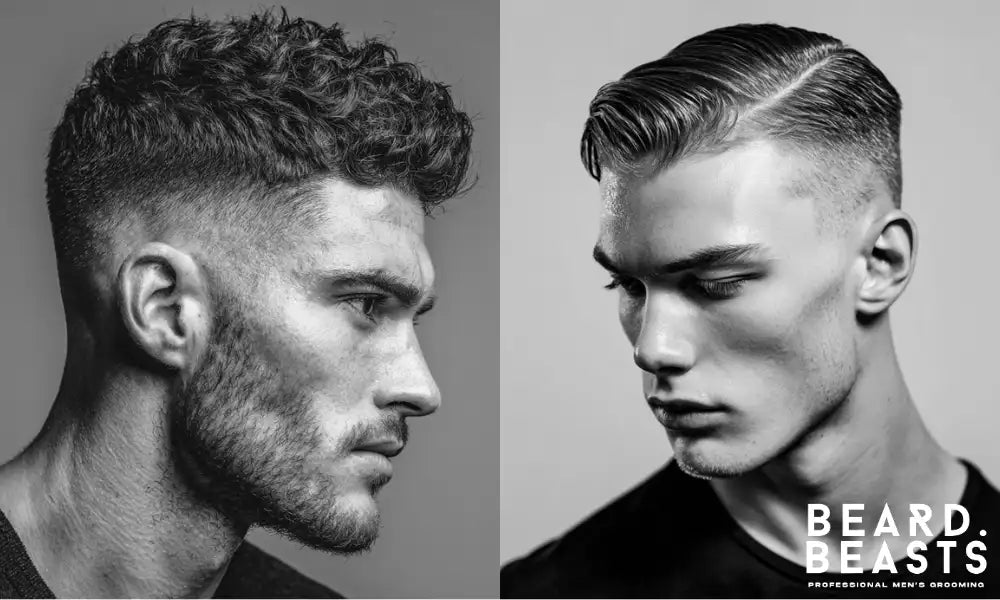
Hair clay vs hair gel comes down to finish. Clay gives a drier hold with grip and breakup. Gel gives shine, structure and a harder set.
I’m not anti-gel. I still reach for it when the cut asks for it. But hair clay is where I start with the majority of men now, because it handles textured crops, messy quiffs, short styles with length on top, and medium hair that needs hold without looking stiff. Gel isn’t dead. It just shouldn’t be the automatic choice anymore.

In this article
Most Men Are Still Choosing Product Like It’s 2008
A lot of men learned styling through hair gel, and it’s hard to blame them. It was simple: put it in, push the hair where you wanted it, let it set. For the cuts that were everywhere at the time, shiny spikes, stiff fronts, hard side parts, it worked.
The haircuts have moved on. The products haven’t.
A textured crop doesn’t want the same finish as a slick back. A loose quiff doesn’t want shine. A short, broken-up haircut doesn’t benefit from being flattened into place. When a man has one of those haircuts, clay is usually the first product I’m reaching for. I want the hair to keep some life in it, not get sealed into one shiny block.
This is where I think a lot of men blame the wrong thing. They say product doesn’t work for them, when actually the product is fighting the haircut. Swap it and the same haircut can look completely different.
Gel Locks Things Down. Clay Gives You Something to Play With.
Gel commits. Clay collaborates.
Gel spreads easily, sits wetter in the hair, and usually dries into a firmer hold. When the style needs to stay fixed, that’s exactly the job: slick backs, sharper side parts, spikes, formal styles where shine and structure are part of the look.
Clay feels different the moment you warm it between your hands. It’s thicker, drier, and works through the hair rather than sitting over it like a glossy layer. I can break the top up, build height, push it back, adjust it an hour later, and the hair still looks natural the whole time. Gel doesn’t give you that. Once it dries, the style is committed, which is useful sometimes but leaves you less room as the day moves.
Then there’s the finish. Shine draws attention to every strand and every gap. Matte reads fuller. That’s why I’m careful putting gel on fine or thinning hair: the shine highlights the weaker areas, especially when the hair separates into glossy sections. Clay won’t fix thinning, but the drier finish is far kinder.
Why Clay Suits More of the Cuts I’m Actually Doing
The haircuts coming through my door almost all need movement on top. Textured crops, messy quiffs, short choppy cuts, fades with length above, medium styles where the whole point is looking like you haven’t tried too hard. Clay helps with every one. Gel tends to make the same cuts look sealed and stiff.
When finishing a textured crop, you want the top to separate slightly. Not the fringe pressed flat. When styling a quiff, you want height through the front and enough hold to keep it up. Not every strand glued into a block.
often does better with clay because it stops the top turning into one solid block. I see this a lot with thick crops. The wrong product packs the hair together. Clay gives it grit and separation without making the finish look forced.
Fine hair is the opposite problem. Gel’s shine makes the scalp more visible than anyone wants. A small amount of clay lifts the hair without dragging it down, which on fine hair is usually the difference between looking flat and looking like you’ve got something to work with.
Straight hair shows product mistakes fast, so I lean hair clay almost every time there as well. Too much gloss, uneven application, product loaded at the front: straight hair puts all of it on display. Clay sits more naturally because it holds without announcing itself.
Gel Still Earns Its Place
Gel does get dismissed too quickly and I don’t think that’s fair.
When I’m doing a slick back that needs to last all day, clay often isn’t enough. When the cut calls for a sharper side part with real shine, gel handles it better. When the hair is thick, strong and needs a firmer grip than clay can offer, gel is the right tool. I’m not going to force clay into a job gel does better just because clay happens to be trendier.
The problem was never gel. It was gel on the wrong hairstyles.
A textured fringe doesn’t need pressing flat. A loose crop doesn’t benefit from shine. A choppy top shouldn’t be turned into a rigid shell. When gel does that to a modern cut, the haircut ages ten years overnight. But on the styles it was built for, gel still looks strong.
The Product Isn’t Failing. The Match Is Wrong.
Bad styling almost always traces back to a mismatch.
I see it constantly. A guy gets a textured crop and keeps using the gel he’s always used, then can’t figure out why the top looks flat and lifeless. Another man wants a slick back, buys clay because he read that clay is better, then fights his hair every morning because the hold isn’t there and the finish looks dry. In both cases the product is doing exactly what it was built to do. It’s just doing it on the wrong haircut.
I’d swap the product before I blamed the cut, every time.
If the cut needs height, separation and a natural finish, clay fits. If it needs shine, firmness and a harder set, gel fits. Judge the haircut first and the product follows. Simple as that.
Amount trips men up just as often. I’ve lost count of how many times I’ve watched someone load a palm full of clay into short hair and wonder why it feels heavy and dull, or dump gel through the front first and end up with a crunchy strip across the forehead while the back does nothing. Less product, applied properly, fixes more bad styling than any brand swap.
Warm clay in your hands before it touches the hair, spread gel evenly before trying to set anything, and work through the whole head rather than loading the front and hoping.
The Beard Beasts Verdict
Clay is where I’d start. It handles the cuts that are actually popular now, holds without turning the hair into a construction project, and leaves the finish looking natural.
Gel earns its place on slick backs, structured side parts, wet-look styles, and anything that genuinely needs a harder set. Pick it because the cut asks for it, not because it’s what you’ve always grabbed off the shelf.
The men who look best tend to have one thing in common: the product matches the haircut. Get that pairing right and even a basic routine looks sharp. Get it wrong and the best product in the world won’t save it.
Hair Clay vs Hair Gel FAQs
Is clay better than gel for hair?
For most modern men’s haircuts, yes. Clay gives a more natural finish with texture, control and movement. Gel is the better pick when you want shine, firmness and a style that stays fixed.
What are the disadvantages of hair clay?
It can feel heavy if you overdo it, thicker formulas tug during application, and some clays need a proper shampoo to wash out fully.
Is hair clay good for your hair?
It’s fine for most men when used properly. Problems usually come from using too much, washing badly, or pulling too hard during application.
Can I use hair clay every day?
Yes, as long as you wash your hair properly and don’t layer fresh product over old buildup. Start small. Most men need far less than they think.
Why do fewer men use hair gel now?
Because the haircuts have changed. Most current cuts suit matte texture better than shine and stiffness. Gel still works, but fewer men need that hard, glossy finish every day.
Is hair clay good for thin hair?
It can work well, since a matte finish usually reads fuller than a shiny one. Use a lighter clay and don’t overload the hair.
Does hair clay cause thinning?
No. Male pattern hair loss is driven by genetics, hormones and health factors. Problems from clay are more likely to come from pulling too hard during application or letting buildup sit too long without washing.
Which lasts longer, clay or gel?
Gel usually lasts longer if you mean a hard, locked-in hold. Clay holds differently: it gives control but stays flexible, so the style moves with you rather than setting rigid.