
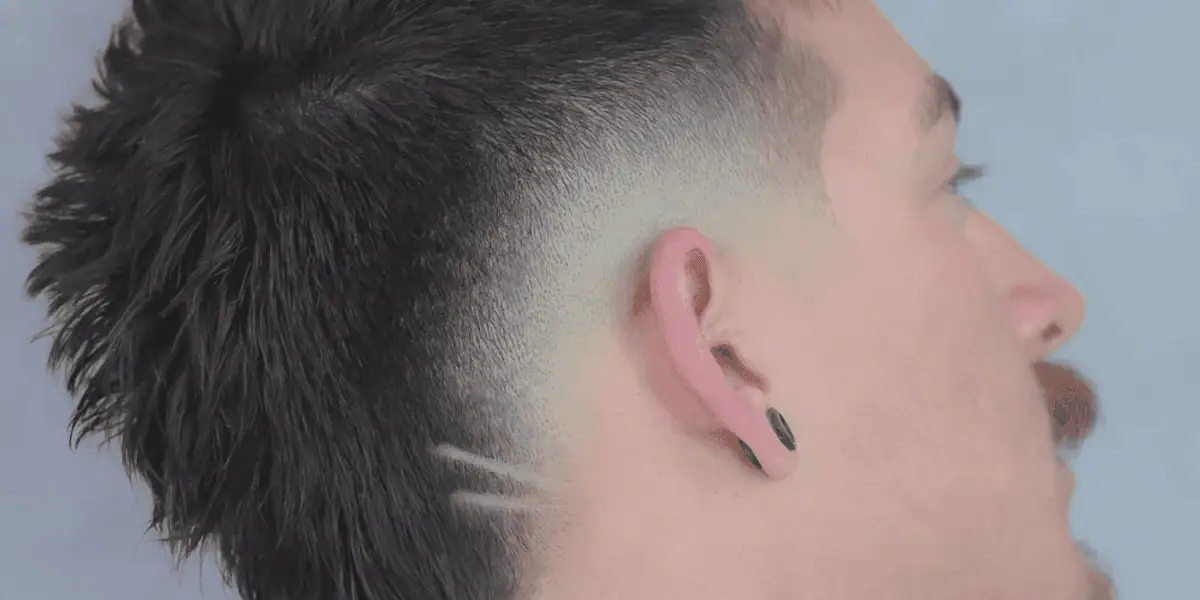
The mohawk fade is one of those cuts where the concept is simple and the execution is harder than it looks. A strip of hair down the centre, faded sides. That’s it. The problem is that “a strip” covers everything from a razor-thin line that looks like a mistake to a wide, heavy block that looks like a helmet with the sides removed.
Getting the width of that strip right is the whole cut.

In this article
Mohawk Fade Haircuts That Actually Work
Fifteen versions below. A few are actually low maintenance. More of them aren’t.
Afro Mohawk Fade

Natural afro texture gives the centre real volume without product, making this one of the few mohawk versions that holds its shape through the day on its own. The fade needs to be taken tighter than you’d think. I’d go skin or near-skin on the sides regardless of how low-key you want the overall look, because the natural expansion of afro hair will soften the contrast faster than any other hair type.
A mid fade that looks sharp on straight hair looks blurry on this one within a week.
Bald Mohawk Fade

Sides to skin, centre left full. Maximum contrast, most demanding upkeep. The skin fade shows regrowth within ten days, and I’d only choose this if a biweekly touch-up is actually built into the plan rather than aspirationally intended.
Curly Mohawk Fade

Curl gives the centre volume and texture that straight hair has to manufacture with product, which gives curly hair a real advantage on this cut.
The problem, and it’s a real one, is width. Curly hair expands outward as it dries, and the expansion is unpredictable depending on the curl pattern. Two inches on paper can look like three on the head, sometimes more. I’ve seen men come back after a curly mohawk looking like they’d asked for something twice as wide as they intended, not because the barber measured wrong but because neither of them checked the width after the hair dried.
I’d keep it to no more than two inches on tight curl patterns and specifically ask the barber to dry-check before calling it finished.
Straight Hair Mohawk Fade

This is the hair type that needs the most from the cut itself. Without natural texture the centre lies flat unless product is used, and the product choice matters more here than on any other version. Matte paste or hair clay gives height and separation. Wax or pomade makes it look like a greasy ridge.
The centre also needs internal texturising during the cut so it has something to push against when you style it upward. I’d ask for point-cutting through the centre specifically. A blunt, even length on straight hair just collapses by midday regardless of what’s in it.
Buzz Cut Mohawk Fade

The least interesting version on this list. Buzzed all over, shape visible, nothing to style. Fine if you want the shape without the effort, but calling it a mohawk is generous.
Short Mohawk Fade

Under an inch on top. Where most men should start before going longer.
Medium Mohawk Fade

Between one and two and a half inches on top. Enough length for real movement and direction, not so much that it requires serious product every morning to stay upright. Most face shapes work here, which is more than can be said for the longer versions.
I’d argue the medium mohawk is the version that looks the most intentional relative to how much effort it takes. The longer versions demand more from you every morning than most men anticipate when they ask for them. If you’re unsure how committed you actually are to this cut, start here and you’ll find out quickly enough.
Long Mohawk Fade

Past two and a half inches. Committed look, committed routine. Long centres need strong hold applied to dry or nearly dry hair, worked section by section rather than all at once. Applied to damp hair the product gets diluted and the centre falls within an hour regardless of what you used.
Mohawk Fade with Beard

A beard anchors the visual height of the centre. Without one, a tall mohawk on a longer face can look like everything is racing upward. With a full beard there are two strong horizontal lines, the fade and the beard cheek line, containing the height rather than letting it run unchecked.
I’d keep the cheek line tight here. A soft, undefined cheek line against a sharp skin fade just draws attention to the fact that one of them got the care the other didn’t.
Messy Mohawk Fade

Centre left loose and textured, not spiked or structured. Salt spray on damp hair, air dry, done.
I know this gets dismissed as the lazy version, and it is the lazy version, but I’d put it ahead of the structured mohawk for most men in most situations. The structured version requires you to be precise every single morning, and the second you’re not, it looks like a mohawk that’s given up on itself.
The messy version looks almost identical on a day you put effort in and on a day you didn’t. That’s not a downside. That’s the whole point.
Mohawk Mullet Fade

The centre runs from the front all the way to the nape with real length left behind the crown rather than tapering down to nothing. The shape from behind is completely different from a standard mohawk, which is the bit most men don’t think about until after they’ve got it.
I like this cut more than most people do. It has an energy that the standard mohawk doesn’t, and the length at the back gives it somewhere to go on days when the front isn’t looking its best. The downside is that you’re essentially committed to two styling zones, the front which you can see and the back which you largely can’t, and they can fall out of sync with each other faster than you’d think.
Low Fade Mohawk

The fade starts just above the ear rather than at the temple. More conservative contrast, slower to show regrowth, better for most environments. Because more hair is visible on the sides before the fade kicks in, the centre looks wider than it actually measures. I’d factor that in before choosing a centre width. If you’re already on the wider side, a low fade will push it further than you intended.
High Fade Mohawk

Fade starts at or near the temple. The centre appears narrower than it actually is because so much hair on the sides has been removed, which is useful on thicker hair where the natural volume makes the centre look wider than intended. Less useful on fine hair where you want every millimetre of width you can get.
Expect to be back for a touch-up within two weeks if you want it to stay sharp.
Taper Fade Mohawk

Less contrast than a hard fade, more forgiveness between appointments. I’d suggest this as the starting point for anyone trying a mohawk fade for the first time, partly because it’s easier to maintain and partly because you can always go harder on the next visit once you know the shape suits you.
On some head shapes the taper actually gives the mohawk more presence than a high fade, because the retained hair on the sides provides a longer visual platform before reaching the centre.
Mohawk Fade With Design

A line or geometric pattern shaved into the faded section. Looks sharp fresh, looks like a mistake once it grows out, which happens within two weeks. Only for men who are actually committed to the schedule, not men who think they will be.
The Strip Width Is the Whole Decision
On a traditional mohawk the sides are shaved and the contrast is absolute. A mohawk fade is different. The sides taper gradually rather than disappearing entirely, which means the strip doesn’t have to work as hard on its own to create the shape.
The right width depends entirely on the hair type, the fade height, and how bold you want the result. There’s no universal number because the same measured width looks completely different depending on hair texture, volume, and how high the fade starts. Thicker or curlier hair looks wider once it dries than it measured before styling. Fine flat hair needs more width to register at all. The dry result is always the one that matters.
There’s also a taper from front to back that almost no guide mentions. A centre that stays exactly the same width from hairline to crown looks rigid. A slight narrowing toward the crown gives it a more natural shape without changing how the front looks.
The fade height should match the visual result. A strip that looks narrow with a high skin fade loses the shape entirely. A mid or low fade gives a narrower-looking strip enough context to register as a mohawk rather than just longer hair on top. Save the skin fade for wider, more voluminous strips where the contrast amplifies something worth amplifying.
One More Thing: The Back
I nearly forgot to mention this, which is exactly the problem.
The area from the crown down to the neckline gets ignored in most mohawk conversations because it’s the part you can’t see yourself. Either the fade continues all the way around and the cut has the same sharpness from every angle, or the centre strip runs down the back as well, creating a continuous line from front to nape. Both work. What doesn’t work is letting the barber decide without any input, because then it becomes an afterthought.
The neckline is worth specifying too. A squared neckline looks harder. A tapered one looks softer and usually suits a mohawk fade better, since the cut is already angular and a squared neckline at the back can make it look like two separate haircuts stacked on top of each other.
The Beard Beasts Verdict
Get the width right, match the fade height to it, and make sure the back is part of the conversation before you leave.
Most mohawk fades that fall flat do so because the width was never really decided, just defaulted to whatever the barber felt like doing. That’s the part worth being specific about. Everything else follows from it.