
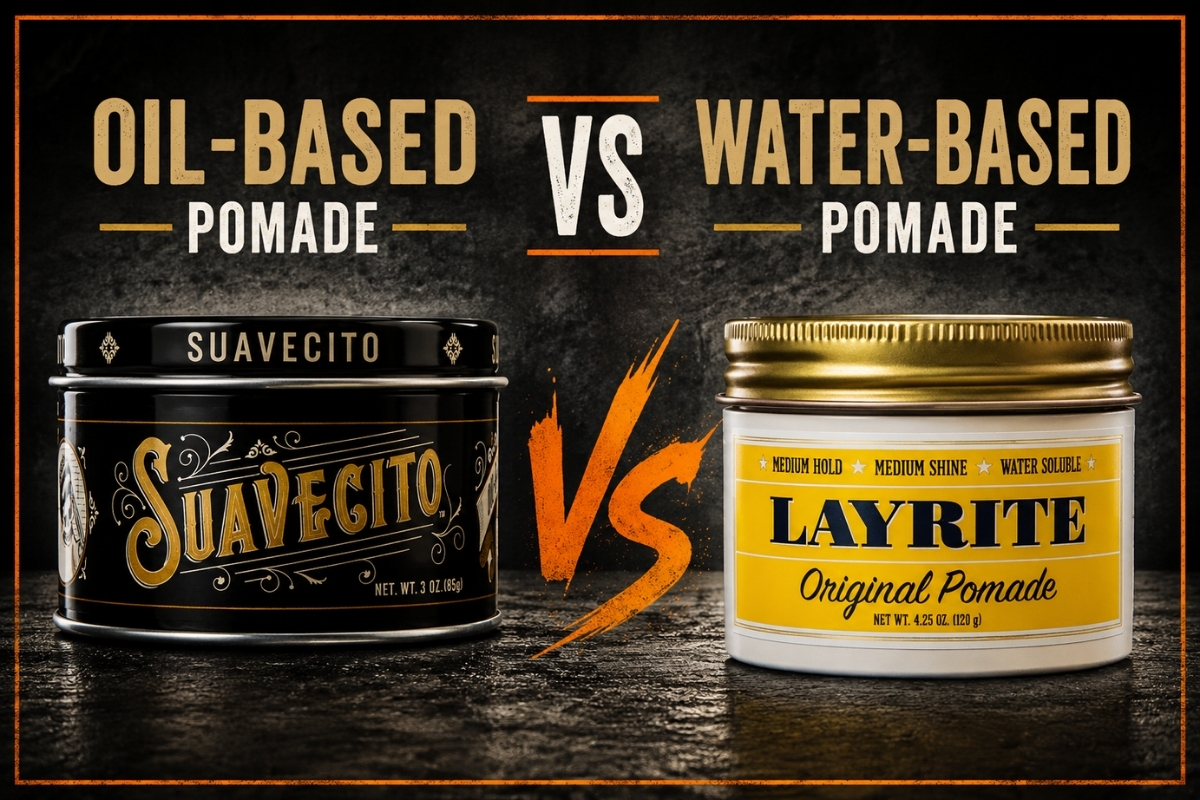
If you’re comparing oil based vs water based pomade, the choice can seem simple from the jar. Two products can make similar promises and still feel very different once they are in your hair.
That’s why I wouldn’t choose based on hold claims or assume the more traditional option must be better. Neither is enough to make the decision for you.
The problem is that those category names leave quite a lot out. Once you know what actually matters, the choice gets much easier.

In this article
The Difference Matters More After You Style Than While You Apply It
Oil-based and water-based pomades can both give you plenty of hold and control. The real difference becomes clearer after you’ve finished styling.

Traditional oil-based pomade tends to stay pliable, while water-based pomade is generally easier to wash out. But neither label tells you exactly how the product will feel in your hair several hours later.
That is why I would think beyond the first few minutes in front of the mirror. Do you want the hair to stay softer and easier to work with, or would you rather it feel more fixed in place? And how much effort are you willing to put into washing the product out?
Those differences matter more than simply seeing oil-based or water-based on the jar.
Oil-Based Pomade Only Makes Sense If You Actually Want What Comes With It
The part that puts some people off oil-based pomade is getting it back out. It usually takes more effort to wash out completely, and some product can stay in your hair between washes.
That is not necessarily a bad thing. If you like working with some product already in your hair the next morning, buildup can be part of the appeal. If you want to wash everything out and start fresh each day, oil-based probably is not for you.
Suavecito Oil Based Pomade is a good example of the traditional approach. It stays pliable and gives you that old-school pomade feel, but you need to be comfortable with the extra effort when it comes to washing it out. I would choose it because you specifically want that experience, not because oil-based sounds stronger or better.
Not Every Water-Based Pomade Behaves Like Hair Gel
Water-based pomade often gets lumped together as if it all behaves the same. It doesn’t. Some formulas dry firmer and keep the hair more fixed in place, while others stay workable enough to comb your hair back into shape later.
So if you’ve used a water-based pomade that dried hard, don’t assume they all will. Water-based usually points toward easier washout, but it tells you much less about how the product will feel once it dries.
Layrite Original Pomade is a good example of the other side of the category. It is water-based but designed to give you a flexible hold, so it makes more sense if you want to be able to fix your hair later rather than leave it completely locked in place.
Don’t Choose Pomade by Hold Strength Alone
“Strong hold” sounds useful on a jar, but there’s no universal scale behind it. One brand’s strong hold can feel very different from another’s, so comparing the words on two jars only gets you so far.

The same goes for medium and heavy. Those terms are more useful for comparing products from the same brand than comparing two completely different pomades.
What matters more is the type of hold you want. Do you want your hair kept firmly in place, or do you want to be able to comb it back into shape later if it moves? That matters more than any hold number printed on the front.
When you compare oil-based and water-based pomades, I wouldn’t let the hold rating be the deciding factor. Decide how you want the hair to behave first.
If You’re Unsure, Start With Water-Based
If you’re new to pomade and still figuring out what you like, I’d start with water-based.
It’s easier to change your mind. Use too much, dislike the finish or realize the hold is wrong for your hair, and you can generally wash it out more easily and try something different next time.
That makes water-based a good place to work out what matters to you. You might discover that easy washout is a priority, or that you want something softer and easier to restyle. Either way, you’re learning what you like without taking on the harder cleanup of a traditional oil-based pomade.
Oil-based still has a place, but I’d move to it because you specifically want what it does differently. I wouldn’t start there just because it feels like the more traditional or serious choice.
A water-based option that makes sense if you want flexible hold without taking on the harder cleanup of a traditional oil-based pomade.
The better fit if you specifically want an oil-based pomade that stays pliable and gives you that old-school styling experience.
Verdict: Water-Based Is the Safer Starting Point
If you’re comparing oil based vs water based pomade and don’t already have a clear preference, I’d start with water-based. You still have plenty of choice in how firmly it holds your hair, without making washout more difficult than it needs to be.
Oil-based makes more sense when you specifically want that traditional, pliable pomade feel and don’t mind putting more effort into washing it out. If that sounds more like a drawback than a benefit, water-based is the better choice.