
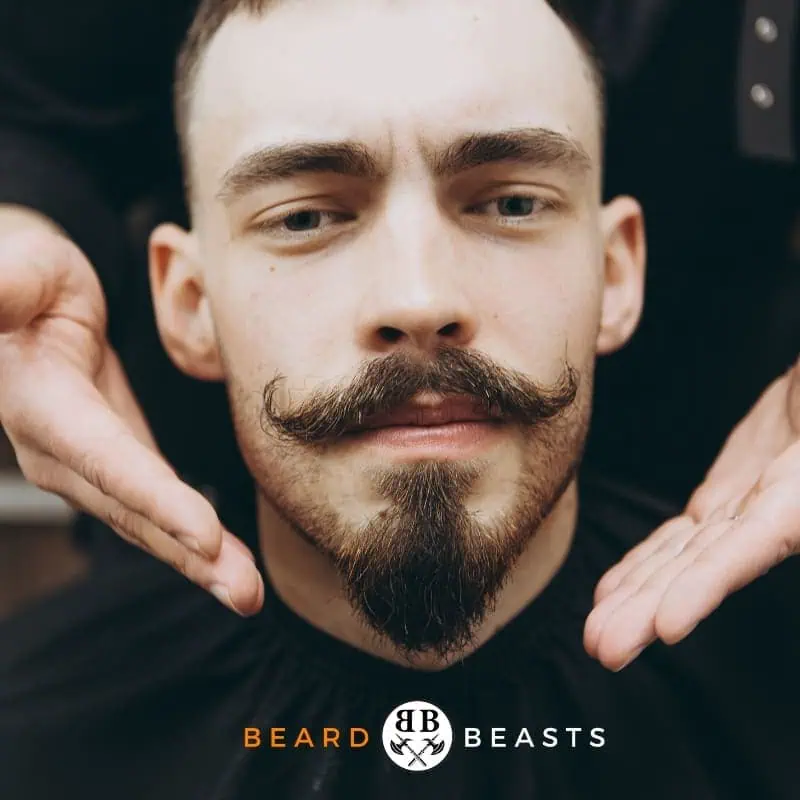
A mustache hides a lot of laziness. A goatee doesn’t. Once you isolate hair to just the chin, maybe the mustache too, every line you cut is visible, and every line you skip shows up just as fast. I’ve fixed more crooked jobs on this part of the face than on any other beard style that comes through my door, mostly because guys treat “goatee” like one thing instead of eleven different builds with eleven different rules.
What follows covers all eleven, what the mustache does to each one, and how wide the chin patch should actually run for your face. Not “find what works for you.” Real guard numbers, real timeframes, and the mistakes I watch guys make more than once.

In this article
Best Goatee Styles for Men
These are the eleven I get asked for most, starting with the one that survives a bad week and ending with the ones that don’t.
Classic Goatee
The mustache connects straight down into a small patch on the chin, and everything else on the lower face stays bare. Give it two to three weeks of growth before you judge the taper. Anything earlier and there just isn’t enough length to work with yet.
I trim the middle to somewhere between a 4 and a 6 guard, then drop the outer edges down to a 2 so the sides fade instead of stopping off a cliff. The mistake I see most: guys let the hair creep past the corners of the mouth. Once that happens, it stops being a shape and starts being a beard that gave up halfway through.
Petite Goatee
A small patch right at the point of the chin, roughly the width of your bottom lip and no wider. It suits rounder faces because it puts a single anchor point at the bottom instead of adding bulk to the sides.
On a wide jaw, it just disappears. I’ve had guys ask me why theirs “doesn’t show up” in photos, and it’s always the same answer: the jaw is wide enough that a patch this small can’t compete with it.
Full Goatee
The mustache and chin patch join through two thin strips running down from the corners of the mouth, with the cheeks left bare. This is what most guys picture when someone says “goatee” without qualifying it, and it’s also the highest upkeep of anything on this list. Those connector strips need a trimmer pass every four to five days. Skip a week and they thicken into stubble that blurs straight into the cheek. I tell guys this before they commit: if you’re not touching it up twice a week, pick something else, because a neglected Full Goatee just turns into patchy cheeks.
Extended Goatee
Chin hair that runs along the jaw toward the ears but stops well short of full coverage, with the cheek above still shaved. It suits a jaw that’s stronger than the chin, since the extra width along the bottom gives the lower face more structure without tipping into a full beard.
I run the guard at a 4 along the jaw and fade it down to bare skin over about a quarter inch near the ear. Rush that fade and it looks stapled on instead of blended. That’s the exact spot where this one falls apart, on almost every guy who walks in wanting it.
Pointed Goatee
Same base as the classic, but the chin hair gets combed and trimmed down to a point, sometimes with wax to hold it. You need at least an inch of growth before there’s anything worth tapering.
Use a firm-hold mustache wax here, not beard balm. Balm is too soft to hold a point through a full workday. I learned that one from a client who came back three times convinced his goatee wouldn’t hold its shape, before we swapped the product instead of the technique.
Long Goatee
Anything past an inch and a half at the chin. This needs daily oil, no exceptions, or the ends split and go wiry instead of staying full. I get the same walk-in for this length over and over: six months of growth, half of it needs to come off, not because the length is wrong but because none of it was ever conditioned.
Goatee with Soul Patch
A small square or oval patch under the lower lip, kept separate from the main chin patch by a shaved gap of two to three millimeters. Go wider than that and you’ve got two different beards, not one style. They just happen to share a face. I don’t push this one on guys who already struggle to keep their main line straight. Now there’s a second line to maintain instead of one.
Van Dyke Beard
The mustache disconnects completely from the chin beard, with a shaved strip running from the corner of the mouth down to the jaw. This is the style I see butchered most often, because that disconnect line has to be exact. Off by even a couple of millimeters and it stops looking like a choice. It starts looking like a shaving accident instead.
Anchor Beard
Chin hair shaped to a point at the bottom, with thin lines running up the jaw toward the sideburns and into a trimmed mustache. This one needs the straightest lines on the list, and I finish the jaw with a straight razor rather than a guard, since a guard can’t hold a line that fine. It’s only worth starting if you’re willing to book a touch-up every three to four weeks. Leave it any longer and those lines soften into fuzz.
Balbo Beard
The mustache floats above the chin beard with a visible gap between them, no connection to the sideburns at all, cheeks fully bare. It’s named for Italo Balbo, an Italian aviator, though nobody who’s asked me for one has ever brought that up.
What I like about the Balbo is that it hides a weak chin better than almost anything else here, because the shape below the mouth is entirely up to the trimmer, not the bone underneath it.
Goatee with Stubble
The goatee outline trimmed a touch longer than the stubble on the cheeks, usually a 3 to 4 millimeter difference in guard length between the two zones. The softest transition on this list. It’s the one I recommend most to guys who travel a lot for work, since a missed week on the road doesn’t wreck it the way it would wreck a Full Goatee.
A Goatee Needs a Clear Center, Not Random Chin Hair
Before you touch width, find the center. I use the philtrum, that little groove under your nose, as the vertical guide, never what looks symmetrical in a mirror. Mirrors flip your face, and guys who eyeball symmetry off the reflection end up with something crooked in real life and straight only in the glass. I check that line before the trimmer ever touches skin, every time, because fixing a lopsided goatee later costs you more length than getting the center right from the start.
Once that center is fixed, everything else, width, taper, connector strips, gets measured off that line instead of guessed at from scratch every time you trim.
The Mustache Changes the Whole Style
Connect the mustache to the chin patch and the whole face holds together as one piece. Disconnect it, even by a few millimeters, and the face changes completely. A connected mustache pulls the eye down and stretches the jaw. A disconnected one, like on a Van Dyke or Balbo, splits the face into separate zones and tends to add angles to a round face.
Thickness matters just as much as connection. A thin mustache over a full chin patch looks unfinished, like you ran out of time halfway through. Match the density, not just the outline. I’ve also seen guys keep the mustache long while trimming the chin patch short on a Van Dyke, and it never works. Match the length between the two pieces too, or the whole thing ends up belonging to two different guys.
Face Shape Decides How Wide the Goatee Should Be
The common advice that any face shape can carry a goatee is true, and also not very useful. Width decides whether it works. Not the general category your face falls into. I measure the patch against the widest point of the jaw before I pick up a trimmer. Under a third of that width, and it looks like stubble that got missed, not a chosen style, on anything but a narrow face.
Round faces need a narrower patch that tapers to a point, since extra width just adds more roundness. Long faces can carry something fuller, since it breaks up the length instead of adding to it. Square jaws do well with an anchor or extended build that follows the jawline instead of fighting it.
The Cheeks Need to Stay Out or Join Properly
Half-committed cheeks are the fastest way to ruin a goatee. Either shave them bare, or let them join the beard on purpose with even stubble, like the style above. What doesn’t work is a five o’clock shadow drifting up the cheek on its own schedule while the chin patch stays sharp. That combination comes across as neglect, not style, no matter how good the chin line is. I turn away plenty of guys who want a hard cheek line but haven’t shaved in four days, because the stubble underneath undoes that line by the same afternoon.
The Beard Beasts Verdict
If I had to send one guy home with a single style, it would be the classic goatee with a connected mustache. It’s the most forgiving build here, the easiest to maintain on a normal schedule, and it suits more face shapes than anything else on this list.
But forgiving isn’t the same as best for everyone. If your chin doesn’t project much on its own, don’t force the petite goatee just because it takes the least work. Go extended or anchor instead, and let the added width do what your chin isn’t doing. If you’ve got the patience for straight-razor upkeep, the anchor beard looks better than almost anything else in this guide, on the right face. Pick based on your actual bone structure, not on whichever style showed up first on your search.
Men’s goatee styles are one of the cleanest, boldest moves in men’s facial hair—and they’ve been making guys look sharper for decades.
A good goatee can carve out your jawline, add character, and give you that edge between clean-cut and rugged. It’s not a full beard, and it’s not baby-faced—it’s confident, controlled, and customizable.
Whether you’re after something low-maintenance or a style that turns heads, there’s a goatee look out there that fits your face, your vibe, and your lifestyle.
Let’s break down the goatee beard styles that actually work—and how to wear them without looking like you got halfway through shaving and changed your mind.
Best Men’s Goatee Styles
Not all goatee beards are created equal. Some are subtle. Some are sharp. And some look like you know exactly what you’re doing. Here’s a breakdown of the most popular types of goatees—and why they work.
Full Goatee
The classic. Clean, balanced, and straight to the point.

The full goatee wraps around your mouth—connecting the mustache and chin beard into one sharp circle. It’s the most recognizable goatee beard for a reason: it works on nearly every face shape and gives you that strong, centered look without going full beard. You can keep it tight and trimmed or let it grow in a bit for a more rugged vibe.
Why it works:
- Great for guys who want structure without the bulk
- Easy to maintain once shaped properly
- One of the most versatile goatee styles for men, period
Van Dyke
Detached. Defined. A little rebellious in the best way.

The Van Dyke separates the mustache from the goatee, giving your face two distinct focal points. It’s bold without being bulky—and it works best when both pieces are sharply groomed. This goatee beard brings an artsy edge, ideal for guys who like to stand out without going overboard.
Why it works:
- Elongates the face and sharpens your look
- Great for thinner jawlines or softer features
- One of the most eye-catching men’s goatee beard styles
Anchor Goatee
Sharp jawline? This one’s your wingman.

The anchor goatee draws a line from your chin up toward each corner of the mouth—paired with a clean pencil mustache. It literally outlines your jaw and chin, creating the shape of a ship’s anchor. Sleek, stylish, and full of personality, this is one of those types of goatees that commands attention without shouting.
Why it works:
- Defines your lower face in a bold way
- Best for oval and square face shapes
- Looks great clean-shaven around the edges
Balbo Goatee
Bold, sculpted, and unapologetically masculine.

The Balbo beard features a floating mustache and a separate chin beard that flares out a bit wider at the jaw. Think of it as a more filled-out version of the anchor.
It’s a little more maintenance, but when done right, it gives off serious confidence. A great option for guys who want facial hair that makes a statement.
Why it works:
- Adds width to longer faces
- Great for guys who can grow thick facial hair
- A goatee beard style that looks both modern and commanding
Circle Goatee
Simple, clean, and corporate-approved.

Image Via Pinterest
The circle beard connects your mustache and chin hair in a rounded shape, giving you a neat, symmetrical look. It’s like the full goatee’s polished cousin—less rugged, more refined. This is the goatee style for men who want facial hair that’s subtle but still says, “I put effort into this.”
Why it works:
- Easy to maintain with regular trims
- Great for square or round faces that need balance
- A goatee beard that works in both casual and professional settings
Petite Goatee
Low effort. High impact.
The petite goatee is a small patch of hair on the chin—no mustache, no fluff. Just enough to add structure and edge to your face. This is one of the goatee styles for men who want a minimalist look with just a hint of character.
Why it works:
- Ideal for guys with finer facial hair
- Pairs well with shorter hairstyles or clean fades
- Keeps the jawline in play without overpowering your features
Disconnected Goatee
Clean cut, with just the right amount of chaos.

The disconnected goatee breaks the traditional loop by separating the mustache from the chin beard. It’s subtle, edgy, and modern—perfect if you’re after a look that’s just different enough to feel fresh.
Why it works:
- Works well on angular face shapes
- Easier to style than it looks
- One of the most laid-back goatee beard styles with real personality
Soul Patch Goatee
Small patch, big attitude.

Image Via Pinterest
The soul patch goatee is all about the detail—a small tuft of hair just below the bottom lip. It’s one of those goatee beard styles that doesn’t try too hard but still brings some personality. Add a mustache or keep it solo—it works either way if you’ve got the confidence to pull it off.
Why it works:
- Great for creative or laid-back personalities
- Adds contrast without full commitment
- A classic move that still turns heads when styled right
Stubble Goatee
Effortless. Masculine. Always in style.

The stubble goatee is what you get when you let your facial hair grow just enough to give your chin and mustache a rugged outline. It’s not polished—it’s intentional. This is the style for guys who want facial hair without looking like they care too much.
Why it works:
- Super low maintenance
- Enhances jawlines without the full beard bulk
- One of the most natural-looking goatee styles for men
No matter your vibe—clean and classic or bold and unconventional—there’s a goatee beard that fits the bill. The right one doesn’t just add facial hair. It adds edge, shape, and personality.
Goatee Styles by Face Shape
The best goatee style isn’t just about what looks cool—it’s about what looks right on your face. Let’s break down which goatee beards work best with your face shape, so your facial hair does the heavy lifting.

Round Face
If you’ve got a round face, you want a goatee that adds length and angles. Skip wide styles that make your face look fuller—go for something that brings the eye downward.
Goatee styles that work:
- Van Dyke – adds definition and space between features
- Classic Goatee – elongates your face subtly
- Anchor Goatee – outlines the chin and draws the shape downward
These styles help slim things out and create structure where you need it.
Square Face
A square face is bold and defined, so the goal here is to balance those strong lines with curves or rounded shapes. Nothing too blocky.
Goatee beard styles that work:
- Circle Beard – smooths out harsh corners
- Full Goatee – adds control without more angles
- Petite Goatee – lightens things up while keeping focus on the chin
The right goatee can tone down the intensity and bring some calm to that chiseled look.
Oval Face
Oval faces are the most flexible when it comes to goatee beards. You’ve got natural symmetry and balance—so it’s more about picking a vibe than correcting shape.
Goatee styles that work:
- Full Goatee – brings focus without overwhelming
- Balbo Goatee – adds width and attitude
- Disconnected Goatee – keeps it stylish with a modern twist
When in doubt, try a few and see what feels the most you.
Long Face
If your face is on the longer side, you’ll want to avoid styles that exaggerate the vertical lines. Go wide, not low—horizontal detail is your friend.
Goatee styles that work:
- Balbo Goatee – breaks up face length with bold shape
- Anchor Goatee – keeps the attention across the jaw
- Circle Beard – adds fullness without dragging your face down
The trick here is balance. Keep the bottom trimmed and the sides full to square things out.
When you match the right goatee to your face shape, everything just clicks—your features look sharper, your jaw stands out, and your whole style levels up. It’s not about guessing—it’s about knowing what works and owning it.
How to Groom and Maintain Your Goatee
Trimming is just the start—grooming is everything that happens between trims. If you want your goatee to actually look good (and not just exist on your face), you need a routine that keeps it soft, shaped, and clean.

Here’s how to keep your goatee beard in top form—day after day.
Wash It (But Don’t Overdo It)
Use a beard wash, not your shampoo. Regular soap strips your natural oils and dries everything out. Wash your goatee 2–3 times a week, or more if you’re sweating, eating messy, or living in a dusty city. And make sure you rinse well—leftover product buildup is a fast track to dull, greasy beard hair.
Keep It Conditioned
Beard oil or balm is non-negotiable. It keeps your hair soft, stops it from looking wiry, and hydrates the skin underneath (so you’re not itching your chin all day). Use beard oil daily—just a few drops go a long way. If your goatee is coarse or grays are popping up, a richer balm adds softness and control.
Comb It Into Shape
Yes, even short goatees. A quick once-over with a fine-tooth beard comb helps train the hair, spot strays, and evenly spread oils. It also makes your goatee look more intentional—even when it’s casual. If your goatee grows in different directions, daily combing helps keep the lines cleaner over time.
Trim Strays Between Sessions
A clean edge goes further than you think. Grab scissors or a detail trimmer every few days to snip rogue hairs and tighten the outline. Focus on the sides and corners where things tend to grow uneven or stick out. You don’t need a full shape-up—just enough to keep it crisp.
Take Care of the Skin Too
Dry, flaky skin ruins the whole look. Use a beard oil daily to keep the skin under your goatee healthy and flake-free. Don’t forget to exfoliate once a week—this clears out dead skin, helps prevent ingrown hairs, and boosts growth.
Watch What You Eat (Literally)
Crumbs and oils love your beard. Rinse with water after messy meals, or keep a travel comb in your pocket if you’re serious about looking dialed-in all day. If you wear your goatee longer, wiping down the chin with a damp cloth keeps food and grease from hanging around longer than they should.
Beard Beasts Top Tip: A well-groomed goatee doesn’t take hours—it just takes consistency. Build the habits, and your facial hair will do the rest.
The difference between a goatee that looks intentional and one that looks accidental? Daily care. Keep it clean, soft, and shaped—and it’ll always work in your favor.
Final Thoughts: Why Goatee Styles Still Hit Hard
Men’s goatee styles aren’t going anywhere—and for good reason. They’re versatile, easy to maintain, and sharp enough to stand on their own. Whether you’re going for something minimal or a full statement piece, the right goatee beard style can define your look without overpowering it.
You’ve now got the full playbook—from the best goatee beards for your face shape to grooming tips that actually work. Whether you lean clean, rugged, bold, or subtle, there’s a type of goatee that fits your face, your vibe, and your routine.
Try one. Tweak it. Own it.
This isn’t just about growing facial hair—it’s about showing up with confidence.