
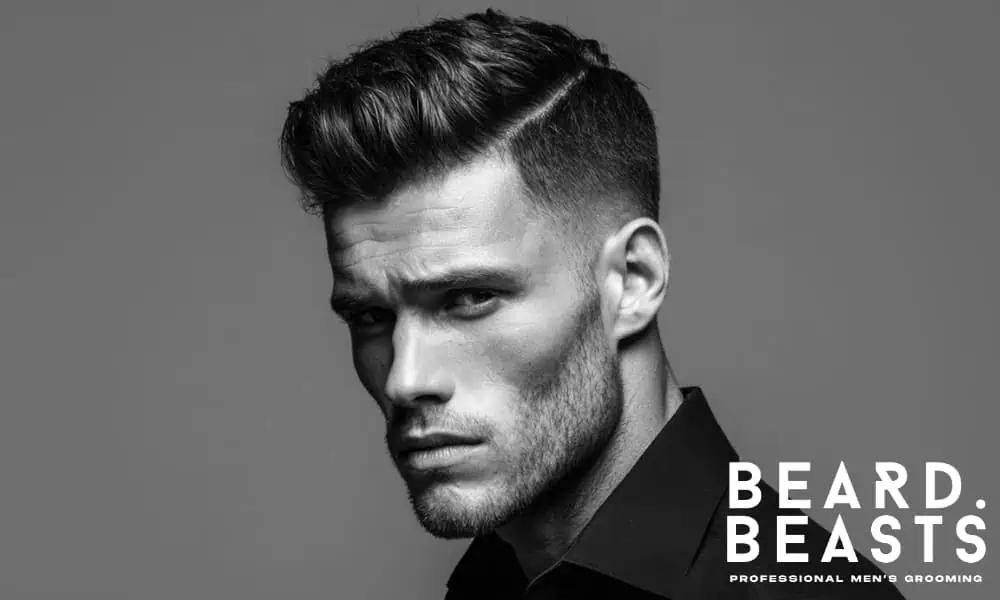
A quiff without a part just stands up. A quiff with a side part has somewhere to go, a direction the height at the front actually builds toward rather than just rising straight up off the head. That direction is the whole reason this combination works better than a standard quiff for a lot of men, and it’s also the part most guides skip past on their way to talking about product.
Get the part wrong and the quiff above it looks like it’s fighting itself, height going one way, part suggesting another.

In this article
Best Side Part Quiff Haircuts for Men
Eight versions below.
Classic Side Part Quiff

A defined part, hair swept up and back from it into height at the front, faded or tapered sides. I’d start here regardless of what you think you eventually want. It’s the one version that tells you exactly where your natural part falls and how much length you actually need for the quiff to hold, information every other entry on this list depends on getting right first.
Textured Side Part Quiff

Point-cut ends through the top rather than a blunt, uniform length. The texture is what stops this version from looking like a solid wall of hair rising off the part. Without it, the quiff can look stiff even with the right product, since a blunt-cut top has nothing for the product to actually separate.
Side Part Quiff with Low Fade

A low fade starting just above the ear, sides tapering gradually toward it. This is the lowest-maintenance version on this list, since a low fade grows out over four to five weeks without the sharp regrowth line a higher fade shows within two.
Side Part Quiff with High Fade

Fade starting near the temple, maximum contrast against the height on top. I’d only recommend this to men who are actually going to keep up the two-week touch-up schedule a high fade demands. On someone who can’t commit to that, the fade line blurs and the sides start looking grown-out well before the quiff itself needs any attention.
Slick Side Part Quiff

Height and part combined with a glossy, fully controlled finish rather than texture. Water-based pomade is the product for this one, not matte clay, for reasons covered in full further down. Get that choice wrong and this specific version suffers more than any other on this list.
Curly Side Part Quiff

Natural curl providing volume and lift at the front with minimal product needed to hold the height. The part itself needs more attention here than on straight hair, since curl tends to spring back toward its natural fall pattern rather than staying where it’s been directed, especially in humidity.
Disconnected Side Part Quiff

A hard, undercut-style separation between the long top and the very short or shaved sides, rather than a gradual fade or taper. The disconnection makes the part and the height above it look even more intentional by contrast, since there’s no gradual blend softening the transition anywhere on the head.
Side Part Quiff with Beard

Any version above paired with a beard. The two need to run on roughly the same maintenance schedule, since a sharp side part quiff that’s freshly cut every few weeks next to a beard that’s only trimmed every couple of months looks like two different grooming standards on one head, even when both individually look fine. I’d get the beard shaped whenever the hairline or fade gets touched up, not on a separate schedule of its own.
The Part Should Guide the Hair, Not Split the Head
A part isn’t just a line drawn where it looks convenient. It follows the direction your hair actually wants to fall, which comes down to how your hair grows out at the front hairline, not something a barber can override just by combing it a different way.
That’s why you probably already have a natural part somewhere near where your hair separates when it’s wet and combed straight back, whether you’ve ever thought about it or not. Ask for a part anywhere else and you’ll be fighting that pattern every single day, and it shows up as flyaways and a part that never lies quite flat no matter how much product goes in.
Tell the barber where your hair already wants to part rather than letting them pick a spot based on what looks even in the mirror. Work with your own pattern and the part holds itself. Fight it and you’re restyling it every morning.
The Quiff Needs Lift Without Turning Stiff
The lift in a quiff comes from the cut first and the product second, and most men get that order backwards.
A quiff cut with enough length at the front, generally an inch and a half to two inches, has natural leverage to stand up with a small amount of product. Too short and there’s nothing to lift, so you end up reaching for more product to compensate, which is exactly what turns a natural-looking quiff into a stiff, obviously styled one. Apply product to damp, not soaking, hair and work it in from the roots at the front rather than through the ends, then let it dry partially before checking the shape. Adding more product to a quiff that’s already falling rarely fixes it. It usually just adds weight on top of a problem that started with too little length underneath.
The Best Product Depends on the Finish You Want
Water-based pomade and matte clay produce noticeably different results here, and choosing between them isn’t just personal preference.
Pomade gives shine and a more polished, controlled hold, which is exactly why the slick side part quiff calls for it specifically. Matte clay gives texture, separation, and a more natural, undone finish, which suits the textured version far better. Using clay on a slick quiff leaves it looking flat and undefined instead of polished. Using pomade on a textured quiff can end up looking wet and heavy rather than casually lifted.
Pick based on the finish you actually want, not whichever product happens to be in the cabinet already. Going textured and grabbing a pomade, or going slick and grabbing clay, undoes the whole point of choosing that version in the first place.
The Sides Decide How Hard the Haircut Feels
The same top section and the same part can feel completely different depending on what’s happening at the sides. A low fade or taper keeps the whole look softer and more conservative. A high fade or a disconnected undercut makes the exact same top look sharper and more severe, even though nothing above the ears has changed.
Think about where you actually spend most of your week, not the one photo that made you want the cut in the first place. A high fade in a room full of suits can come across as trying a bit too hard. A low fade or a taper doesn’t have that problem.
The Beard Beasts Verdict
A side part quiff haircut works when the part follows your natural growth pattern instead of fighting it, the quiff gets its lift mainly from length and cut rather than product alone, and the product itself matches the finish you actually want, shine from pomade, texture from clay.
Start with the classic version and a low fade if you’re not sure where to begin. It’s forgiving on maintenance, forgiving on face shape, and it tells you within a few weeks whether you want to push toward more shine, more texture, or more contrast at the sides.