
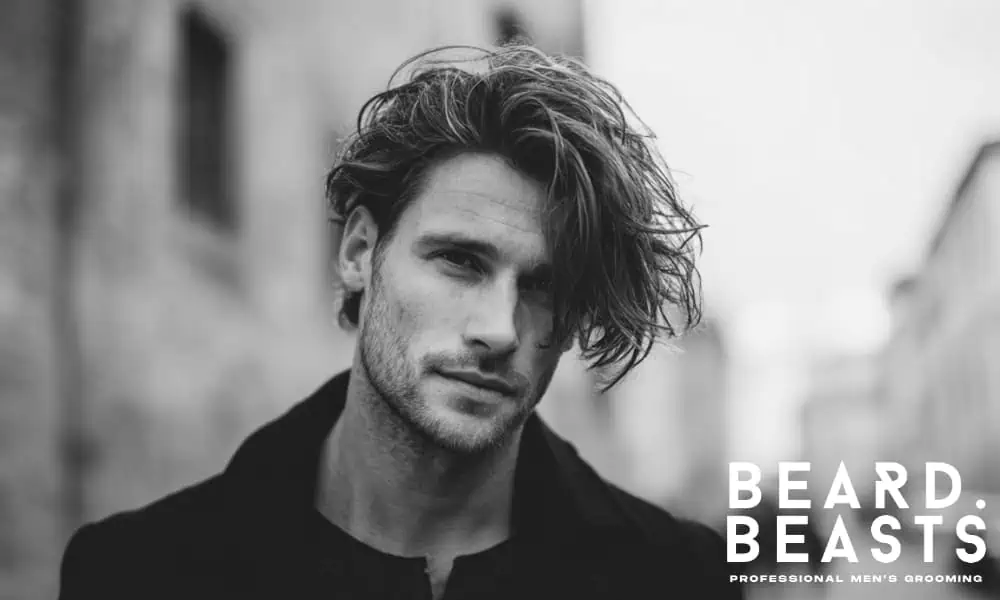
Flow is not what happens when you forget to book a haircut. It’s a specific quality in the way hair moves, and most men who think they have it don’t. The hair hangs heavy, bunches at the neck, loses all shape by midday, and does nothing the word flow implies.
Getting it right is mostly about patience and the right cut. Getting it wrong is mostly about doing nothing and hoping length solves everything.

In this article
The Best Men’s Flow Haircut Styles
Twenty-eight flow haircuts below. Some suit most men. Some suit very few. I’ve noted which is which.
Classic Flow

Hair that falls past the ears, moves as a unit, and looks intentional without product. The reference point for everything else on this list, and the version most men picture when they say they want a flow haircut.
Here’s the honest version: most hair can’t do this without help. You need four inches or more from the root, and you need either natural texture or enough body that the hair doesn’t just lie flat and heavy.
Straight, fine hair at this length often looks limp rather than flowing, and no amount of wanting it to be classic flow haircut changes that. The men who have it looking right either got lucky with their texture or found a barber who understood exactly how to layer it so the weight distributes properly.
It’s the goal. It’s not always the destination.
Bro Flow

Basically what most men are actually after when they say they want a flow haircut. Hair grown to shoulder-adjacent length, pushed back or tucked behind the ears, minimal styling, no real routine. It’s not trying to be anything precise.
The problem is that a bro flow on straight, fine hair just looks like someone who stopped booking haircuts. On wavy or naturally textured hair it looks intentional and relaxed. That gap is enormous, and which side you fall on is almost entirely down to your hair type. Worth knowing before you spend six months growing it.
Modern Flow Haircut

Same length as classic flow, same general movement, but shaped at the ends with layering and maintained with a matte product. The difference between this and the unstyled version is significant and most men underestimate it until they see it.
The layering is everything here. It keeps the ends light, stops the hair picking up that dense helmet element that longer unstyled hair develops, and creates movement in the right places rather than everywhere at once. I’d argue this is what most men should actually be aiming for rather than the pure grow-and-hope version. The completely unstyled route works for about one in ten hair types. The modern version works for most of them.
Messy Flow

Looser ends, more texture, intentionally undone. Salt spray on damp hair before it dries, or a low-hold clay worked through dry hair to break up smoothness.
The mistake almost everyone makes is thinking this happens by itself. Intentionally messy hair requires more product awareness than cleanly styled hair, not less. You’re controlling the texture without appearing to control anything, which is harder than it sounds. The men who pull off messy flow usually have a very specific two-product routine they do every morning. It just doesn’t look like it.
Slicked Back Flow

Hair going straight back from the hairline with a medium to high-hold product, the length adding real weight and movement at the back. Strong look on straight to wavy hair with enough density to hold the sweep. On fine hair it goes flat and thin rather than full and purposeful, and no amount of product rescues it.
Middle Part Flow Haircut

The hair parts down the centre and falls on either side. At flow length the symmetry lands well on the right face shape and looks slightly off on the wrong one.
Long and oval faces carry it well. Round or square faces often find that a centre part emphasises width in the wrong direction, and a side part handles those shapes considerably better. The middle part flow is having a strong moment right now, which means a lot of men are growing toward it regardless of whether their face shape suits it.
The ones it doesn’t suit tend to find out about eight months in, which is a frustrating way to learn that lesson.
Straight Flow Haircut

Thick, straight hair at flow length can look excellent. Fine, straight hair tends to hang rather than flow, and I’ve never found a product that fully fixes it. If you have straight fine hair and you’re chasing a flow haircut, get layers cut in before you reach full length, not after. They create the movement the hair won’t generate on its own.
Wavy Flow Haircut

Look, if you’ve got a natural wave and you’re asking about a flow haircut, half the work is already done. The wave pattern creates movement and texture on its own, the ends separate without product, and the whole thing looks effortless in a way that straight hair spends months trying to achieve and still doesn’t quite get there.
That said, wavy hair at flow length has one specific enemy: bulk. Let it get too heavy and the wave starts bunching, separating into clumps rather than flowing cleanly. The fix is regular trims to remove weight from the ends and through the mid-lengths, not length, just bulk. Get that right and a wavy flow haircut is one of the lowest-maintenance styles on this entire list.
The other thing worth knowing is how wavy hair changes at different lengths. Waves that look great at three inches can tighten, flatten, or separate differently at five inches. Most men assume their wave will behave the same way as it gets longer. Sometimes it does. Sometimes you’re three months in and the texture is completely different from what you expected. Account for that before you commit.
Curly Flow Haircut

Tight curls at flow length create volume, not movement, which can look great or can look like the hair is fighting the style rather than working with it. Looser curls and defined waves are where the flow hairstyle actually works with curly hair.
The thing that kills a curly flow is dryness. Dry curls shrink, frizz, and lose all definition. Well-moisturised curls at this length can look extraordinary, and the difference between the two is dramatic enough that most men with curly hair who struggled with the style were fighting a moisture problem, not a cut problem.
Curl cream on damp hair before air drying is usually the right answer, and less manipulation while it dries is better than more.
Short Flow Haircut

A useful way to test whether your hair has the texture for a flow haircut before you commit to growing it. Two to three inches with some movement is enough to tell you whether you’re wasting the next six months.
Medium Length Flow Haircut

Three to siz inches is where most men spend the longest time and where most of them give up. The hair is too long to look like a conventional cut and too short to do anything useful. It bunches at the neck, sticks out at the sides, and basically looks bad from every angle.
Don’t quit here though. A light layer through the ends and a small amount of product pushed back helps it look less chaotic. The men who get through this stage to proper flow length are the ones who committed to looking slightly wrong for a while. Everyone else resets and starts over.
Long Flow Hairstyle

Past the shoulders is where most men find out whether they’re actually committed to the flow hairstyle or just liked the idea of it. The hair needs conditioning regularly, trims to stop split ends working their way up the shaft, and a product routine that takes more than thirty seconds. There’s no winging it at this length.
When it’s right it’s one of the most striking haircuts a man can have. When it’s not, it’s equally obvious. Dry, split, unmanaged long hair doesn’t look rugged. It looks like neglect.
Textured Flow

Texture is what separates a flow haircut from just long hair. Point-cut ends, layering through the mid-lengths, a matte product that enhances separation rather than smoothing it away. Fine hair benefits most because the texturing creates density where there isn’t much. Thick hair benefits because the layers remove the weight that would otherwise turn the ends into a solid block.
The fear most men have about layers is that they’ll make the hair look shorter. They won’t. A well-executed layer removes bulk, not length, and the difference in how the hair moves is immediately obvious. A textured flow and layered flow are basically the same haircut. If anyone tries to tell you otherwise, they’re splitting hairs that don’t need splitting.
Flow Perm

A perm at flow length adds wave or curl to straight hair that wouldn’t otherwise have the texture to carry the style. At its best, it transforms hair that lies flat into something that moves and separates naturally.
At its worst it looks crispy and artificial, and at flow length that’s very visible. I’ve seen men try over-the-counter perm kits on their own flow-length hair and end up with something that felt like steel wool for months. Don’t risk it. The timing of the chemicals matters, the neutralising step matters, the condition of the hair going in matters. A good perm requires someone who does them regularly, not someone who watched a tutorial.
Done right, by someone who actually knows what they’re doing, it’s one of the more transformative things you can do at this length. Done wrong it’s six months of damage control.
Curtain Flow Haircut

A centre part with the hair falling symmetrically on either side. The style most men reference when they describe what they’re growing toward right now. The catch is that the actual hair needs body and texture to hold the drape, otherwise it just parts and lies flat rather than falling the way curtain flow is supposed to.
That distinction is the difference between a curtain flow and just having a centre parting with long hair.
Mullet Flow

The mullet and the flow haircut share DNA. Both involve length at the back, both involve movement, and the line between a modern mullet and a flow hairstyle with a longer nape is honestly blurry.
The distinction I’d make is intent. A mullet is an intentional shape, shorter at the front and sides with an explicit length contrast at the back. A flow hairstyle that runs longer at the back without that contrast lands differently. The mullet flow leans into the shape intentionally. It’s a strong look on the right head, but you should know going in that it’s a mullet, not just long hair.
Surfer Flow

Salt spray, air dry, done. This is the version that works effortlessly on wavy or lightly curly hair and requires significant daily effort to fake on straight hair. If you have the right texture, it’s one of the lowest-maintenance looks on the list. If you don’t, you’re spending twenty minutes every morning recreating something that should take two.
Flow Taper

A taper on the sides and back with flow length on top. The sides stay clean, the top keeps its movement, and the shape holds together in a way that pure unshaped length never quite manages.
This is the version I’d suggest to most men who want a flow haircut but need it to look intentional in a professional context. The taper makes the cut look considered from every angle rather than just from the front, and it manages the bulk that longer hair naturally picks up at the sides. Most hair types suit it. It’s the least risky version on the fade side of this list.
Side Part Flow Haircut

More composed than the middle part and more versatile across face shapes. A defined part on one side with the length sweeping across. It handles professional environments better than most other flow versions and suits a wider range of face shapes than the centre part, which makes it the more practical option for most men even if it’s not the one trending on their social feeds.
Men’s Shaggy Flow

Heavy layering, textured ends, and a general sense of intentional disorder. One of the more maintenance-intensive versions because the layers need refreshing regularly, the texture collapses without the right product, and the whole thing can tip from characterful into just unkempt very easily.
When it works it looks exactly right. When it doesn’t it looks like the hair grew out and nobody noticed. The margin between those two outcomes is narrower than it appears.
Asian Flow Haircut

Asian hair is typically straight and dense, with a strong natural direction. At flow length it can look exceptional, but it needs layering more than almost any other hair type to avoid the helmet effect that density and straightness combine to create.
The weight of Asian hair at length, without layering, often prevents any real movement. With the right cut it flows with a smoothness and volume that other hair types can’t replicate. The cut is doing most of the work here rather than the product.
Wolf Cut Flow Haircut

The wolf cut adds heavy layering, a defined fringe, and significant volume at the crown. At flow length it creates a dramatic shape that’s part shag, part flow hairstyle, and entirely dependent on the hair having enough body to hold the layers.
It’s one of the more demanding styles on the list in terms of maintenance and styling time. The layers need to be freshened regularly, the fringe needs to be managed, and the volume at the crown doesn’t maintain itself without product. If you’re willing to put in the work, it’s striking. If you’re not, the shape collapses fast.
Fringe Flow

Only works if the fringe and the flow haircut feel like the same thing. When they don’t, it looks like two separate decisions that happened to land on the same head. Keep the fringe light and textured rather than heavy and blunt, or it drags the whole thing down.
Blonde Flow

Lighter hair colour changes how a flow haircut looks. Blonde hair shows texture differently from darker hair, picks up light across the movement, and generally photographs well at flow length.
The practical note is that blonde hair, particularly if it’s been lightened, tends to be drier and more prone to frizz than darker hair. At flow length that means conditioning is more important, not optional.
Brushed Back Flow

The softer alternative to the slicked back. A boar bristle brush through slightly damp hair, no product or very little, and the hair goes back without the lacquered finish. Works better in professional contexts than the slicked version and is a lot more forgiving when the hair starts moving during the day.
Bro Flow with Full Beard

Flow length hair and a full beard is a bold combination. Both are long, both are visible, and if either one looks neglected the whole thing falls apart.
The beard and the hair have to be at a similar level of grooming. A well-kept full beard with a clean flow haircut that’s regularly trimmed at the ends looks sharp and considered. The same combination left entirely to its own devices looks like a man who’s given up on both, which is the opposite of what either does when it’s working.
Shaggy Curls

Curls at flow length with heavy layering and minimal styling. The shaggy version lets the curl pattern do most of the work and keeps product use low.
It works best when the curls have a consistent pattern rather than a mix of textures. Inconsistent curl patterns at this length can look chaotic in a way that isn’t flattering, and a good cut that works with the natural pattern makes all the difference.
Flow Dies When the Barber Cuts Out the Weight
This is the most common way a flow haircut gets ruined and most men don’t know it’s happening until it’s too late.
A barber who doesn’t understand the flow haircut, or who’s used to cutting conventional short haircuts, will pull out the thinning shears the second you mention length and start removing bulk from areas that need to keep it. The result is hair that’s lighter in all the wrong places, loses structure, and won’t hold any direction or movement. I’ve seen a good flow haircut ruined in fifteen minutes by someone who treated it like any other long hairstyle.
If the thinning shears come out before you’ve had a proper conversation about what you’re trying to preserve, say something.
The weight in flow-length hair isn’t the problem. It’s the distribution of the weight that decides whether the hair moves or just hangs. A barber who understands the style removes weight from specific areas to encourage movement in others. One who doesn’t just removes weight generally, and the flow haircut never recovers.
Before any trim, be specific. Show a reference, explain that you want length preserved and weight removed only where it’s causing bulk at the ends or crowding at the nape. If you feel the barber isn’t listening, it’s fine to stop the cut early. A bad trim at flow length costs you weeks.
Most Men Quit Flow Before It Starts Working
The grow-out phase is where almost everyone gives up, usually somewhere between three and four inches. The hair is too long to look like a conventional cut and too short to do anything resembling a flow hairstyle. You look like a 90s tech support guy and every mirror is making the case for a reset.
Don’t do it.
The hair needs another inch or two before the weight kicks in and starts creating the movement you’re actually after. Everyone with a flow hairstyle that looks good went through this exact window of looking wrong, and I’d put money on most of them nearly shaving it off at some point.
A light layer through the ends keeps it from looking too blunt and heavy. A small amount of product pushed back from the face gives it somewhere to go while it grows. And honestly, stop checking the mirror every morning. The transition looks better in motion than it does standing still under bathroom lighting.
Product Should Keep the Hair Moving, Not Lock It Down
A flow haircut lives or dies on product choice and most men get this wrong in the same direction: too much hold.
Gel, strong pomade, or any product that dries hard kills the movement that makes a flow haircut worth having. The hair ends up crunchy, fixed in one position, and doing the opposite of what the style is built around. I’ve watched good flow haircuts disappear under a handful of wrong product more times than I’d like.
At flow length the product should be enhancing what the hair already wants to do, not imposing a shape on it. Salt spray on damp hair before air drying adds texture and separation without hold. A matte cream or low-hold paste worked through dry hair gives control without fixing. Light serums adds shine and reduces frizz without weight.
Less is almost always right. Work a small amount through from mid-lengths to ends, leave the roots alone, and let the hair move. If it feels stiff, you’ve used too much.
The Beard Beasts Verdict
The flow haircut is one of the most rewarding styles a man can have and one of the most misunderstood. The men who have it looking right didn’t just grow their hair. They grew it through the difficult stage, found a barber who understood what to preserve, and learned which product keeps movement rather than kills it.
Most men who try and fail at the flow haircut make the same three mistakes: they quit during the transition, they let a barber thin it out incorrectly, or they reach for too much hold. Fix those three things and most hair types can carry some version of the style.
Pick the version on this list that matches your hair type first and your lifestyle second. The one that looks best in a photo is not always the one that works on your head. Start there, be patient, and resist the urge to cut it off every time it goes through an awkward week.