
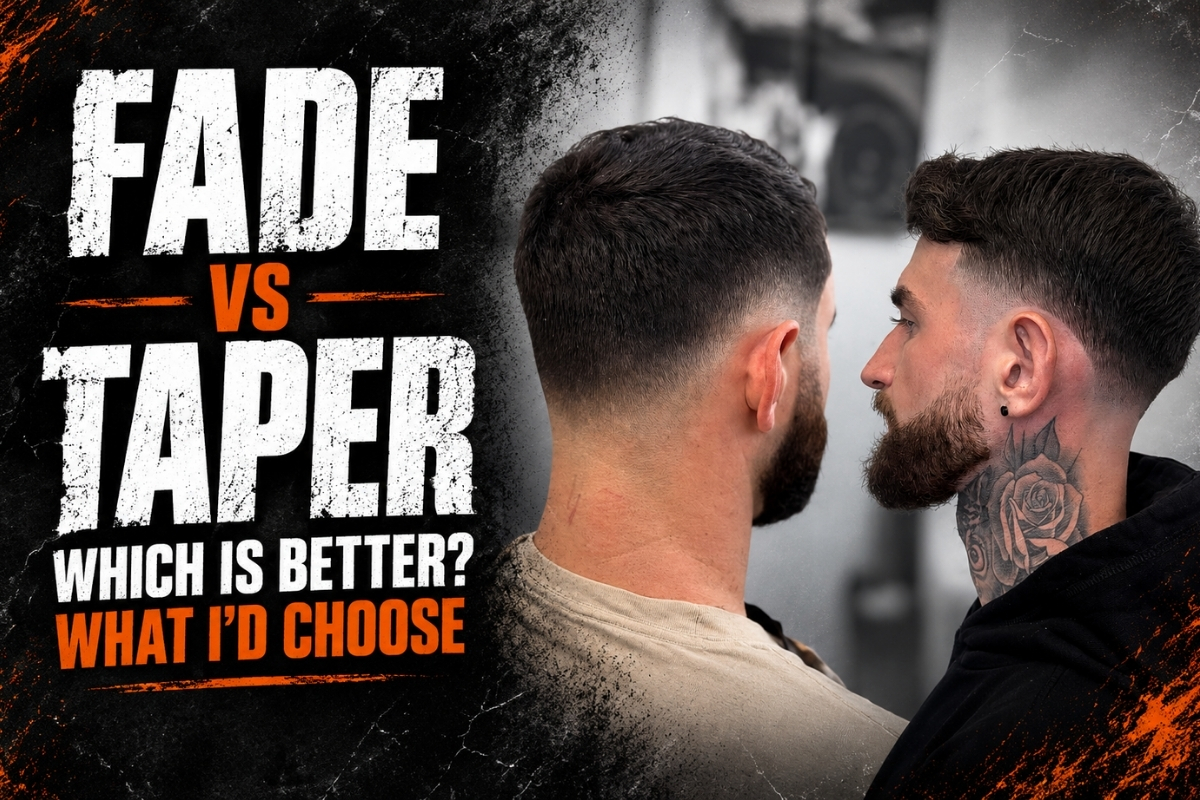
If you’re comparing the fade vs taper, the confusing part usually isn’t the finished haircut. It’s the terminology. The two cuts get labeled inconsistently online, and terms like “taper fade” only make things murkier.
The difference matters because choosing one over the other changes how much hair comes off, how much length stays through the sides, and how the haircut looks as it grows.
Before you choose between them, it helps to know what you’re asking for and which details will make the biggest difference to the finished cut.

In this article
What Separates a Fade From a Taper?
The simplest difference is how much of the sides and back are cut short. A taper keeps more length through most of the sides, while a fade takes a larger section much shorter and blends it gradually into the longer hair above.

With a taper, the shortest hair is usually concentrated around areas like the temples, sideburns, and neckline. Most of the sides stay relatively full. A fade spreads that shorter blending across more of the sides and back, which makes the change in length much more noticeable.
A fade does not always have to go down to bare skin. Some fades leave a little hair at the shortest point, while a skin fade takes that section all the way down to the scalp. That is why it helps to be specific about whether you actually want skin showing.
There is still some overlap in how the two cuts are created.
Both gradually move from shorter hair into longer hair. A fade usually takes more of the sides and back much shorter, while a taper leaves more length in place. That overlap is one reason the terminology is not always used in exactly the same way.
The term “taper fade” is a good example. It usually describes a cut that keeps more length through the sides but fades the hair very short around areas like the temples and neckline. Even then, different barbers may use the term slightly differently, so it is better to focus on the haircut you actually want rather than the name alone.
Look at How Much of the Sides Are Taken Short
Once you know the basic difference between a taper and a fade, the next thing to look at is how far that shorter section travels up the head.

This is where low, mid, and high fades start to look very different from one another. A low fade keeps most of the shortening closer to the ears and lower part of the head. A mid fade moves the transition farther upward, while a high fade removes much more length through the upper sides.
That means two fades can use a similar short length at the bottom and still produce completely different results. One can leave plenty of hair through the upper sides, while another can take that area much shorter and create far more separation from the hair on top.
The same idea helps when you are looking at a taper.
Instead of just checking how short the temples or neckline are, look at how much length remains through the rest of the sides. That tells you whether the haircut is keeping most of its fullness or moving closer to the look of a fade.
Reference photos are especially useful here. Pay attention to how high the shortest section travels, how much hair remains above it, and how quickly the length changes from bottom to top. Those details give you a much better idea of the finished haircut than the label attached to the photo.
Taper vs Fade Maintenance: Which Grows Out Better?
A taper usually grows out more forgivingly because most of the sides and back are left longer. You will still notice extra growth around the temples and neckline, but the haircut tends to change less between barber visits.
A fade usually shows regrowth sooner because more of the sides and back have been cut short. As that hair grows back, the contrast starts to disappear. With a skin fade, the bare section at the bottom quickly turns into visible stubble.
Fade height matters too. A high fade has a larger area of short hair growing back, while a low fade leaves more length through the upper sides and can be a little more forgiving.
How much that bothers you is personal. Some guys like a fade most when the contrast is fresh, while others are happy to let it soften before going back to the barber.
For maintenance alone, I’d give the taper the advantage. It usually changes less as it grows, so you can often leave it longer before it starts to look noticeably different.
Which Is Better: A Fade or Taper?
Neither is better in every case. A taper makes more sense when you want to keep more length through the sides, while a fade is the better choice when you want the sides noticeably shorter.
I’d lean toward a taper if you already like how much hair you have through the sides and only want the lower areas taken shorter.
You get some graduation without changing the rest of the haircut too much.
A fade makes more sense when you want a stronger difference between the top and sides. Crops, textured tops, curls, and plenty of other styles can work well with a fade when that contrast is part of the look you want.
Your starting length matters too.
Going from fairly full sides straight into a mid or high fade can remove much more hair than you expect. If the sides feel too heavy and you want more of that hair taken away, a fade makes more sense.
I wouldn’t make the choice purely from face shape either. You’ll often see advice assigning fades and tapers to round, square, or oval faces, but that simplifies things too much.
Fade height, top length, hair texture, and how much length stays through the sides can all change the finished result.
The easiest way to decide is to think about what you want the sides to look like. If you want to keep more hair there, go with a taper. If you want the sides much shorter and the top to stand out more, go with a fade.
Don’t Tell Your Barber “Give Me a Fade”
Asking for a fade or taper is only the starting point. Those terms still leave plenty of room for interpretation.

Tell your barber how short you want the hair at the bottom and how high you want the shorter section to go. With a fade, that means saying whether you want skin showing and whether you want it low, mid, or high. With a taper, explain how short you want the temples and neckline while keeping more length through the rest of the sides.
A reference photo helps too, especially when barbers use the same terms differently. Your hair density, texture, growth direction, and starting length can affect the final result, but a photo still gives the barber a much clearer idea of what you want.
The more specific you are about the length and placement, the less guesswork there is. That matters far more than simply asking for a fade or taper and hoping your barber has the same picture in mind.
Fade vs Taper: Which Would I Choose?
I’d choose a fade if you already know you want the sides much shorter and you want a stronger difference between the top and sides.
If you’re unsure, I’d start with a taper. It keeps more of your existing length, usually grows out more forgivingly, and still gives you the option to go shorter later.
That is the main reason I think a taper is the safer starting point. Your barber can always take more hair off, but if a fade is cut higher or shorter than you wanted, you have to wait for that length to grow back.
So I would not say one is always better. Go with a taper if you want to keep more length through the sides. Go with a fade if you want those sides taken much shorter and the contrast to be more obvious.