
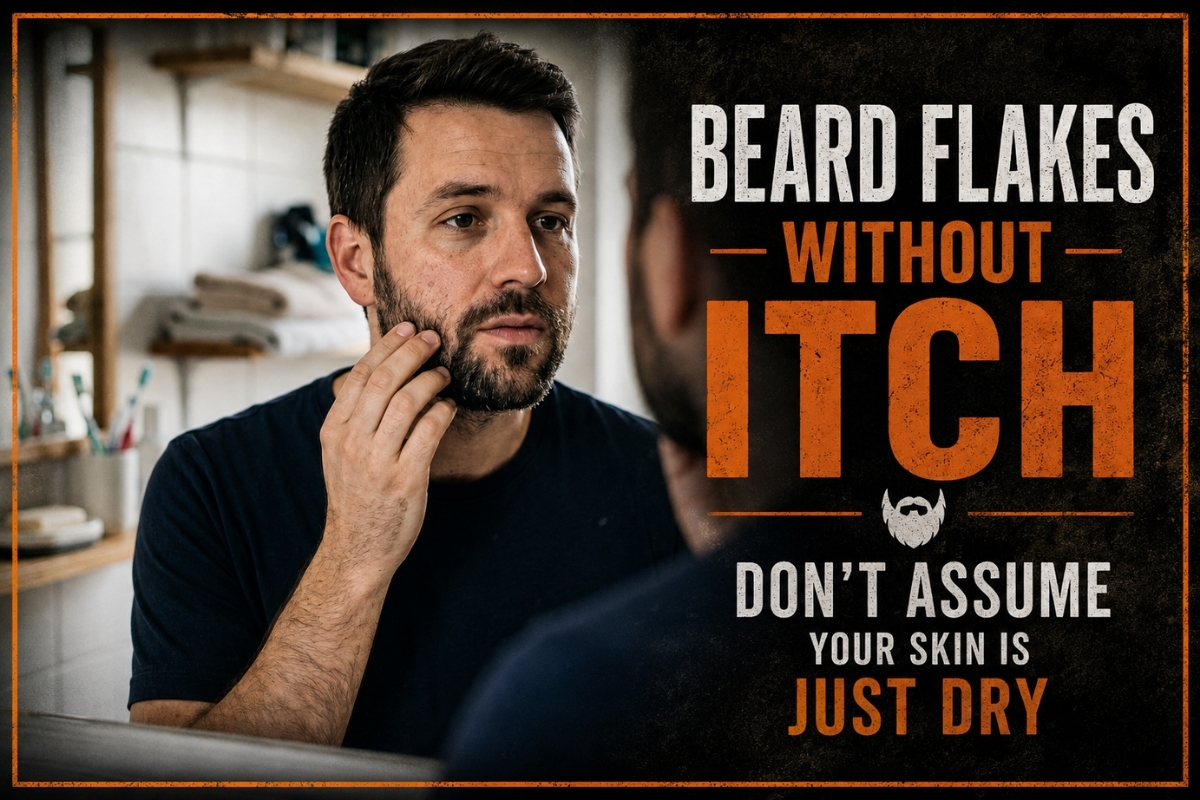
Seeing flakes scattered through your beard or showing up on a dark shirt is hard to ignore. It’s even more confusing when the skin underneath doesn’t itch, sting or feel particularly irritated.
Beard flakes without itch can leave you wondering whether your skin is dry, something in your routine is causing it, or you’re looking at something else entirely.
I’d resist the urge to start fixing it straight away. Without an obvious answer, taking a closer look first can save you from changing the wrong thing.

In this article
Make Sure the Beard Flakes Are Actually Coming From Your Skin
Before you start treating the skin underneath your beard, make sure that’s actually where the flakes are coming from. What looks like dandruff caught in the beard can sometimes be dried grooming product instead.

Beard balm, wax and other products can leave residue caught in the facial hair, especially if you use too much or don’t wash them out properly. That residue can easily look like skin flakes.
Part the beard and look underneath before you apply anything else. If you can see flaking or scaling on the skin itself, that tells you far more than whatever happens to be caught higher up in the hair.
Check more than one area, especially where you tend to notice the most flakes. If the skin looks clear and most of what you’re seeing is caught through the facial hair, I wouldn’t assume the skin is causing it yet.
No Itch Doesn’t Automatically Mean Dry Skin
If your beard is flaking but not itching, it’s easy to assume the skin is simply dry. I wouldn’t use the lack of itch as proof.
Itching doesn’t tell you whether you’re dealing with simple dryness or something else. Some skin problems that affect the beard area can cause scaling even when there’s very little itching.
What I’d pay attention to is whether anything else has changed. Ongoing scaling, greasy-looking areas, redness or patches that look different from the skin around them would make me think twice about calling it simple dryness.
If all you’re seeing is loose flaking and everything else looks normal, dryness can still be one possibility. But don’t decide that’s the cause just because nothing itches. When the flakes show up can tell you more.
Pay Attention to When the Beard Flakes Come Back
Say your beard looks fine after washing, but the flakes only start showing up later after you’ve used balm, wax or another styling product. That makes the product worth looking at. If the flakes are already there before you apply anything, it’s much less likely to be the cause.

You may notice something different after washing. If the flakes tend to show up once the beard has dried and the skin underneath feels noticeably drier afterward, I’d look at what you’re washing with and how often you’re using it.
You might also find that the flakes slowly come back over a few days no matter what you put in your beard. That’s more useful to know than blaming whichever product happened to be in your hand when you first noticed them.
The important part isn’t to change everything at once. Pick the most obvious pattern, change one thing and see what happens. Otherwise, even if the flakes improve, you won’t know what helped.
Strip the Routine Back Before You Start Adding More
If you’re already using several products, flakes are a bad reason to add another one. I’d simplify what you’re doing first.
Keep the beard clean and rinse it properly, but leave out anything you don’t really need for a few days. Hold off on the balm and wax while you work out what’s happening underneath.
I wouldn’t start washing more aggressively either. More grooming isn’t automatically the answer just because you can see flakes.
I’d also be careful about reaching straight for beard oil. It’s an easy recommendation because flakes look like dryness, but that doesn’t mean dryness is actually the problem.
If the skin underneath feels dry and otherwise looks normal, beard oil can make sense. Jack Black Beard Oil is the one I’d look at here if you need an oil. I still wouldn’t add it simply because you can see flakes. Use it when dryness is actually what you’re trying to deal with.
Your beard can also feel rough while the skin underneath is flaking, but those aren’t automatically the same problem. Making the facial hair feel softer doesn’t mean you’ve dealt with whatever is causing the flakes.
If the Flakes Keep Coming Back, Stop Treating It Like a Grooming Mistake
If product residue looks less likely and the flakes are clearly coming from the skin, I’d start paying more attention to the skin itself.

A few loose flakes are one thing. Ongoing scaling, greasy-looking patches, a rash, soreness, broken skin or changes that keep coming back are different. Seborrheic dermatitis is one condition that can affect the beard area and cause flaking and scaling, sometimes without much itching.
That doesn’t mean it’s on you to work out exactly what it is. If the skin keeps changing or the problem keeps coming back, trying different oils, washes or treatments without knowing what you’re dealing with quickly turns into guesswork.
That’s where I’d get it checked rather than keep experimenting. Once you know what’s going on, it’s much easier to decide what, if anything, needs changing in your grooming routine.
Verdict: Fix the Cause, Not Just the Flakes
If you have beard flakes without itch, I wouldn’t assume you simply need more beard oil. The lack of itching doesn’t tell you what’s causing the flakes, and sometimes what looks like flaky skin isn’t coming from the skin at all.
I’d keep the routine simple and only change something when you have a reason to suspect it. If the skin really does seem dry, beard oil can make sense. If the flakes keep returning or the skin underneath starts looking noticeably different, that’s not something I’d keep trying to solve by adding grooming products.
You don’t need to throw more at the problem. You need to work out what you’re actually trying to fix first.