
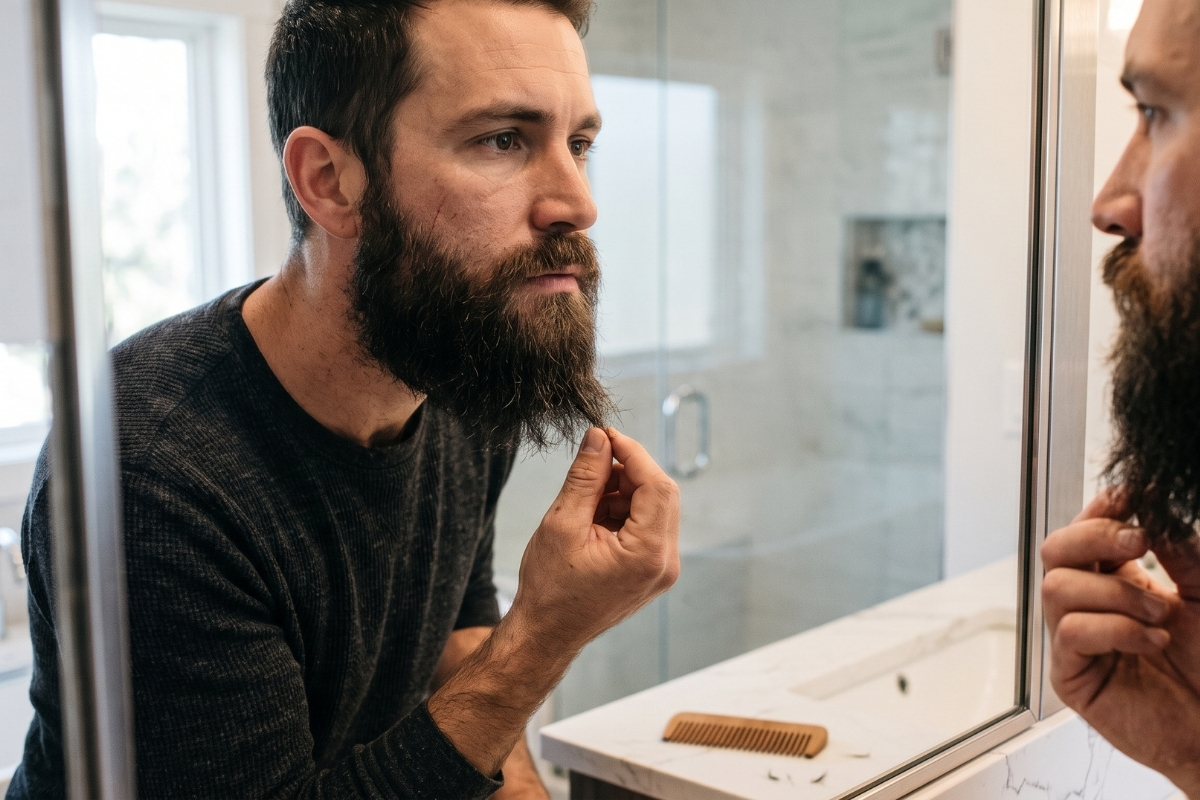
Beard breakage can be hard to spot at first. Your beard still grows, you still see new hairs coming through, but somehow the length never seems to add up the way you expected.
Maybe the bottom keeps looking thinner. Maybe you find short hairs after grooming. Or maybe one part of your beard always seems to fall behind the rest.
I wouldn’t assume right away that you have a growth problem. There are better clues to check first, and once you know what to look for, beard breakage becomes much easier to figure out.

In this article
Your Beard Might Be Growing Fine. You’re Just Losing the Length
If your beard seems to stop at roughly the same point every time you grow it out, that doesn’t automatically mean growth has stalled. Your beard can still be growing normally while older sections farther down are snapping off, so some of that progress disappears before you really notice it.

That’s why I separate beard growth from length retention. You can be growing hair normally but still struggle to build a longer beard if too much of the older length keeps breaking. From the outside, both problems can look the same.
What you find after grooming can give you a clue, but look for a pattern rather than judging it from one or two hairs. A shed hair has detached from the follicle.
Breakage happens somewhere along the shaft, so the pieces you find may be noticeably shorter than the surrounding beard. One short hair tells you very little. Finding them regularly is more useful.
The beard itself can tell you just as much. If it stays full higher up but becomes noticeably thinner or more uneven toward the ends, or one area repeatedly falls behind the rest, breakage becomes more plausible, especially if you’re also finding those shorter pieces.
That changes what you should investigate. If the beard is still growing but some of the length keeps disappearing, trying to make it grow faster may be solving the wrong problem. First work out where you’re losing it.
Where Your Beard Is Breaking Can Tell You What’s Going Wrong
Once breakage looks likely, stop treating your beard as one big problem and pay attention to where the damage keeps showing up. The location won’t tell you the cause with certainty, but it can give you a much better place to start.

The ends are an obvious example. On a longer beard, they are the oldest part of each hair and have had more time to go through washing, drying, tangles and grooming. If the bottom is gradually getting thinner and you regularly notice short pieces after detangling, look closely at how you handle those ends.
Damage underneath the jaw makes friction worth checking. Collars, jackets, scarves and anything else that regularly comes into contact with that area can matter. If the underside seems to be losing length while the front is holding up much better, that difference is worth investigating.
Uneven breakage can expose habits you barely notice. Maybe you constantly touch one side while working, sleep with the beard pressed in the same direction or keep fiddling with one particular area. None of those proves the cause, but they give you something specific to look at.
Grooming can be even more revealing. If short hairs keep appearing after you comb or brush, notice where the tool catches. If it’s always the same section or the same stubborn knot, that tells you more than simply deciding the whole beard needs another product.
No single sign proves what’s happening, and I wouldn’t chase just one. What matters is the repeat pattern. If the same part of your beard keeps losing length, ask what’s different about that area and how you treat it compared with the rest.
A Beard Hair Can Take Damage Long Before It Finally Snaps
When a beard hair snaps while you’re combing, the comb may only be the last thing that happened to it. A hair can pick up small amounts of damage from bending, rubbing, tangling, heat and grooming over time.

The final pull is obvious. The buildup isn’t.
That matters because damage can change how the hair behaves. As the outer surface becomes more worn, friction can increase and strands can become harder to separate.
A tangle then needs more force to work apart, putting an already compromised hair under even more strain. A small grooming problem can start feeding itself.
I think that’s more useful to understand than obsessing over one bad morning. The question isn’t whether you’ve ever snagged a beard hair. Everyone has.
It’s whether the same hairs keep being put through unnecessary strain again and again.
You don’t need to handle your beard like it’s made of glass. Washing, drying and grooming are normal. The goal is simply to stop making the same difficult sections work harder than they need to.
Stop the Damage Before You Start Adding More Products
Once you know breakage is part of the problem, I wouldn’t start by rebuilding your whole beard routine. If something you do every day keeps putting unnecessary strain on the hair, deal with that first. Otherwise, you can buy more products while the same problem carries on underneath them.

That doesn’t make beard oil, conditioner, butter or beard balm irrelevant. Their useful role here is conditioning the hair and reducing friction. Making the beard softer and easier to separate can mean less resistance when you groom it, which helps when tangles are part of the problem.
Keep the roles clear, though. A conditioning product can make the hair easier to manage. It can’t make rough grooming harmless or repair a hair that has already snapped.
I care more about how the beard behaves than how much product is on it. If it separates more easily and you can groom it with less pulling, that product is doing real work. If the beard just gets heavier or greasier while the same tangles keep fighting back, adding more has achieved very little.
What I’d use here
For everyday conditioning, Jack Black Beard Oil is the stronger fit. It is made to soften and condition facial hair, which can make a dry, difficult beard easier to handle during normal grooming.
If your bigger problem is tangling after washing, Detroit Grooming Co. Beard Conditioner makes more sense. It is a rinse-out conditioner, so this is the option I’d choose when the beard needs more help becoming manageable before you start combing it.
You probably don’t need both. If your beard already detangles reasonably well after washing, I’d choose the oil. If it comes out of the shower rough and difficult to work through, I’d start with the conditioner.
When Damaged Ends Are No Longer Worth Saving
The occasional rough or split hair isn’t a reason to start trimming away good length. What changes the decision is when the bottom becomes consistently thin, uneven or almost see-through compared with the fuller beard above it, especially if those ends keep splitting or snapping.

At that point, hanging onto every last millimeter can start working against the beard you actually want. Conditioning may take some of the roughness out of compromised hair, but a split shaft stays split. Softer isn’t the same as fixed.
This is where I think a small maintenance trim is worth it. Rather than chasing individual damaged hairs, take off only enough to get back to a section that looks noticeably fuller. On some beards, that may be very little.
I’d rather lose a small amount of badly damaged length than keep a thin bottom section purely because the number on the ruler is higher. You’re still growing the beard. You’re just being more selective about the length worth keeping.
Verdict: Keeping Length Matters as Much as Growing It
Beard breakage can make a normally growing beard look stuck. If you keep losing length to snapping, chasing faster growth isn’t where I’d start.
Look at where the breakage keeps showing up and what that part of your beard goes through every day. Reduce the repeated strain, keep the hair conditioned enough that grooming doesn’t turn into a fight, and trim only when the ends are clearly thin, split or repeatedly snapping.
If you want more length, don’t judge progress only by what grows from the root. Judge it by how much of that length you’re still holding onto months later.