
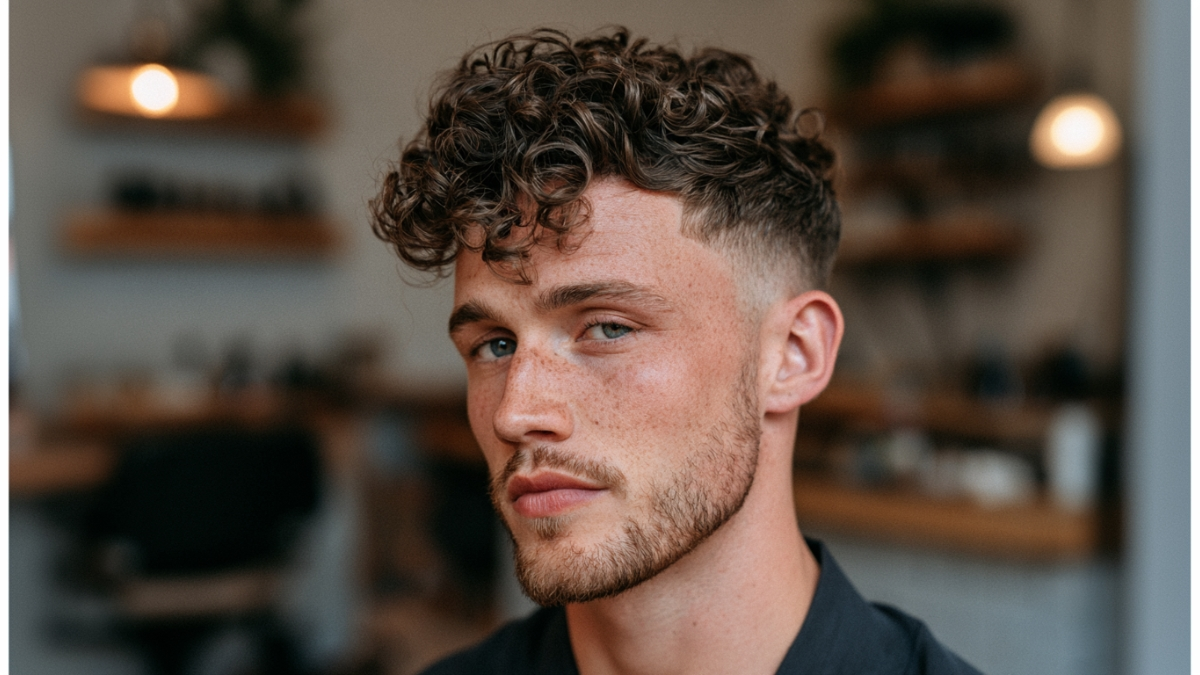
Curly hair fades for men can look very different depending on how the sides are taken down and how much length you keep on top.
Some work far better with certain curl lengths and hair thicknesses, and the difference isn’t always obvious from the name alone.
The styles below are the ones I’d actually compare before choosing your next cut.

In this article
9 Curly Hair Fades for Men
Some keep more hair around the sides, while others make the curls on top much more noticeable.
Curly Low Fade

A low fade keeps most of the hair around the sides and only gets very short close to the ears and neckline.
That makes it a good choice if you want a fade without changing the overall shape of your curly hair too much. There’s still enough hair around the sides for the top to feel connected rather than standing alone.
I also like it when the curls aren’t long. You don’t need loads of length or volume on top for a low fade to work.
Curly Mid Fade

A mid fade takes more hair away from the sides and makes the curls above it stand out more clearly.
This is the fade I’d suggest to most people first. It changes the haircut enough to be noticeable, but you still keep enough hair through the upper sides for shorter curls to work well.
Longer curls suit it too, which is why I see the mid fade as one of the best options to get right across different curl lengths.
Curly High Fade

A high fade takes the sides up much higher and leaves the curls concentrated on top.
In this version, the curls are kept fairly short, but they still have enough definition to stand out clearly against the tighter sides. That is what makes the haircut work. You do not need a lot of length, but you do need the curls to show properly.
I like this if you want a sharper, cleaner look with much more separation between the top and the sides. It is a stronger option than a low or mid fade, and it puts far more attention on the curl pattern itself.
Curly Taper Fade

A taper fade only takes the hair shorter around the temples and neckline instead of fading the entire side.
That lets you keep much more of the natural shape and fullness of your curls.
I particularly like this on thicker curly hair when you want the haircut freshened up without removing the width through the sides. It’s a much smaller change than a full fade, and that’s exactly why it works.
Curly Drop Fade

A drop fade curves lower behind the ear instead of staying at the same height around the head.
That leaves more shape behind the ear and through the back, which can work really well with curls that you don’t want taken equally short all the way around.
If a normal mid fade feels a little too straightforward, I’d look at a drop fade before jumping to something much higher or shorter.
Curly Burst Fade

A burst fade keeps the shortest area concentrated around the ear while leaving more length toward the back.
That gives it a completely different profile from a standard low or mid fade. You can keep plenty of curl through the back while making the area around the ear much tighter.
This isn’t the one I’d choose if you want the fade to disappear into the haircut. The shape around the ear is meant to be noticed.
Curly Skin Fade

A skin fade takes the shortest part of the sides right down to bare skin.
On thick or longer curls, that difference can make the top look much more prominent.
I’d be selective with this one. Taking the sides to skin changes the haircut more than simply choosing a slightly higher fade, and the result is much less forgiving if you later decide you preferred having some hair around the sides.
Curly High Taper Fade

A high taper takes the shorter temple area farther up than a regular taper while still keeping plenty of hair through the sides and back.
It gives you a more noticeable change from the front without turning the haircut into a full high fade.
I’d choose this when a standard taper feels too subtle but you still want your curls to keep some width around the sides.
Curly Fade with Beard

A beard changes the way a curly fade looks because the sideburn becomes the point where the haircut and facial hair meet.
A fuller beard usually looks better when that connection gets some thought rather than simply fading the sideburn away and letting the beard begin lower down.
I also look at the overall amount of hair. If you have thick curls and a substantial beard, the fade gives you some separation between the two without either one disappearing.
For me, the connection around the sideburn is what makes this combination work.
The Higher You Take the Fade, the More the Curls Have to Carry the Haircut
The higher the fade goes, the more width you remove from the sides of your head.
That puts much more attention on the curls above it. Thin or sparse curls can end up looking swallowed by the extra space above the ears.
I’d be more cautious if your curls are very short or fine. Remove too much from the sides and you can end up with very little hair around the head except for the curls right on top.
Your head shape matters as well. A higher fade exposes much more of the side of the head, while a low fade or taper keeps more width there.
For me, that’s the real choice. A higher fade isn’t automatically better because it looks stronger in a photo. It needs to work with the length and fullness of your curls and the shape underneath them.
Your Temples Can Change Which Fade Looks Best
Your temples can make two very similar curly fades look completely different.
If your hairline is strong and you’re happy showing more of the corners, a higher fade can work well. If your temples are starting to move back, the same haircut can make that recession much easier to see.
I’d usually keep more coverage there if the corners are already thinning. A low fade, taper fade or softer mid fade leaves more hair around that area and keeps less attention on the hairline.
This is why I wouldn’t copy the exact fade height from somebody else’s photo without looking at your own front hairline first. Their curls might be similar to yours, but their temples may be completely different.
If showing more of your temples is something you already worry about, I see very little reason to push the fade higher just because you liked one particular photo.
Some Curly Fades Grow Out Much Better Than Others
The fade can start looking grown out long before the curls on top actually need cutting.
The tighter and higher you go, the sooner you tend to notice hair returning through the shortest areas. Softer fades and tapers usually give you more breathing room because the difference isn’t as severe once everything starts growing.
A skin or high fade usually needs a top-up every two to three weeks to keep the line sharp. A softer taper or low fade can often stretch to four or five.
What I wouldn’t do is cut the curls every time you refresh the fade just to make the whole haircut feel newly done. If the top still has the length and shape you like, leave it alone.
That matters with curly hair because taking a little too much off every visit can quickly change how much curl you actually see.
For me, this is one of those things that sounds minor until you live with the haircut. If you don’t want frequent barber visits, choose a fade you can still tolerate once the sides are no longer fresh.
Beard Beasts Verdict
Curly hair fades for men work best when you don’t start with the most extreme option.
A low fade, mid fade or taper gives you more room to work with your natural curl, hairline and head shape without taking too much away from the sides.
If you want something stronger, go higher or tighter because you really prefer that look, not because you think it automatically works better with curly hair.
For me, the best curly hair fades for men are the ones that still look right once the sides have softened a little and your curls have fallen back into their usual shape.
If you still like the haircut then, you picked the right fade.