
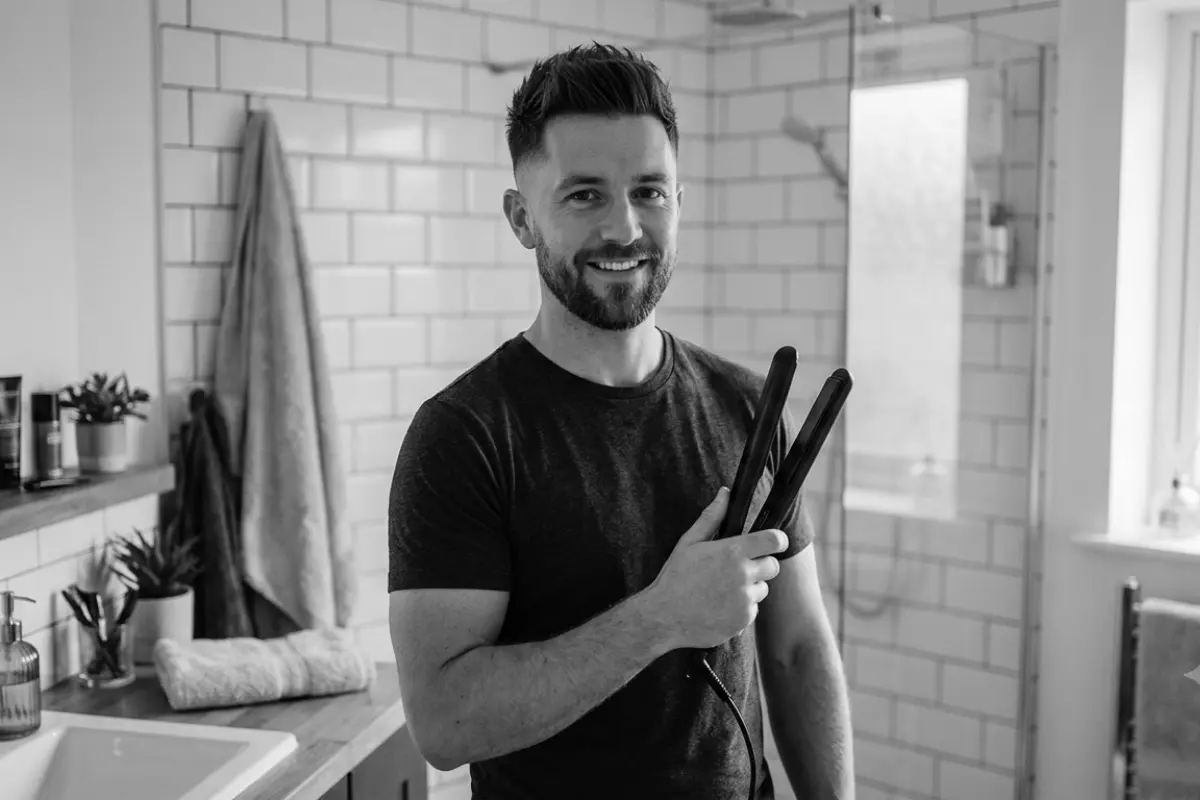
Treat a flat iron like a shortcut and you’ll fry your hair faster than anything else in your routine.
Most of the time, the tool isn’t the real problem. The problem is rushing, using too much heat, grabbing sections that are too thick, or forcing the hair straighter than it needs to be.
I don’t think most men need poker-straight hair. They need awkward bends calmed down, side puff reduced, or a front section that falls closer to how the haircut was supposed to.
If you want to straighten men’s hair without frying it, the goal isn’t hair that looks pressed into place. It’s hair that still looks like yours, just less awkward to deal with.


In this article
Straightened Hair Should Still Look Like Hair
The worst straightened hair is hair that announces itself as straightened.
That dead-flat, overworked look is usually where men go wrong. They think the aim is to remove every bend, wave, flick, and bit of movement, when most of the time the job is much smaller than that.
You’re trying to calm the part that’s fighting the haircut, not flatten the whole thing for the sake of it.
Men’s hair usually looks worse when it has been forced too straight. The top can look thin, the fringe can look stiff, and wavy hair can lose the bit that made it look good in the first place.
Use the flat iron to make the cut cooperate. Don’t use it to make your hair look like it belongs to someone else.
That matters most with short and medium-length hair. A crop, quiff, side-swept style, brush-up, or longer fringe still needs some movement through it. Take too much out and the haircut can look flat, even if the hair is technically straighter.
So before you touch the iron, know what you’re actually fixing. If one section is throwing the style off, deal with that section first.
You don’t always need to straighten the whole head.
The best result is when nobody looks at your hair and thinks, he has straightened that. It should look less puffy, less awkward, and closer to what the haircut was supposed to do.
Don’t Put a Flat Iron on Hair That Isn’t Ready
One straightening session doesn’t wreck hair. Treating every session like a five-minute panic job before you’re out the door does.
It usually goes the same way. Shower, towel, hair still holding moisture, front sticking up, sides puffing out, then the iron goes straight on it.
That’s the entire mistake, right there.
A flat iron is a finishing tool, not a dryer. If there’s moisture still in the hair, the heat has to deal with that before it can do anything useful. That’s when you get steam, crackling, and rough ends.
I’d rather see one extra minute with a hairdryer than five rushed passes with a straightener.
Heat protectant is the other thing men skip because it feels like an extra step. I get why. Most men want the fastest route from wet hair to out the door. But if hot plates are touching your hair, a light heat protectant isn’t some fancy add-on. It’s part of using the tool properly.
Styling product should come later. Clay, paste, cream, wax, or gel shouldn’t be in the hair before you straighten it. Heat can make product feel sticky, coated, or dry, and it can leave buildup on the plates too.
Straighten first. Let the hair cool. Then use a small amount of product if the style needs it.
Do that, and you avoid most of the damage men blame on the flat iron.
Stop Trying to Beat Your Hair With More Heat

This is where the real damage happens, every time.
The first pass doesn’t do enough, so they turn the temperature up. The fringe still kicks out, so they go higher again. Thick hair feels stubborn, so they assume it needs more power.
Most of the time, that’s the wrong fix.
If the hair isn’t straightening properly, more heat is rarely the actual fix. It just makes the real problem, usually the prep or the technique, look solved for a few minutes before the hair pays for it later.
A moderate temperature and a better pass beats cranking the iron up and hoping for the best, every time. If you know you’re the type to keep turning the heat up when your hair doesn’t behave, a flat iron that caps heat at 185°C makes sense because it removes the temptation to blast your hair just to save two minutes.
Damage from overheating rarely shows up on the day. It creeps in over the following weeks as dry ends and hair that looks worse even when it’s technically straighter, which is exactly why the extra heat feels like it’s working right up until it isn’t.
The iron shouldn’t feel like a fight. If you’re clamping harder, holding longer, and turning the temperature up every time the hair pushes back, the technique is the problem, not the hair.
Fix that first, and the specific advice for your actual hair type is below.
The Way You Pass the Iron Matters More Than You Think
Most men blame the iron when the result looks bad.
It’s rarely the iron. It’s the pass.
They grab too much hair, clamp down hard, rush through it, then keep going over the same bit because it still has a bend in it. That isn’t always the iron failing. That’s poor handling.
The section of hair has to be small enough for the plates to reach it properly. If you drag the iron over a thick clump, the outside gets the heat and the inside barely changes. Then you end up doing three passes on a piece that should have needed one.
Smaller sections and one steady glide win here. Start close to the root, but not right at the skin. Clamp gently, then move through the section from root area to ends without stopping halfway down.
If one part doesn’t behave, let it cool for a moment before going back in. Holding the iron still or running over hot hair again and again is how you get creases, dry patches, and that pressed look.
The pass should feel calm. If you’re squeezing hard, dragging fast, or fighting the hair all the way down, the section is probably too big, the hair isn’t dry enough, or you’re trying to force it.
Your Hair Type Changes How Careful You Need to Be
Your hair isn’t the same as the next guy’s, so stop straightening it like it’s his.

Wavy hair usually needs restraint. Most of the time, you’re calming puff, a bend in the fringe, or sides that kick out, not removing the wave completely. Take too much out and the hair can start looking limp.
Curly hair needs smaller sections and more patience. A curl that’s only half caught by the plates will spring back, so rushing usually leads to repeated passes. That’s where the damage builds. Better sectioning matters more than hotter plates.
Thick or coarse hair is where men get overconfident. Because it feels tougher, they hold the iron longer, turn the heat up, or keep attacking the same piece, and that’s exactly the overheating pattern covered above.
Fine hair needs the lightest touch. It can go flat quickly, and if the front or crown is already thin, pressing it too straight can make that more obvious. For some men, a hairdryer and a small amount of product will do a better job than flattening it with an iron.
For me, the harder your hair is to straighten, the less you should try to overpower it. Use smaller sections, a steadier pass, and less repeat heat.
Your hair type should decide how much straightening you do, not your impatience.
Don’t Ruin It After You’ve Straightened It
Plenty of men nail the straightening, then wreck it in the next two minutes flat.
They run their hands through it while it’s still hot. They throw product in too early. They keep messing with the fringe because it doesn’t look right straight away.
Hands off. Give it a minute.
Hair needs to cool before you start judging it. Touch it too soon and you can pull the bend back in, flatten the front, or make the whole thing look overworked.
That’s the same rule from earlier, just applied at the other end: product goes on once the hair has actually cooled, not while it’s still warm from the plates.
Go light. Too much can drag straightened hair down, make fine hair look thinner, or turn thick hair into clumps. You only need enough to stop the style falling apart.
I’d also avoid dragging it through every section. Use your fingers only where the hair actually needs support.
The result shouldn’t look coated. It should look like the styling was handled properly, not like you straightened it and buried it under product.
The Beard Beasts Verdict
Straightening men’s hair works. It stops working the second heat becomes your answer to every problem.
The aim isn’t perfectly straight hair. It’s hair that falls better without looking pressed, fried, or forced into place.
That usually comes down to the boring stuff men try to skip: dry hair, heat protectant, smaller sections, a steady pass, and letting the hair cool before adding product.
Use enough heat to do the job, but don’t keep turning it up because your technique is poor.
The best straightened men’s hair shouldn’t look like it has been attacked with hot plates. It should just look easier to handle.