
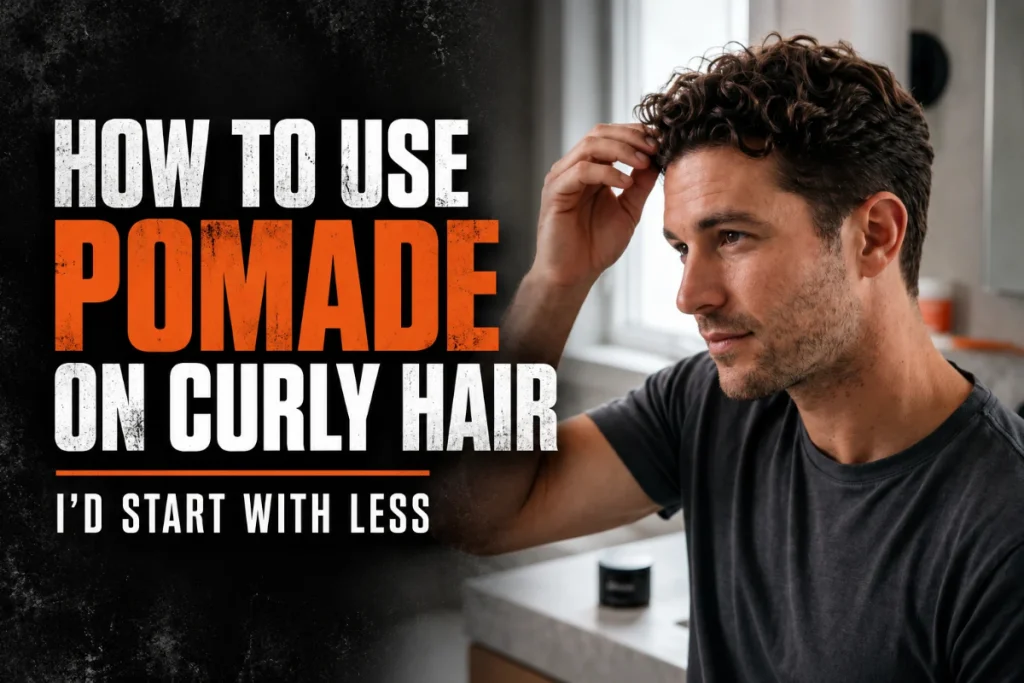
Ever put pomade in your curls and immediately wished you’d left them alone? You only wanted to fix the front. Now one side looks greasy, the other looks flat, and those curls aren’t falling the way they did five minutes ago.
The annoying part is that you might be using a perfectly decent pomade. Curly hair can lose its shape while you’re trying to style it, so it’s not always the product that’s letting you down.
If you’re wondering how to use pomade on curly hair without making a mess of it, there’s more to consider than simply rubbing some between your palms and running your hands through your hair.
In this article
How to Use Pomade on Curly Hair
For a natural curly style, how you spread pomade matters just as much as the amount you use.

Running your fingers through every curl might distribute the product, but it can also pull apart sections that already looked good. I’d get your hair roughly where you want it first, then use pomade to help it hold.
- Get your hair going in the right direction. After washing, gently squeeze out excess water with a towel or cotton T-shirt rather than rubbing, then use your fingers to position the front and sides. Dry curls work too, so there’s no need to wash your hair just to put pomade in.
- Start with a small amount. A pea-sized dab is a reasonable starting point for short curls, although the amount will vary with your hair and the formula. Rub it over your palms and fingertips until you’ve spread it into a thin, even layer. Longer or denser hair may need more, so build up gradually.
- Choose where it goes. A stubborn front section or a few flyaways may only need a light pass over the surface. For control across your whole head, lift a few sections and work a little product along the curls underneath before smoothing over the top. Repeatedly dragging your fingers from root to tip can stretch and separate curls.
- Shape the style you want. Lightly scrunch upward to keep your natural curl shape, twist an odd curl around your finger, or use your fingertips to direct the front on a shorter cut. For a slicked-back style, I’d start with damp hair and use my fingers to guide the curls backward. A wide-tooth comb can help if you want a smoother finish, but avoid forcing it through tangled or sticky hair.
- Check the result before adding more. Deal with the section that’s misbehaving instead of covering everything with another layer. Let damp curls air-dry or use a diffuser with gentle airflow; once the hair is in place, constant rearranging can bring back the frizz.
Pay attention to how the pomade feels as you apply it. If it keeps catching and tugging at your curls even after you’ve spread it thinly, I’d stop working it through rather than force it. The formula may be too sticky for the style you want, or you may have applied too much.
Damp or Dry Hair: Which Works Better With Pomade?

For keeping natural curls together, I’d start with slightly damp hair. The moisture can make many pomades easier to spread and gives you time to shape the hair before it dries. With dripping-wet hair, however, it can be harder to judge how much hold you’re getting until later.
Dry application is useful when your curls already have shape and you’re finishing the style. You can see the effect immediately, although thicker formulas may catch on dry strands and break up curl groups if you keep handling them.
The finished hold depends heavily on the pomade itself. Some water-based formulas set firm as they dry, while others stay pliable. Applying a product to damp hair doesn’t guarantee softer curls, just as applying it dry doesn’t automatically give you stronger hold.
To find what works for your hair, try the same small amount on slightly damp hair one day and dry hair another. Changing one thing at a time gives you a better idea of which approach produces the result you want.
Choosing the Right Pomade for Your Curls
A pomade labeled “for curly hair” isn’t necessarily the best match for your hairstyle. I’d pay more attention to how the formula feels and whether you want movement, texture, or a smoother finish.

For fine curls that lose volume easily, I’d start with a lighter-feeling formula and flexible hold. Heavy, waxy products can make curls clump into larger pieces and leave the hair looking flatter. Light hold doesn’t always mean lightweight, though; a conditioning cream can have little hold and still feel rich.
Thick, dense curls can sometimes handle heavier products, especially on short hairstyles where you want more control. Hair density alone won’t tell you which hold strength to buy, and a firm, sticky pomade can leave curls feeling stiff when all you wanted was a bit of control.
Water-based pomades are often easier to rinse out, although some set firmly as they dry. Oil-based formulas frequently stay more workable, but they can feel greasier and take more effort to remove. Those are general tendencies, so I’d still check the actual formula before choosing one over the other.
Shine changes the result, too. A glossy finish can make curls look more grouped together and give you a slicker hairstyle. On fine or thinning hair, that extra separation may also make the scalp easier to see. I’d start with lower shine if keeping a fuller appearance matters to you.
Here are two pomades I’d consider.
- American Crew Cream Pomade: Its light-to-medium hold and low-shine finish make it a reasonable pick for softer, natural-looking styles. It’s moisture-rich, so I’d be careful with the amount on fine hair.
- Reuzel Fiber Pomade: Firm but pliable hold and low shine make more sense for a shorter, more textured cut that needs staying power. For longer, looser curls, I’d lean toward something with a softer feel.
BEARD BEASTS PICKS
Two Pomades I’d Consider for Curly Hair

FOR SOFTER, NATURAL STYLES
American Crew Cream Pomade
Worth considering if you want a little control
without a firm finish. I’d start with less
on fine curls because the formula is quite rich.

FOR SHORTER CURLS AND MORE CONTROL
Reuzel Fiber Pomade
The option I’d consider for a short, textured
curly hairstyle that needs more control.
Less suited to longer curls when softness
and movement are your priority.
Affiliate disclosure: As an Amazon Associate,
Beard Beasts earns from qualifying purchases.
Before buying either one, see whether a smaller amount of your current pomade gives you a better result. A different formula makes more sense when the hold, weight, or finish itself is causing the problem.
If Pomade Leaves Your Curls Greasy, Stiff, or Frizzy
Greasy, stiff, and frizzy curls need different fixes. Take a closer look at what’s happening before reaching for more pomade.

Greasy roots with otherwise decent-looking curls can point to where you’ve applied the product. Check whether you’re working it too close to your scalp. Natural oil and leftover styling product can also contribute, so the cause isn’t always the application itself.
A whole hairstyle that looks slick and heavy is a different problem. You may have used too much pomade or chosen a formula that’s too rich for your hair. Buildup from previous applications can make things worse. I’d wash out a particularly greasy result rather than try to cover it with another product.
Some firm-hold pomades are designed to set as they dry, which can leave your curls feeling stiff even when you’ve applied them correctly. Gently scrunching the hair once it’s completely dry may soften the result, but certain formulas will stay quite firm.
Frizz can appear when you repeatedly pull sticky fingers through the same curls. For a few loose hairs, gently smooth the surface with slightly damp fingertips.
If a curl has completely lost its shape, try lightly rewetting and reshaping that section instead of trying to stick the hairs down with more pomade. A little moisture may make the hair easier to work with; soaking it can disturb the surrounding curls.
Timing gives you another clue. Hair that looks greasy immediately points you toward the amount or distribution, while curls that look good initially but lose their shape later raise questions about hold or product weight. I’d investigate those differences before spending money on a stronger pomade.
Pomade vs. Curl Cream vs. Gel for Curly Hair
Pomade, curl cream, and gel do different styling jobs, even though all three can help with curls. The better choice depends on what you’re trying to change about your hair.

For a short curly crop that needs more control around the front, I’d reach for pomade. It can also help direct stubborn sections without restyling everything. But for soft, springy curls with plenty of natural movement, I’d be more selective about working it through your whole head.
Curl cream is where I’d look if your hair feels dry or frizzy and you want your curls to look more defined without a firm finish. Some creams offer a little hold, but many won’t keep a hairstyle in place throughout the day. Rich formulas can also weigh down fine curls.
Hair gel makes more sense when your curls form nicely but struggle to keep their shape. It can hold curl groups as they dry, and some formulas form a firm cast that you can gently scrunch out once your hair is completely dry.
The important difference is what your hair actually needs. Curls that feel dry but already hold their shape may benefit more from a suitable curl cream than stronger pomade. If your curls feel soft but lose definition throughout the day, a product with better hold could make more sense.
You may already have something suitable at home. I’d try adjusting how you apply the product you’ve already got before spending money on another one.
Final Verdict: Is Pomade Worth Using on Curly Hair?
Knowing how to use pomade on curly hair is one thing. Knowing when it’s actually worth using is just as important. I’d reach for it when a short curly crop needs more control at the front, or for a slicked-back style where losing some natural movement is part of the look.
If your curls already fall the way you like, I’d save the pomade for the stubborn sections rather than work it through everything. That way, the rest of your hair can keep its natural shape and volume.
Judge the result once your hair is completely dry and you’ve worn the style for a while. If even a small amount leaves your curls flat or stiff, I’d try a different formula or skip pomade altogether.