
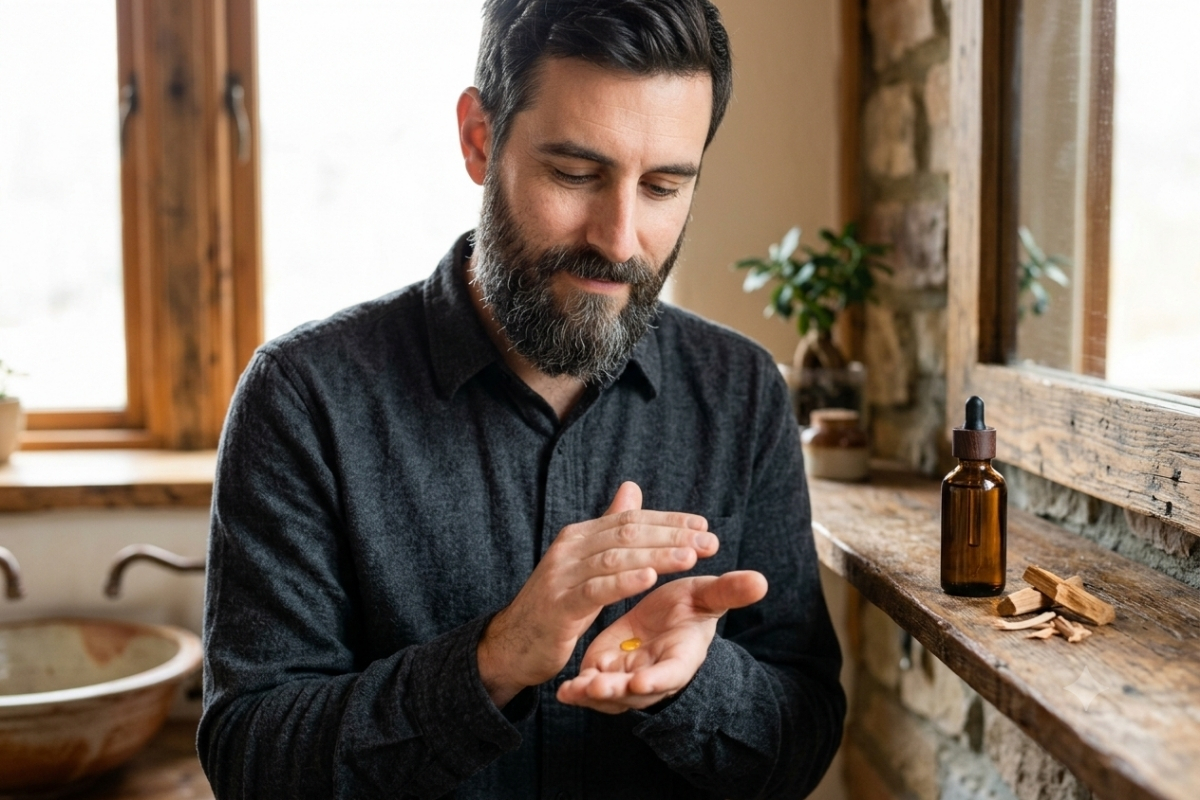
Sandalwood oil for beards is often sold on the scent first. That warm, woody fragrance can be a good reason to buy it, but sandalwood also gets attached to claims about beard growth, skin and conditioning that deserve a closer look.
That is where I think the ingredient gets more credit than it should. A sandalwood beard oil might be a very good product, but the name on the bottle does not tell you which parts of the formula are actually doing the useful work.
I’d judge it by something simpler: how your beard feels, how your skin responds and whether you actually enjoy the scent.

In this article
Sandalwood Essential Oil Has Not Been Shown to Grow a Beard
There is no good clinical evidence that sandalwood essential oil fills patchy cheeks, thickens weak connectors or increases beard growth.

Some of the confusion comes from research involving Sandalore, a synthetic sandalwood-like fragrance ingredient rather than ordinary sandalwood essential oil.
Earlier laboratory research found that Sandalore stimulated growth-related activity in human scalp hair follicles studied outside the body. A later 24-week clinical trial involved 60 women with telogen effluvium. Thirty used a formula containing 1% Sandalore, while the other 30 received the same vehicle with 0.05% natural sandalwood oil.
Hair volume improved more in the Sandalore group. Hair shedding fell in both groups, but the difference in shedding between the two groups was not statistically significant.
That is interesting research, but it does not show that sandalwood essential oil grows a beard. The study tested a different substance on scalp hair in women with a specific hair-loss condition. The control treatment actually contained natural sandalwood oil.
I’m not turning that into a beard-growth claim. The study simply does not answer that question.
Use sandalwood because you like the scent or because the complete beard oil works well for you. Don’t buy it expecting hair to start growing where your beard does not naturally fill in.
What Sandalwood Beard Oil Can Actually Do
A good sandalwood beard oil can make existing beard hair feel softer, less rough and easier to comb. It can also leave your beard with the warm, woody fragrance people usually associate with sandalwood.

That may sound less exciting than a beard-growth claim, but these are the results I would actually judge the product on.
After application, your beard should feel easier to manage without becoming greasy, heavy or stuck together in oily sections. The skin underneath should remain comfortable rather than itchy or irritated.
Those are results from the finished formula, not automatically from sandalwood itself. In a typical sandalwood beard oil, the carrier-oil blend is doing much of the conditioning. Sandalwood may be what you notice most because of the scent, but that does not mean it deserves the credit for everything the product does.
For me, that is enough. A beard oil does not need an exaggerated growth story if it makes your beard easier to manage and gives you a scent you genuinely enjoy.
Check What “Sandalwood Oil” Actually Means
Not every bottle with sandalwood on the label contains the same thing.

Some beard oils contain sandalwood essential oil. Others use fragrance oil, synthetic aroma or a blend of aromatic ingredients.
If genuine sandalwood essential oil matters to you, check the ingredient list rather than assuming the name on the front tells you what is inside. Seeing sandalwood essential oil listed confirms that it is present, but it still does not tell you how much is in the formula or how much it contributes to the finished product.
If the label only says fragrance, don’t assume the sandalwood scent comes from sandalwood essential oil.
Neither approach automatically makes a beard oil good or bad. For me, sandalwood on the label tells you more about the scent to expect than how well the product will perform.
Don’t Apply Undiluted Sandalwood Essential Oil to Your Face
Straight sandalwood essential oil and a finished sandalwood beard oil are not the same product.
Essential oil is concentrated. A finished beard oil should already be formulated for leave-on use on your beard and skin.
I would not apply undiluted sandalwood essential oil directly to my beard or the skin underneath. Stronger does not mean better here. Essential oils can cause irritation or allergic contact dermatitis, and sandalwood is one of the oils known to cause contact allergy in some people.
Stick with a finished beard oil and follow the directions on the bottle. Adding extra sandalwood essential oil does not guarantee better conditioning. It simply increases your exposure to the aromatic oil.
More sandalwood does not mean better beard care.
How to Use Sandalwood Beard Oil Without Overdoing It
Apply sandalwood beard oil when your beard is slightly damp after washing or rinsing. It should no longer be dripping wet.
For a short beard, I would start with one or two drops and see how far that gets you. Longer or denser growth may need more, but the exact amount depends on the formula, drop size and your beard.
Warm the oil between your palms, work it through the beard and use your fingertips to spread some toward the skin underneath.
For medium or longer growth, a wide-tooth comb can help distribute the oil through the lengths.
Judge the amount by the result rather than chasing a particular number of drops. Your beard should feel more flexible and easier to manage without looking greasy or separating into oily sections.
The scent should stay fairly close to the beard too. If the fragrance becomes overpowering or your beard feels heavy, use less next time.
Starting small is easier than trying to rescue a beard after you have used too much oil.
Fragrance Reactions Matter More Than the Word “Natural”
Natural does not mean harmless.
Sandalwood essential oil can still irritate skin or trigger allergic contact dermatitis in someone who is sensitive to it.
Pay attention when you introduce a new beard oil. Itching, burning, redness, swelling or new flaking are reasons to stop using it rather than assuming your skin simply needs time to adjust.
Allergic contact dermatitis is a delayed reaction and can appear 24 to 72 hours after exposure, so think about products you have used over the previous few days rather than only what touched your beard that morning.
Words such as natural, botanical and organic do not guarantee that your skin will tolerate the formula.
If a new oil causes problems, stop using it and return to products your skin already handles well. If the reaction continues, spreads or becomes painful, speak to a healthcare professional. Swelling of the lips, tongue or throat, or difficulty breathing, needs urgent medical attention.
A sandalwood scent is optional. Comfortable skin underneath your beard is not.
Beard Beasts Verdict: Is Sandalwood Oil Good for Beards?
When judging sandalwood oil for beards, I would look at the complete product rather than getting carried away by the ingredient on the front.
If you like a warm, woody scent and the formula leaves your beard softer and easier to manage without making your skin uncomfortable, sandalwood beard oil can absolutely be worth buying.
If beard growth is the reason you are considering it, I’d save your money. There is no good clinical evidence that sandalwood essential oil grows a thicker beard, and the Sandalore research does not prove otherwise.
For me, that makes the decision fairly simple. Buy sandalwood beard oil because you like the scent and the formula works for your beard, not because somebody has borrowed unrelated hair research to sell you a growth claim.