
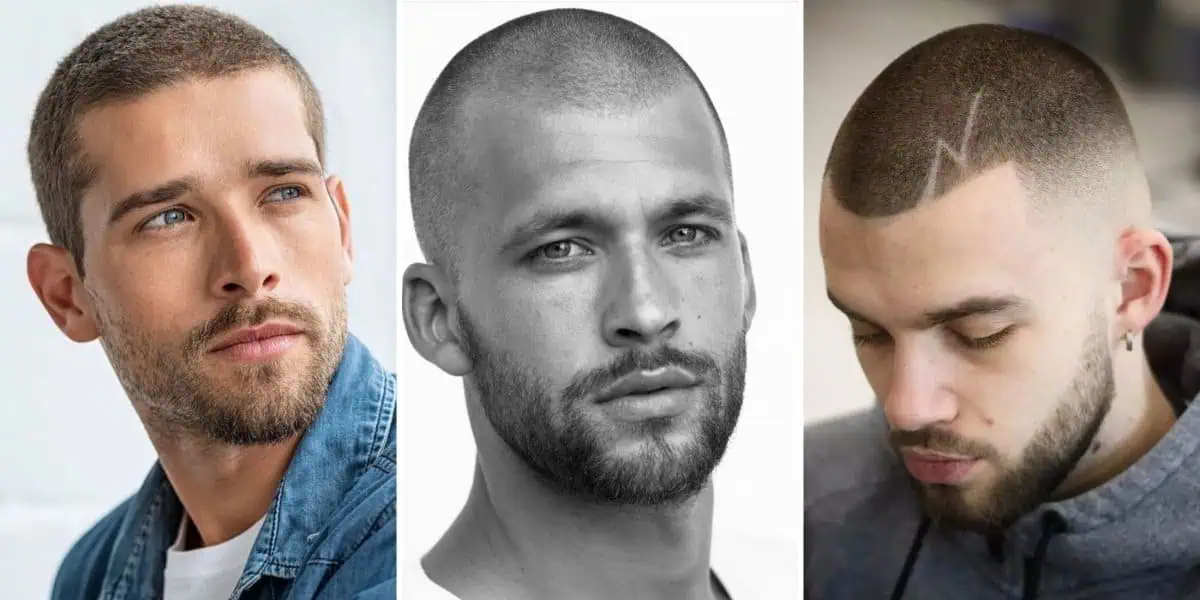
Most men think a buzz cut is just a guard number and five minutes of work. It is until something goes wrong: the wrong length for the head shape, a fade that starts too high and makes the head look like a triangle, a hairline that looked fine at longer lengths and now demands all the attention. Short hair exposes everything.
That’s what makes it harder than it looks and why so many buzz cuts look like they were done by someone who didn’t think about anything beyond the guard size.

In this article
Best Buzz Cut Haircuts for Men
Twenty styles below. Several of them are actually different cuts. A few are the same cut with different names, and I’ll say which is which.
Classic Buzz Cut

Uniform length all over, one guard size from front to back. The reference point for everything else on this list.
What most men don’t realise: the classic buzz cut is the only version where the guard number is the complete description. Every other style on this list modifies that base in some way. If you want a buzz cut and don’t want to make any other decisions, this is the one. Everything else involves at least one additional choice.
Induction Buzz Cut

The shortest version: a number 1 guard or shorter, sometimes clippers with no guard. Named after the military induction process where new recruits have their heads buzzed on arrival.
At this length the scalp dominates and from more than a few feet away most people can’t tell the difference between an induction buzz cut and a fully shaved head. Worth knowing before you book it.
Burr Buzz Cut

A very short buzz cut, typically a number 2, that’s sometimes described as a distinct style from the classic. I’d push back on that. A burr cut is a classic buzz cut at a number 2. The name is regional, not technical. If a barber treats it as meaningfully different from asking for a number 2 buzz cut, they’re either upselling a name or working in a region where the terminology has a specific meaning locally.
Butch Cut

Similar length to the classic buzz cut but with the top left very slightly longer than the sides, creating a barely visible graduation from back to front. Unlike the induction cut or the burr cut, this one is actually a distinct style in technical terms.
The difference from a crew cut is minimal at short lengths. I’d call it a crew cut without the structural front line.
Crew Buzz Cut

A buzz cut where the top is kept slightly longer than the sides and a defined front hairline is shaped at the forehead. The crew cut is really where the buzz cut starts becoming a shaped haircut rather than just short hair. The front line is what distinguishes it, and that line needs to follow the natural hairline or it ends up looking artificial.
High and Tight Buzz Cut

The high and tight is a military-derived cut: sides taken very short or to skin, flat top kept uniform and close. The hardest version on this list to maintain and the one that shows head shape most unforgivingly. I’ve written more on the high and tight versus crew cut comparison in a separate article, but the short version is that most men would be better served by a crew cut or taper fade version.
Buzz Cut Line-Up

A classic buzz cut with a shaved line added to define the hairline at the forehead, temples, and around the ears. The line-up is the sharpest-looking version of the basic buzz cut, and also the fastest to lose its edge. That defined line starts blurring within a week as the hair grows in around it. For men who maintain on a biweekly schedule it looks exceptional. For everyone else the line is gone before the next appointment.
Skin Fade Buzz Cut

A skin fade buzz cut where the sides are faded to skin rather than cut to a uniform length. The skin fade creates maximum contrast between the bare sides and the hair on top.
The maintenance reality: a skin fade looks its best on day one and starts softening from day three onward. By day ten to fourteen the contrast has reduced enough that the cut starts looking grown out. This is the version that needs a touch-up every two weeks to consistently look sharp.
Taper Fade Buzz Cut

A gradual taper on the sides rather than a hard fade to skin. The difference in maintenance is significant. A taper fade can hold its shape for four to five weeks before it looks like it needs refreshing, versus the skin fade’s two-week window. For most men who want a fade, the taper fade is the more practical choice.
Textured Buzz Cut Fade

A fade on the sides with enough length on top to add texture through point-cutting rather than leaving everything at one uniform length. This is where the buzz cut starts crossing into crop territory. The texture on top needs at least three quarters of an inch to be meaningful. Under that and “textured” just means slightly longer than a classic buzz.
Buzz Cut with Beard

Covered in detail in a separate article, but the core point: as the buzz cut gets shorter, the beard becomes more important rather than less. At a number 1 or skin fade, the beard is the primary structural element of the whole look. Without one, everything depends on head shape and facial structure carrying the cut alone. Full detail in our buzz cut and beard guide.
Low Fade Buzz Cut with Line Up

A low fade starting just above the ear, combined with a shaved line at the hairline. The low fade is more conservative than a mid or high fade and grows out more gradually. The line-up on the hairline, as mentioned above, will degrade faster than the fade. The two elements are on different maintenance schedules, which is worth knowing before booking.
Buzz Cut with Hard Part

A line shaved into the hair to create a defined parting. At buzz cut length this is subtle because there’s so little hair to part. The hard part makes more visual sense at longer lengths where the parting has actual hair to direct. At a number 2 or 3 it’s a detail that adds precision without changing much about the overall shape.
Buzz Cut with Design

A shaved pattern, line, or geometric shape cut into the hair or the faded section. Looks sharp fresh. Looks like a mistake within ten days as the hair grows in over the design. I’d only recommend this to men who are already on a weekly maintenance schedule rather than men who will try to stretch it to three or four weeks.
Colored Buzz Cut

A buzz cut where the hair is lightened, bleached, or dyed. At short lengths the colour has nowhere to hide behind, so the condition of the hair is immediately visible. Bleached buzz cuts in particular show brassiness, unevenness, and dryness much more than longer bleached hair does. The conditioning routine matters as much as the cut.
Buzz Cut Mohawk

The sides faded or shaved with a strip of longer hair running down the centre from front to back. At buzz cut lengths the strip can be kept at a number 3 to 6 while the sides go to skin or near-skin. The width of the strip determines whether it looks like a mohawk or just like a slightly longer top. A strip narrower than about an inch and a half looks like a line. Wider than that starts looking like a proper mohawk.
Buzz Cut Faux Hawk

Similar to the mohawk but without the sides going all the way to skin. The hair on the sides is shorter than the centre but not faded out, leaving a visible gradient rather than a hard contrast. Less dramatic than the full mohawk, more forgiving to maintain.
Buzz Cut Undercut

A buzz cut on top with the sides shaved very short or to skin, creating a disconnected look between the top and sides. The undercut at buzz cut length is the most severe version of the contrast fade and the one that grows out fastest. The disconnect becomes messy within ten days as the sides start to blend toward the top length.
Buzz Cut Drop Fade

A fade that curves down behind the ear rather than running horizontally around the head. The drop gives the sides a more natural contour and suits rounder or wider head shapes better than a standard horizontal fade because it follows the skull rather than cutting across it.
Buzz Cut Temple Fade

A fade isolated to the temple area only, blending the hairline at the side without extending down to the ear or the neckline. The most subtle fade option on this list. Easy to maintain since only a small zone needs refreshing, and it works as an addition to almost any buzz cut length without dramatically changing the overall shape.
The Guard Number Decides the Whole Haircut
Every buzz cut decision starts with the guard, and most men either pick one based on what sounds right or defer entirely to the barber.
Here’s what each number actually means in visible terms. A number 1 at 3mm is close enough to shaved that scalp dominates. A number 2 at 6mm is where most men start when they say they want a buzz cut: short enough to look like a real decision, long enough that the scalp isn’t the headline. A number 3 at 10mm is still a buzz cut but with enough coverage that the scalp barely shows, making it the most forgiving of the three on thinner or patchier hair. A number 4 at 13mm is the longest version that still looks like a true buzz cut, though at this length it starts to have some real texture and presence on top.
Hair density and colour change this significantly. Dark, dense hair at a number 2 can look almost solid. Fair, fine hair at the same number shows considerably more scalp. Two men asking for the same guard sizes can walk out looking like they got different lengths because the variable was never the guard. It was always what they started with.
I’d go one guard longer than feels right on a first buzz cut. You can always go shorter on the next visit. You can’t go back.
The Fade Changes How Severe the Buzz Cut Feels
A skin fade makes a buzz cut feel aggressive. A taper makes it feel shaped and controlled. A no-fade classic buzz cut makes it feel uniform and functional.
The choice isn’t just aesthetic. It’s also about maintenance. Skin fades degrade in ten days and need ideally a weekly refresh to stay looking intentional. Tapers can hold for four to five weeks. No-fade buzz cuts grow out evenly and can go six weeks before needing attention.
Most men who ask for a skin fade buzz cut don’t account for the maintenance difference. They get the cut, it looks great, and then they don’t go back for three weeks and wonder why it looks grown out. Match the fade choice to the actual schedule rather than the ideal one.
The Hairline and Crown Have Nowhere to Hide
At buzz cut length, the hairline at the temples and forehead is fully on display. Any recession, unevenness, or natural variation in the hairline becomes the dominant feature of the cut rather than something softened by surrounding length.
The crown is the other problem area. Most men have a cowlick or swirl at the crown, and at longer lengths it gets weighted down and becomes nearly invisible. At a number 1 or 2 it springs back up and creates a visible irregularity in the otherwise uniform length. There’s no fix for this other than going shorter, which presses the cowlick closer to the scalp, or going longer, which gives it enough weight to lie flat.
I’d specifically ask a barber to look at the crown before committing to a very short buzz cut. An experienced barber will check the growth direction and adjust the cut to minimise the cowlick’s visibility. An inexperienced one will run the clippers over it the same way they do everywhere else and leave it standing up.
The Beard Beasts Verdict
Buzz cut haircuts for men are not all the same cut. The guard number is just the starting point. The fade style, the hairline treatment, any added design or texture, and whether the crown is going to cause problems are all decisions that build on that guard number and determine what the cut actually looks like.
For most men trying a buzz cut for the first time, a number 2 classic or taper fade version is the right starting point. It’s short enough to commit to, long enough to adjust from, and forgiving enough to grow out without looking like a mistake.
Start there and work out from it.