
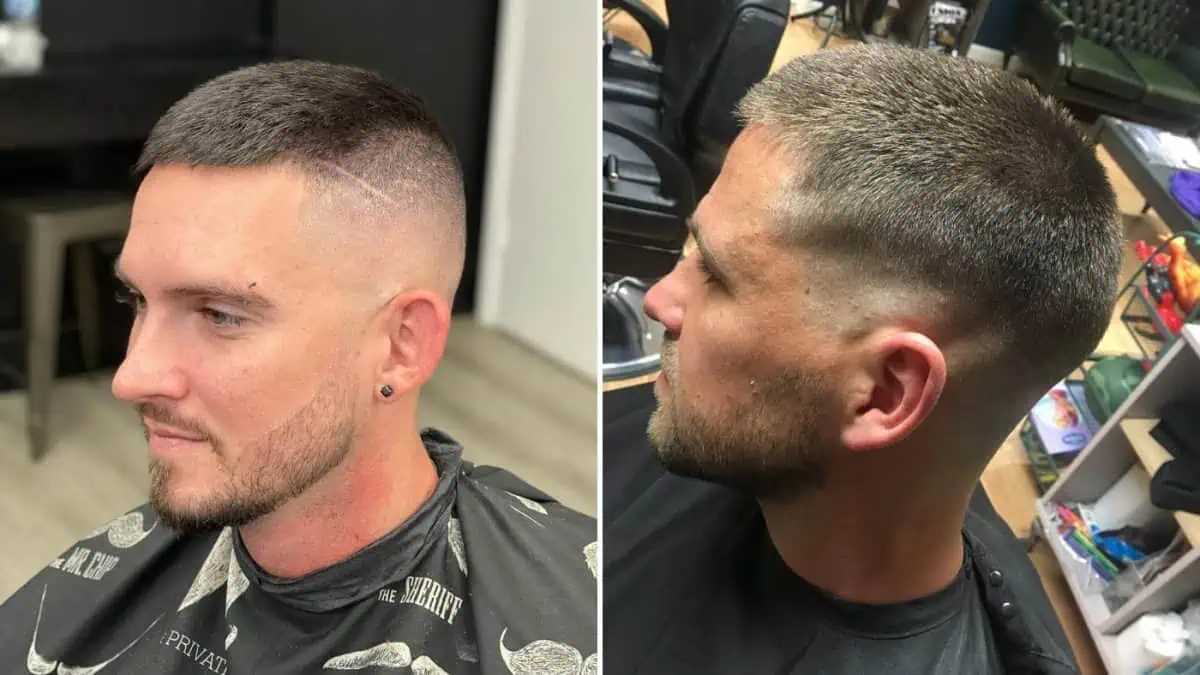
The high and tight vs crew cut debate comes down to one thing: the high and tight looks more impressive on day one, and the crew cut looks better on day twenty-one. Which side of that gap you fall on depends on how honest you are about your actual grooming habits rather than your ideal ones.
Both are short haircuts with short sides. The mechanics are simple. What’s different is how exposed everything gets and how long that exposure stays sharp.

In this article
The Real Difference Is How Much They Put on Show

A crew cut keeps consistent length across the top and tapers the sides, but it never goes all the way down to skin. There’s always some hair on the sides, even at its shortest. That remaining hair gives the cut softness, forgiveness, and a frame the face benefits from.
A high and tight removes almost everything on the sides. The top section is taken high, the sides and back are cut down very short to the skin, and the line between them is abrupt rather than gradual. It’s a military-derived cut that was designed for practicality and function, not for flattering the person underneath it.
The practical consequence of that difference is significant. A crew cut works on most hairlines and most head shapes because the side hair provides enough coverage to soften anything that isn’t perfect. A high and tight puts everything fully on display: the shape of the head/skull, the hairline, and the ears. If those things are good, the cut looks exceptional. If any of them aren’t, there’s nowhere for the cut to hide it.
I’d say most men underestimate how much the side hair of a crew cut is doing for them until they don’t have it anymore.
The High and Tight Leaves Almost No Margin for Error

The appeal of the high and tight is the sharpness. On the right person it looks more defined and more decisive than any other short cut. The problem is what “the right person” actually means.
You need a well-shaped skull, an even hairline with no significant recession at the temples, ears that stay close to the head rather than flaring out, and enough density in the top section to carry the cut on its own without looking thin. That’s a lot of variables all needing to go right simultaneously.
When they don’t, the high and tight exposes every one of them. Ears that nobody would notice on a crew cut become the dominant feature. Temple recession that would be softened by a slight fade becomes a hard line that draws the eye directly to it. A thin or patchy top section that a crew cut would handle with some layering has nowhere to go.
The maintenance window is also shorter. The high and tight looks at its best within the first week and starts visibly degrading after that. The sharp line between the short sides and the longer top grows out unevenly, and by week two you’re looking at something that’s neither a high and tight nor anything else, just a short haircut that’s lost its shape.
The Crew Cut Gives the Barber More to Work With

A crew cut isn’t one fixed haircut. It’s a family of cuts that range from quite short to medium-short on top, with the sides tapered rather than cut to a single uniform length. That variability is where most of the cut’s value comes from.
The taper on the sides can be adjusted to suit whoever’s in front of the barber. A tighter taper on someone with wider-set ears reduces the visual width at the sides. A looser taper on someone with a narrower skull adds some visual weight. The crew cut is flexible in a way the high and tight fundamentally isn’t, because the high and tight’s whole identity depends on the stark contrast between top and sides, and changing that contrast changes the cut entirely.
The top section of a crew cut also gets more barber attention than most men realise. If the crown isn’t done correctly, the back of the head can look flat and disconnected from the front, and no amount of product fixes a structural problem in the cut itself. Managing the front hairline, getting the top to lie correctly, these are the things that separate a crew cut that looks like a twenty-dollar haircut from one that looks like the barber actually thought about it. None of that exists with the high and tight because there’s so little hair to work with.
I’ve seen men with challenging head shapes, prominent cowlicks, uneven hairlines, asymmetric ears, get really good crew cuts because the barber had enough hair to manage those things. The same men with a high and tight would have looked significantly worse.
Day One vs Week Three Is Where the Difference Shows
A high and tight on day one looks sharper than anything else you can do with short hair. I’ll give it that.
By week two the sides have grown in enough to soften the line without being long enough to do anything with. By week three it looks like a short haircut that needs a trim rather than a specific style. If you’re not getting a touch-up every two weeks, the high and tight spends more of its life looking like something that used to be sharp than actually being sharp.
The crew cut grows out more slowly and more gracefully. The taper grows out into a slightly fuller look rather than a fuzzy undefined line, and the top grows into a slightly longer version of itself rather than a different cut entirely. At week three a crew cut still looks like something you chose on purpose. I’d put money on most men not even booking a trim until week five or six, and the crew cut can survive that without embarrassing anyone.
The practical upkeep difference between the two is roughly this: a high and tight needs attention every two weeks to stay sharp. A crew cut can hold its shape for four to five weeks before it actually needs a refresh.
The Beard Beasts Verdict
When it comes to high and tight vs crew cut, the crew cut is the better choice for most men. Not because it’s safer or more conservative, but because it looks good for longer, works with more head shapes and hairlines, and gives the barber actual room to make it suit you specifically rather than just cutting everything short and hoping the result is flattering.
The high and tight is the better choice if your skull is well-shaped, your hairline is solid, and you’re actually going to get a touch-up every two weeks. All three of those need to be true, not just one or two of them. If they are, it’s the sharper, more striking cut and I wouldn’t talk you out of it.
The high and tight is more impressive when it works. The crew cut works more often.