
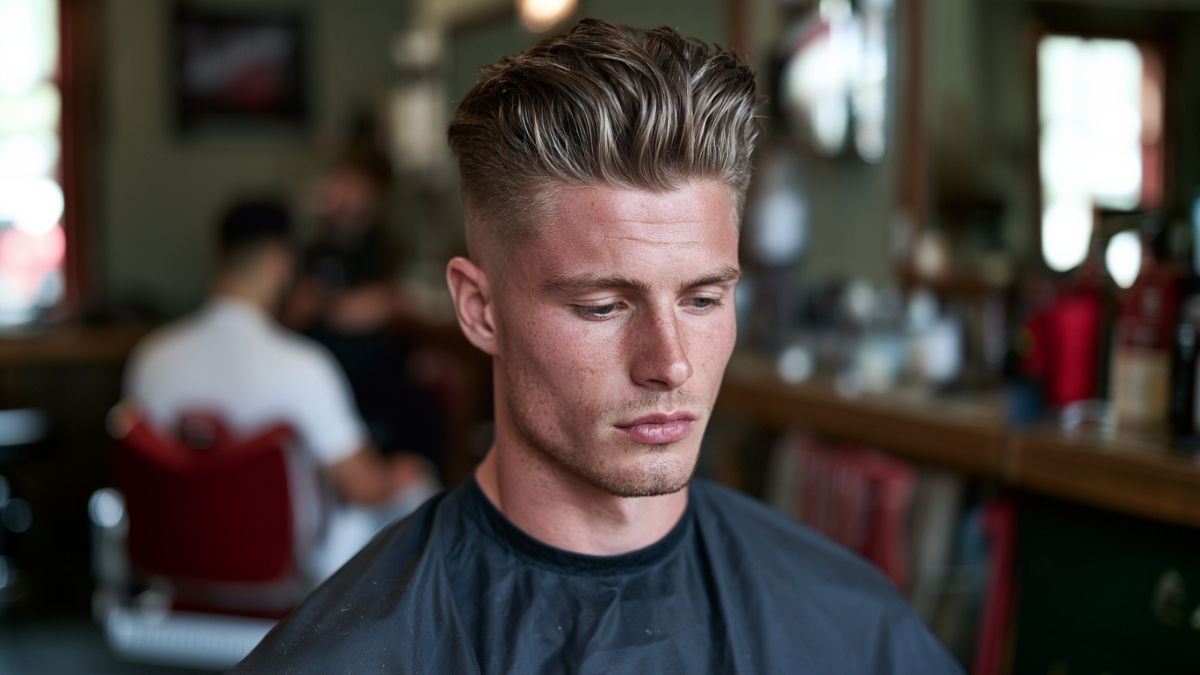
A high fade quiff haircut can look very different depending on how much length you keep through the front and how much shape your hair can actually hold.
Some versions suit certain hair types much better than others, and that’s not always obvious from the photo alone.
The styles below are the ones I’d actually compare before deciding which version makes sense for your hair.

In this article
8 High Fade Quiff Haircuts
These high fade quiff haircuts show how much the look can change once you vary the length, texture and shape through the front.
Classic High Fade Quiff

A classic high fade quiff takes the sides down to the skin while leaving enough length through the front for the hair to lift up and back.
For me, this is the most straightforward version of the cut. The quiff stays obvious, the fade doesn’t compete with it, and you get the traditional shape without making the top overly complicated.
Textured High Fade Quiff

Add more separation through the top instead of keeping everything smooth, and you get the textured high fade quiff.
That gives the front more movement and usually works best when your hair has enough density to show the texture properly.
I’d keep the separation controlled rather than trying to make every section stand apart. Once the top gets too broken up, the quiff starts losing its shape and can drift toward a messy crop instead.
Short High Fade Quiff

The short high fade quiff keeps the front more compact, still lifted but easier to live with day to day.
That gives you the quiff shape without a lot of hair to control, unlike the longer versions.
The line I wouldn’t cross is cutting the front too short. Once it stops lifting properly, it’s no longer doing much that separates it from a textured crop.
Messy High Fade Quiff

The front stays raised on a messy high fade quiff, but the rest of the top gets to move more freely.
The front still needs to look like a quiff. Behind it, the shape can loosen, with some sections falling differently instead of being fixed into one place.
I like this when your hair already has some natural texture because you’re working with what is there rather than creating messiness from scratch.
If the front drops as soon as the hair moves, though, it stops working as a quiff at all.
Wavy High Fade Quiff

A wavy high fade quiff uses the bend already in the hair to help build shape through the front.
Rather than trying to straighten the wave out, I’d let it become part of the quiff. That usually gives the top more character and means less effort trying to force the hair into a smoother finish.
This makes the most sense when your waves already want to lift away from the forehead.
Curly High Fade Quiff

On a curly high fade quiff, the front needs enough length for the curls to rise above the forehead rather than simply lying flat on top.
The high fade removes most of the hair around the sides, so the curl pattern becomes much more noticeable.
Very short curls can still look good with a high fade, but they may not give you enough lift for the haircut to pass as a proper quiff.
For me, that distinction matters. If the front isn’t lifting, I’d call it a curly high fade rather than forcing the quiff name onto it.
High Fade Quiff With Beard

A beard changes the proportions of a high fade quiff because there’s height through the hair and more weight through the lower half of the face.
The sideburn becomes the connection point between the two. If it disappears completely into the fade, a fuller beard can look like it starts suddenly farther down the face.
I like this combination when the beard adds something without taking attention away from the quiff.
With a very full beard, I’d pay particular attention to the overall width around the face. Too much hair at the bottom with a large quiff above can make the whole look feel heavier than you expected.
Long Quiff With High Fade

A long quiff with a high fade gives you much more hair to work with through the front, which means more height and more movement.
The trade-off is that the front takes longer to dry and needs more control if you want it to stay up through the day.
I’d only choose the longer version if that extra height is actually what you want. If you mainly like the quiff shape and want less work, there’s no real advantage in keeping all that extra length.
The Quiff Needs Enough Length at the Front
A high fade can make the sides look great, but the haircut still falls apart if there isn’t enough length through the front to build a proper quiff.
The exact amount depends on your hair. Straighter hair usually needs enough length to lift and stay back, while wavy or curly hair can create more shape at a shorter length because the texture is already doing some of the work.
What I’d avoid is taking the front down just because you want the haircut to feel easier. Once there isn’t enough hair there to lift properly, you start losing the quiff and drifting toward a crop or textured cut instead.
For me, the front is the part I’d protect first. You can always take the sides tighter, but once the quiff is cut too short, there’s nothing you can do except wait for it to grow back.
A High Fade Changes More Than the Sides
A high fade removes a lot of width around the head, which changes how dominant the quiff looks from the front and side.
That works well when you have enough hair on top for the quiff to still look substantial. If the hair is fine or the quiff is kept too short, the difference can start feeling too harsh because there’s so little left around the sides.
Your temples and head shape are worth thinking about too before taking the fade that high. More of both become visible, and that can change the overall result more than people expect from looking at a reference photo.
This is why I wouldn’t treat a high fade as a small detail. It changes the proportions of the whole haircut, not just how short the sides are.
The Front Has to Hold Its Shape
A quiff can look great when it’s first styled and then lose most of its shape a few hours later.
Fine hair is usually the first to drop, especially if the front is longer and there’s not much natural texture helping it stay up. Thicker hair holds more easily, but it can still become heavy if you keep too much length through the top.
How your hair reacts to heat, humidity and movement during the day matters too. If the front falls forward easily, a high fade quiff can become much more work than it looks in a photo.
The best version is one that still has some lift after the perfect finish has gone. If you need to keep fixing the front every few hours, I’d question whether the quiff suits your hair.
The High Fade Grows Out Faster Than the Quiff
The sides grow out long before the quiff on top actually needs any attention.
That’s especially noticeable with a high skin fade, where even a small amount of regrowth changes the look quickly. It will need a touch-up every two weeks to keep the fade sharp, while a softer high fade can often stretch to three.
What I wouldn’t do is shorten the quiff every time the fade gets refreshed just to make the whole haircut feel newly done. If the front is still lifting well and the shape is working, leave it alone.
That’s one of the easiest ways to keep a high fade quiff looking right over time. Refresh the part that has actually grown out instead of automatically taking length off the top.
Beard Beasts Verdict
A high fade quiff haircut works best when the quiff doesn’t have to fight for attention with too many other details.
For most people, I’d keep the top fairly straightforward and let the high fade provide most of the contrast. Too much height, too much texture or an even more aggressive fade can make the whole thing harder to pull off.
I’d choose the version that still looks right on your hair when the front has relaxed a little and the fade is no longer fresh.
If it only looks good at its absolute best, I’d go with a simpler quiff.