
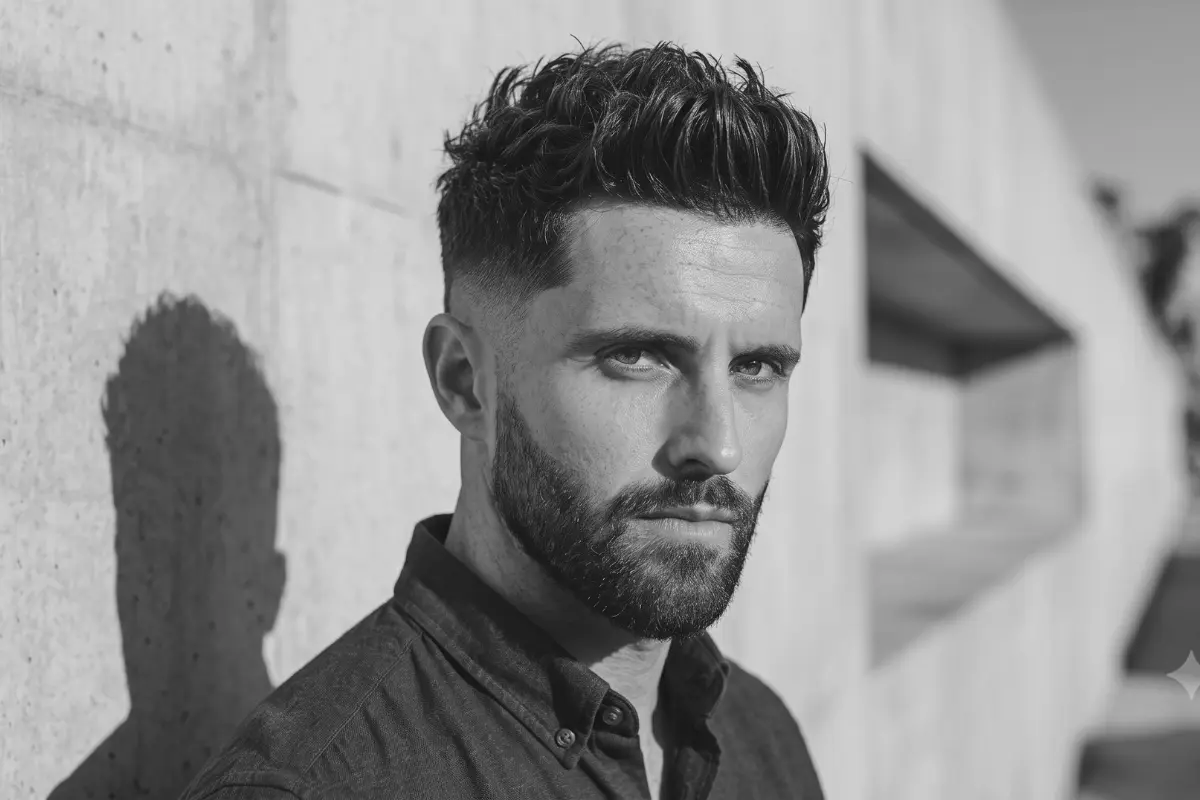
A low fade does less work than a high fade or skin fade, and that’s exactly why the top has to do more. With less contrast at the sides, the textured top becomes the whole story rather than half of it. Get the texture right and a low fade looks intentional and understated. Get it wrong and the same cut just looks like short hair that grew out unevenly.
Most guides treat the fade height as the headline decision. For this combination specifically, it’s the smaller one.

In this article
Best Low Fade Textured Top Styles
Ten versions below, each built around the same principle with a different length or texture on top.
Short Textured Top with Low Fade

An inch or less on top, point-cut for separation, fade starting just above the ear. This is the most forgiving version on this list because there’s not much length to manage and the low fade grows out slowly enough that it doesn’t demand urgent attention week to week.
I’d recommend this as the entry point for a first low fade. It tells you whether the low fade suits your head shape without committing to length on top that needs daily attention.
Messy Textured Top with Low Fade

Slightly longer than the short version, styled loose rather than defined. I’d go easy on the product here specifically. A messy top over a low fade needs less styling intervention than the same messy top over a high fade, since there’s no sharp contrast demanding the top look equally precise. Let it fall closer to how it dries naturally and touch it up rather than restyle it from scratch.
Low Skin Fade with Textured Top

The sides taken to skin but starting low, near the ear rather than at the temple. This is a genuine hybrid: skin fade severity with low fade placement. The result has more contrast than a standard low taper but less than a high skin fade.
I’d recommend this specifically to men who like the crispness of a skin fade but don’t want the two-week maintenance schedule that comes with taking it high. Starting the fade low means less exposed skin overall, so regrowth is less visible day to day even though the fade itself is just as severe in texture.
Low Taper Fade with Textured Top

A gradual taper rather than a hard line, blending from short to the top length without a defined edge. This is the lowest-maintenance combination on this entire list. No hard line means no visible regrowth line. I’d point most men here if low maintenance matters more to you than maximum sharpness.
Textured Crop with Low Fade

A French crop shape, fringe forward, with a low fade underneath rather than the high or skin fade the crop is usually paired with. The low fade version is softer and more versatile for professional environments, though it loses some of the contrast that makes a textured crop look sharp in photos.
Textured Fringe with Low Fade

A fringe that falls forward with texture worked through it, paired with a low fade. The fringe needs trimming every three to four weeks regardless of fade choice, since fringe length is the fastest-moving part of any haircut. The low fade itself can go five to six weeks before it needs attention, so the textured fringe will need trims between fade appointments if you’re tracking them separately.
Textured Quiff with Low Fade

Height at the front, faded sides starting low. This pairing asks more of the product routine than most on this list, since the textured quiff needs real hold to stand up and the low fade offers no visual distraction if it collapses. A medium-hold matte clay worked from the roots up, not just through the ends, keeps the front section standing without adding shine that would clash with the fade’s understated character.
Wavy Textured Top with Low Fade

Natural wave on top, low fade on the sides. The wave does most of the texture work without product, which makes this one of the lower-maintenance combinations here despite the length on top. I’d skip the styling product most mornings and save it for days when the wave looks flatter than usual. Salt spray on damp hair is the only real addition this style needs.
Curly Textured Top with Low Fade

Curls at a length that shows the pattern, low fade underneath. I’d measure the curl width dry before deciding on length, since curls that look proportionate wet often look considerably wider once they’ve dried and expanded. That expansion matters more here than with a higher fade, because the low fade isn’t removing enough side hair to visually offset the extra width on top.
Brushed Back Textured Top with Low Fade

Hair brushed back off the face rather than left forward or textured upward, low fade beneath. The brushed-back direction needs slightly more length than other styles on this list, usually an inch and a half minimum. I’d avoid this pairing under that length. Short brushed-back hair with a low fade tends to look like the hair is simply growing in the wrong direction rather than styled that way on purpose.
The Top Has to Be Cut for Texture, Not Just Styled That Way
A low fade removes the option of using severe contrast to disguise a poorly cut top. Whatever’s happening up there has to hold its own.
Point-cutting and slide-cutting through the top create the separation that makes texture look real rather than applied. A blunt-cut top with a low fade looks flatter and heavier than the same blunt cut paired with a high or skin fade, because there’s no sharp line at the sides pulling the eye away from what’s happening on top. The top is the whole picture here, not half of it.
This is the detail most low fade guides skip: the lower the fade, the more the cut on top has to justify itself. A high fade can make an average haircut look sharp through sheer contrast. A low fade can’t do that. It just shows you what’s actually there.
A Low Fade Only Works If the Side Weight Is Right
The side length in a low fade lands somewhere between a fade and a regular taper, and getting that length wrong is the most common way this combination fails.
Too short at the point where the fade ends and the retained length begins, and the sides look thin and patchy rather than understated. Too long, and the low fade barely registers as a fade at all, just a slightly shorter section blending into a slightly longer one. The sweet spot is usually somewhere around a quarter to half an inch at the top of the fade zone, tapering down from there.
I’d ask the barber specifically where the fade starts relative to the ear, not just for “a low fade.” Starting point matters more than most men realize, and “low” means different things to different barbers without a specific reference point.
Product Should Separate the Hair, Not Flatten It
The product mistake with a low fade textured top is using something with too much hold, which compresses the top into a shape that competes with the low fade’s subtlety rather than complementing it.
A low fade is quiet by design. Heavy product on top creates visual weight that unbalances a cut built around restraint. A light matte clay or a texture powder, worked through with fingers rather than a comb, keeps the separation the cut needs without adding the density that would make the top look disproportionate to the quiet sides.
Apply less than you think you need. This combination fails more often from over-styling the top than from any mistake at the sides.
The Beard Beasts Verdict
A low fade textured top works when the top is actually cut for texture rather than just styled to look textured, the side weight lands at the right length to register as a fade without looking patchy, and the product stays light enough to let the low fade do its quiet work.
Of the ten versions here, the low taper fade with textured top is the one I’d send most men toward first. It asks the least of your schedule and still delivers the exact effect this combination is supposed to have: a haircut that looks put together without looking worked on.