
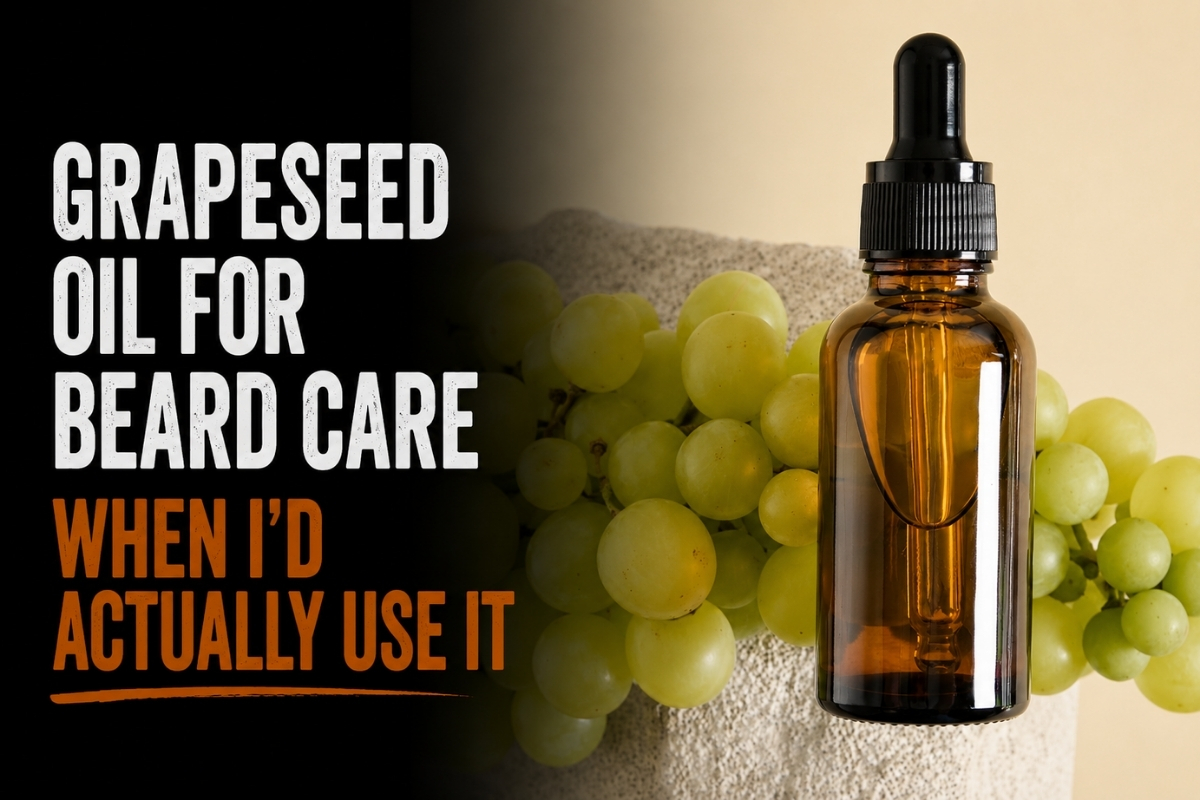
If you’re considering grapeseed oil for your beard, the main appeal is how light it feels compared with many other oils used in beard care. But a lighter oil isn’t automatically a better one, and it won’t suit every beard.
I wouldn’t choose grapeseed oil because of a long list of supposed benefits. What matters is what it actually does for the skin underneath your beard, what it adds to the beard hair and whether another oil would make more sense.
Grapeseed oil definitely has a place, but I think that place is more specific than a lot of beard-care advice makes it sound.

In this article
What Grapeseed Oil Actually Does
Grapeseed oil is mainly useful for conditioning the skin underneath your beard. It tends to feel relatively light on the skin, which is one of the main reasons it works well in beard oil formulas.

On the skin, it acts as an emollient, helping the surface feel softer and reducing that dry, tight feeling you can get underneath facial hair. Like other carrier oils, it can also help slow moisture loss from the skin rather than adding moisture by itself.
The beard hair gets some benefit too. A small amount over the strands can make a dry or rough beard feel softer, reduce friction between the hairs and make it easier to comb through. I still see that as secondary because the skin underneath is where grapeseed oil makes the most sense to me.
Its lighter feel matters. Grapeseed oil can condition the skin and beard hair without making the beard feel as heavy or greasy as some richer carrier oils. How light it feels will still depend on how much you use and what else is in the formula.
What grapeseed oil won’t do is make your beard grow faster, become denser or permanently change coarse beard hair. It can improve the condition and feel of the skin and hair you already have, but it can’t change your natural beard growth.
I’m equally cautious about claims around beard itch. If ordinary dryness is contributing to the discomfort, grapeseed oil may help the skin feel better. Persistent itching, redness, heavy flaking or bumps are different problems, and one carrier oil is unlikely to be the answer.
The useful result is fairly modest but worthwhile: more comfortable-feeling skin with some extra softness through the beard hair, without a particularly heavy oily feel. Grapeseed oil doesn’t need miracle claims attached to it.
When I’d Choose Grapeseed Oil, and When I Wouldn’t
I’d choose grapeseed oil when I want skin conditioning without leaving the beard feeling heavily oiled.

It’s particularly appealing if the skin underneath feels a little dry or tight but richer oils make your beard look greasy or feel weighed down. In that situation, its lighter feel is an actual advantage rather than just another product claim.
I also like it more when the beard hair is already fairly soft and manageable. You may only need enough oil to keep the skin comfortable and give the hair some extra conditioning, rather than something richer worked through the whole beard.
The decision changes when the beard itself feels very coarse, consistently dry or rough through the length. Grapeseed oil can still condition the hair, but its lighter feel becomes less important when the hair is clearly asking for something richer.
Beard-growth promises wouldn’t persuade me to buy it either. And if you’re dealing with persistent redness, heavy flaking, bumps or itching, switching from one carrier oil to another wouldn’t be my first response.
A simple way to judge it’s to work out where the problem actually is. Dry-feeling skin underneath an otherwise manageable beard gives grapeseed oil a clear job. Consistently rough beard hair points me toward a different kind of formula.
Grapeseed Oil vs Jojoba, Argan and Coconut Oil
There’s no reason to call grapeseed the “best” oil for beard care. The useful comparison is what each oil brings to the skin and hair, and how you want the finished beard to feel.

Compared with jojoba oil, grapeseed appeals for a similar reason: both can work well when the skin underneath the beard is the priority. Jojoba is technically a liquid wax rather than a typical plant oil, while grapeseed gives you another light-feeling option that spreads easily.
Argan oil interests me more when conditioning the beard hair becomes a bigger priority. It’s widely used in hair-care products and can help dry or rough strands feel softer, making it worth considering when the beard itself needs more attention rather than just the skin underneath.
Coconut oil can condition both skin and hair, but it has a different feel and can seem heavier in the beard. If you already dislike products that leave your beard feeling oily or weighed down, it wouldn’t be my first alternative to grapeseed.
There’s no universal winner here. Grapeseed earns attention for its lighter feel, while the other options become more interesting as your priorities change. Choose the oil around the problem you’re trying to solve, not because one carrier oil has been declared better for every beard.
Pure Grapeseed Oil or a Beard Oil Blend?
Pure grapeseed oil makes sense if you want a simple, single-ingredient option. It gives you a straightforward way to see whether grapeseed itself suits your skin and beard without several other oils changing how the product feels.

A beard oil blend makes more sense when you like grapeseed oil’s lighter feel but want more from the overall formula. Other carrier oils can change how rich the blend feels, how easily it spreads and how much conditioning the beard hair gets.
I wouldn’t assume 100% pure grapeseed oil is automatically better. Pure tells you that you’re getting one oil. It doesn’t tell you whether that single oil is the best match for what your skin and beard need.
The same applies to blends. A longer ingredient list isn’t automatically an upgrade. Look at which oils are included and whether they add something useful rather than assuming more ingredients mean better beard care.
Freshness matters with pure grapeseed oil too. Because it contains a high proportion of polyunsaturated fats, it’s more vulnerable to oxidation than some more stable oils. Keep the bottle away from unnecessary heat and light, close it properly after use, and don’t keep using oil that has developed an obviously stale or rancid smell.
If you use pure grapeseed oil, keep the application simple. Start with a small amount and work it through the beard to the skin underneath first, then use what remains on your hands through the beard hair. On a longer beard, leaving most of the oil on the outside misses the area where grapeseed makes the most sense.
For a regular beard oil, my preference is generally a well-made blend that uses grapeseed alongside complementary carrier oils. It gives the formula more room to keep that lighter skin feel while adding more conditioning where the beard hair needs it.
Pure grapeseed oil is the option I’d choose when I specifically wanted a minimal formula or already knew grapeseed alone gave me the result I wanted.
Beard Beasts Verdict: Is Grapeseed Oil Good for Beard Care?
Yes, grapeseed oil for beard care makes sense when you want lightweight conditioning, particularly for the skin underneath your beard.
It’s a stronger fit when the skin feels dry or tight but the rest of the beard doesn’t need much help. You still get some conditioning through the hair without necessarily reaching for a heavier-feeling oil.
For a very coarse, dry or rough beard, I’d probably choose differently. Grapeseed can still help, but once the hair needs richer conditioning through the length, another carrier oil or a well-made blend makes more sense to me.
And I wouldn’t buy grapeseed oil for beard growth. It can improve how the skin and beard hair feel, but it won’t make facial hair grow faster or fill in thin areas.
My reason for using grapeseed oil is much simpler: the skin underneath needs conditioning and I don’t want a heavy-feeling oil to do it. If that matches what your beard actually needs, grapeseed is a sensible choice.