
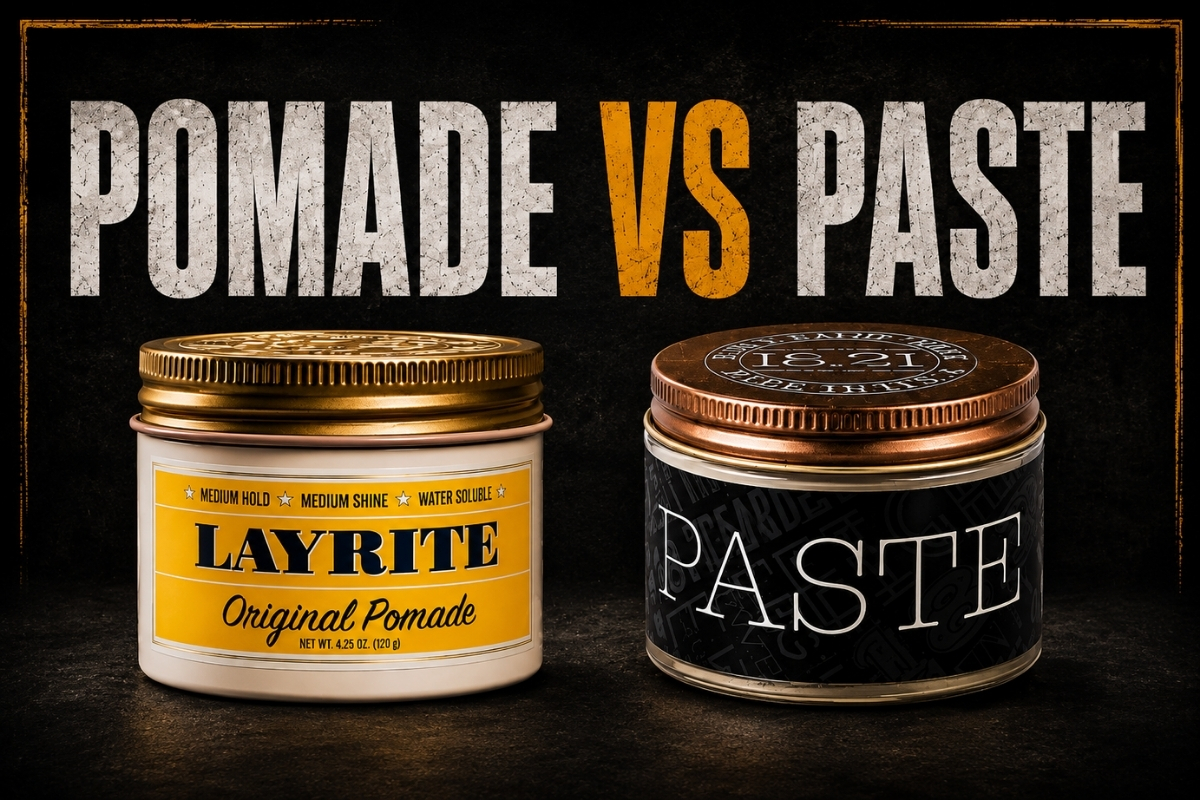
Hair pomade vs hair paste sounds like a simple comparison until you start looking at the products. You’ll find matte pomades, pastes with firm hold and products in both categories that don’t fit the old definitions particularly well.
That’s why I wouldn’t make the decision based on the usual shortcut of pomade for shine and paste for texture. It sounds useful, but it can send you toward the wrong type of product before you’ve looked at what your hairstyle actually needs.
There’s a better way to separate them, and it makes far more sense once you stop treating the words on the jar as the answer.

In this article
Hair Pomade vs Hair Paste at a Glance
Pomade and paste overlap too much for finish or hold alone to settle the decision. I’d use these as tendencies rather than fixed rules.
| Hair Pomade | Hair Paste | |
|---|---|---|
| Styling feel | Often smoother with more slip | Often tackier with more grip |
| Useful when you need to | Keep larger sections together while combing | Create separation, texture and lift |
| Comb styling | Often the easier starting point | Tackier formulas can create more drag |
| Finger styling | Depends heavily on the formula | Often useful for picking out sections |
| Finish | Can range from matte to high shine | Often lower shine, but not always |
| Hold | Varies widely | Varies widely |
| Washout | Can change considerably depending on the type of pomade | Depends on the individual formula |
| Hair Pomade vs Hair Paste |
| Ready to Choose? |
| Want a pomade for side parts, slick backs and other combed styles? |
|
See Layrite Original Pomade → |
| Want a softer paste for finger styling and definition? |
|
See 18.21 Man Made Hair Styling Paste → |
| Beard Beasts may earn a commission when you buy through links on this page. |
Pomade and Paste Overlap More Than the Names Suggest
The overlap becomes much clearer when you look at actual products instead of relying on traditional definitions. Uppercut’s Matte Pomade has a medium hold and matte finish, while its Featherweight paste has firm hold, low shine and plenty of tack while remaining pliable. Even within one grooming range, paste doesn’t automatically mean less hold, and pomade certainly doesn’t have to mean shine.
Hold ratings can hide just as much. American Crew’s Pomade and Defining Paste are both rated medium hold, but the brand positions them very differently. The pomade has high shine and is aimed more toward slicked-back styling and control, while the paste has low shine and is intended to add texture and definition.
That’s why I don’t put much weight on a hold rating by itself. Once two formulas both look suitable on paper, you need to know what they’re going to feel like while you work with them.
The Bigger Difference Is How Much Resistance You Want While Styling
A more useful comparison is how much resistance the formula gives you while you’re shaping your hair.

Some products move through the hair smoothly, with more slip and less drag. Others give you more tack or grip, so you feel more resistance as you work through the hair. Pomades and pastes can fall on either side of that line, which is why the actual formula matters.
You can usually notice the difference before the hairstyle is finished. More slip makes it easier to reposition the hair as you go. More tack gives your fingers something to work against.
Tack isn’t another word for hold, though, and I think that’s where a lot of buying advice gets it wrong. A product can offer plenty of resistance while you’re styling without having the strongest finished hold. Another can spread through the hair more easily but keep the final shape more firmly.
That distinction tells you far more than comparing two hold ratings on the jars. The question is whether you want smoother movement while shaping the hair or more resistance under your fingers.
Pomade Makes More Sense When You Need the Hair to Move Together
Pomade starts to make more sense when you want to shape the hair as one overall style rather than keep pulling smaller sections apart.

Take a side part, slick back or pompadour. You’re usually working with larger sections, often with a comb, and trying to keep what you’ve already shaped from breaking apart as you continue styling. A pomade with enough slip can make that easier because you can keep working through the hair without creating more separation than you want.
Don’t move straight to paste just because you want less shine, either. Some matte pomades are designed for the same kind of combed or swept-back styling, so you can get a lower-shine finish without giving up the styling behavior you were looking for. Uppercut’s current Matte Pomade is one example.
If most of your styling involves keeping larger sections together and combing rather than picking out individual sections for texture, pomade is the category I’d look at first. Then narrow the options down by finish, hold and the feel of the individual formula.
Paste Makes More Sense When You Need to Pull the Hair Apart
I’d reach for paste when you want to build the hairstyle by separating sections rather than keeping everything moving together.

With a textured crop or loose quiff, you might be pinching smaller sections, lifting the front or breaking up areas that are grouping together too much. A paste with enough tack gives you something real to grip and pull against while you do that. Uppercut specifically positions Featherweight around tack, volume, lift and pieced-out texture.
This becomes especially useful once you’ve got the basic shape in place. Instead of repeatedly combing through the hair, you can work on smaller areas with your fingers, pulling out a section here or adding a little more lift there.
That’s a stronger reason to reach for paste than simply wanting a matte finish. If finger styling, separation and texture are doing most of the work, look at paste first and then compare the hold, weight and finish you want.
You Can Have Enough Hold and Still Have the Wrong Product
A product can have enough hold for your hairstyle and still be the wrong tool for building it.
A medium or firm hold rating gives you a rough idea of how strongly the product is meant to hold the finished style. It doesn’t tell you how much grip, slip or weight you’ll be dealing with while you shape the hair. Those are separate parts of how the product behaves.
For me, buying by hold strength first gets the decision backwards. I’d ask two questions: does the product make the hairstyle easier to build, and does it then give you enough hold once you’re finished? If it fails the first one, choosing a stronger hold won’t solve the real problem.
Weight Can Change the Answer More Than Hold Strength
If you want lift or volume, pay close attention to how much weight the product adds to your hair.
By weight, I mean what happens once the product is worked through. Some formulas let the hair lift and separate more easily, while others can make it feel heavier and harder to keep lifted. That matters when the hairstyle depends on height through the front or texture that needs some space between sections.
This is why moving straight to a stronger product isn’t always the answer when a quiff or textured style keeps dropping flatter than you want. More hold might help once the shape is built, but it won’t help much if the product is making that shape harder to create in the first place.
The amount you use matters too. Even a suitable formula can start working against your volume if you keep adding more product. Start with a small amount, see how much grip and lift you’re getting, and only add more if the hairstyle needs it.
Set, Flexibility and Reworkability Aren’t the Same Thing
These three terms are easy to lump together, but they describe different parts of how a styling product behaves after you’ve finished applying it.
By set, I mean how much the product firms up or changes as it settles or dries. Flexibility is how much movement remains once the product reaches its finished state. Reworkability is whether you can come back later and reshape the hair without having to start again.
Hold doesn’t settle any of those questions on its own. American Crew describes Defining Paste as having a pliable medium hold, while Uppercut rates Featherweight as firm hold and still describes it as a pliable paste.
Pomades show the same variation. Reuzel’s oil-based Pink Pomade has heavy hold but a never-dry finish that can be reworked during the day. Its Fiber Pomade has firm hold, yet Reuzel describes it as flexible and easy to rework.
If you want to be able to restyle your hair later in the day, check these characteristics separately. Strong hold doesn’t automatically mean the style will become stiff, and flexibility doesn’t necessarily tell you how easy it will be to reshape later.
With Pomade, the Type of Pomade Matters
Pomade needs one extra check before you compare it with paste: what kind of pomade are you actually looking at?

The washout difference can be substantial. Reuzel describes its water-based Fiber Pomade as easy to wash out, while its oil-based Pink Pomade requires a degreasing routine for full removal. If you don’t want product lingering in your hair after washing, that difference matters.
Newer pomades can complicate things further. Uppercut’s Matte Pomade combines flexible waxes with water-soluble hold agents. The brand says that balance allows the formula to grab quickly but set more slowly, which I’d call a good example of why the base alone doesn’t tell you exactly how a pomade will behave.
Before deciding paste is the better option, check the actual pomade’s base, set and washout. You may find that the drawback putting you off pomade belongs to one type of formula rather than the product you’re considering.
Hair Pomade vs Hair Paste: My Verdict
For me, the best way to decide between pomade and paste is to think about how you actually build your hairstyle.
If you’re working larger sections together or doing most of the styling with a comb, I’d start with pomade. If you’re mainly using your fingers to create lift, separation and texture, paste is usually where I’d look first.
From there, judge the actual formula. Hold, weight, finish, set and washout can all change the decision, so finding the right category is only the first step.
I wouldn’t choose pomade for shine alone, or paste just because you want a matte finish. If I had to reduce the comparison to one rule, it would be this: pomade is the better starting point for grouping and combing; paste is the better starting point for separation and texture. Then choose the individual product that gives you the finish and hold you need.