
A few drops of rosemary oil and a thicker beard? That’s a pretty tempting promise. Some people even claim it rivals minoxidil, which makes it sound like more than another grooming trend.
But if you’re looking into rosemary oil for beard growth, it’s worth asking what those claims are based on. The study everyone keeps talking about is only part of the story.
The product you buy matters, too. Before you start putting rosemary oil on your face, I’d want to know exactly what you’re getting and whether it’s worth the money.
In this article
Does Rosemary Oil Actually Help Beard Growth?
There’s no convincing clinical evidence that rosemary oil makes your beard grow faster, thicker, or denser.

So why does rosemary oil get recommended so often? Much of the excitement comes from research into scalp hair loss. That’s worth looking at, but growing a beard and treating thinning scalp hair are two different things. We can’t assume something that shows promise on your head will have the same effect on your face.
There’s also a difference between growing more facial hair and making the beard you already have look healthier. A beard oil containing rosemary may soften the facial hair you already have and make them easier to manage, but that doesn’t prove rosemary is stimulating growth. Other ingredients in the blend may be doing much of the conditioning.
Your beard’s growth pattern is largely influenced by genetics, age, and how your hair follicles respond to hormones. There’s no good evidence that rosemary oil can change those factors or encourage new growth in areas where your beard is naturally sparse.
If you’re considering rosemary oil specifically to grow a thicker beard, I’d save your money. The claims are ahead of the evidence.
What the Rosemary Oil vs. Minoxidil Study Really Found
The study behind most rosemary oil growth claims was published in 2015. Researchers took 100 men with pattern hair loss and split them into two groups. Half used a rosemary oil preparation, while the other half used 2% minoxidil. Both treatments were applied to the scalp for six months.

After three months, neither group showed a significant increase in hair count. By six months, both groups had more hair than when they started, and researchers found no statistically significant difference between the two treatments.
Those results are often quoted as proof that rosemary oil works just as well as minoxidil. That’s too strong. Not finding a statistically significant difference doesn’t prove two treatments are equally effective. The study also had no placebo group, so we can’t rule out changes unrelated to either treatment.
The trial involved scalp hair loss, not beard growth. Its six-month endpoint tells us nothing about how long it might take to grow more facial hair. The comparison also used 2% minoxidil, rather than the 5% strength commonly used for men’s scalp hair loss.
The researchers used a particular rosemary oil preparation under controlled study conditions. Buying a bottle of rosemary essential oil or mixing your own version doesn’t mean you’re using the same formulation.
Does Rosemary Oil Block DHT or Affect Beard Growth?
You might have heard that rosemary oil blocks DHT. Since DHT helps your beard grow, it’s fair to wonder whether that could work against facial hair rather than help it.

DHT, or dihydrotestosterone, is a hormone made from testosterone. It plays an important role in beard development, helping certain facial hair follicles produce thicker, darker hairs during and after puberty.
DHT can contribute to male pattern hair loss on the scalp, yet it helps stimulate facial hair growth. The same hormone affects follicles differently depending on where they are on your body.
Some research has suggested that compounds in rosemary could interfere with an enzyme called 5-alpha-reductase, which converts testosterone into DHT. A 2013 study found this effect using rosemary leaf extract in laboratory experiments and also examined hair growth in mice.
The rosemary leaf extract used in that research is different from the essential oil found in many grooming products. I’d be cautious about drawing conclusions about your beard from an enzyme result obtained in a laboratory.
There’s no convincing human evidence that rosemary essential oil lowers DHT activity in facial hair follicles or causes beard hair to thin.
Rosemary Essential Oil vs. Rosemary Beard Oil: What’s the Difference?
Not every product labeled rosemary oil is the same. You could be looking at a concentrated essential oil, rosemary infused into another oil, or a beard oil that includes rosemary among several ingredients.
Those differences matter, especially when you’re putting something on your face.

Rosemary essential oil is a concentrated extract of the plant, commonly produced through steam distillation. It’s particularly strong and shouldn’t be applied directly to your beard or the skin underneath without proper dilution. Essential oils can irritate the skin, and being natural doesn’t automatically make them gentle.
Rosemary-infused oil is different. It’s usually made by steeping rosemary leaves in a carrier oil, such as jojoba or olive oil. The finished product contains compounds extracted from the plant, but it’s not the same as rosemary essential oil. The concentration can vary considerably depending on how it’s prepared.
Then there’s rosemary beard oil, which is specifically formulated for facial hair and the skin underneath. These products often combine several carrier oils, with rosemary added as an ingredient. The carrier oils do much of the work when it comes to softening your beard and making it easier to manage.
Jojoba and grapeseed are two carrier oils worth recognizing on the ingredient list. But don’t judge a beard oil by one ingredient alone. The finished formula matters, especially if your skin is easily irritated or prone to breakouts.
For regular grooming, I’d choose a properly formulated beard oil rather than concentrated rosemary essential oil.
Pay close attention to the ingredient list rather than the word “rosemary” on the front of the bottle. A beard oil containing rosemary isn’t automatically a beard-growth treatment, and a higher concentration doesn’t mean better results.
How to Use Rosemary Beard Oil Safely
Start with a clean beard, either dry or slightly damp. You don’t need much oil, especially if you’ve only got short facial hair. Put a little into your palms and rub your hands together.
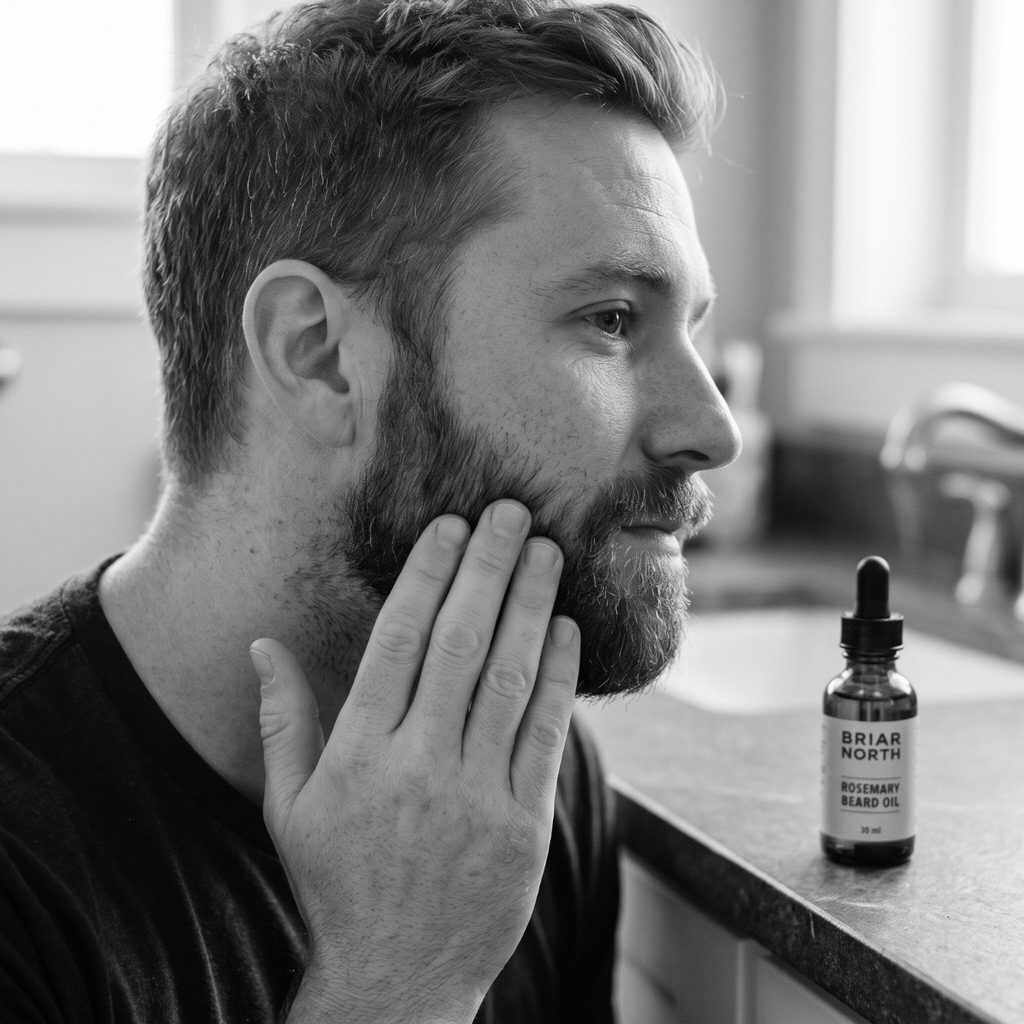
Don’t just rub the oil over the outside of your beard. Use your fingertips to work it down to the skin underneath, then spread the rest through your beard hairs. If you’ve got a longer or thicker beard, take a little extra time to reach the skin rather than just running your hands over the surface.
Once you’ve worked the oil through, use a beard comb or brush to spread it evenly and tidy everything up. You shouldn’t need to keep adding oil until every hair looks shiny. If your beard feels greasy afterward, you’ve probably used too much.
If you’re trying a new rosemary beard oil, check the ingredients first. Fragrances and essential oils can irritate some people’s skin, so test a little on a small area before using it more widely.
Skin reactions can take several days to appear. If you notice burning, redness, itching, or a rash, stop using it. Keep the oil away from your eyes and broken skin.
There’s no proven routine for using rosemary oil to grow a thicker beard. Applying it twice a day or using more than the bottle recommends hasn’t been shown to improve facial hair growth.
Use it as a regular beard grooming product.
And if you’ve already got a beard oil that works well for you, I wouldn’t replace it just because another bottle has rosemary on the label. A rosemary beard oil might be worth using for everyday grooming, but I wouldn’t buy it expecting more growth.