
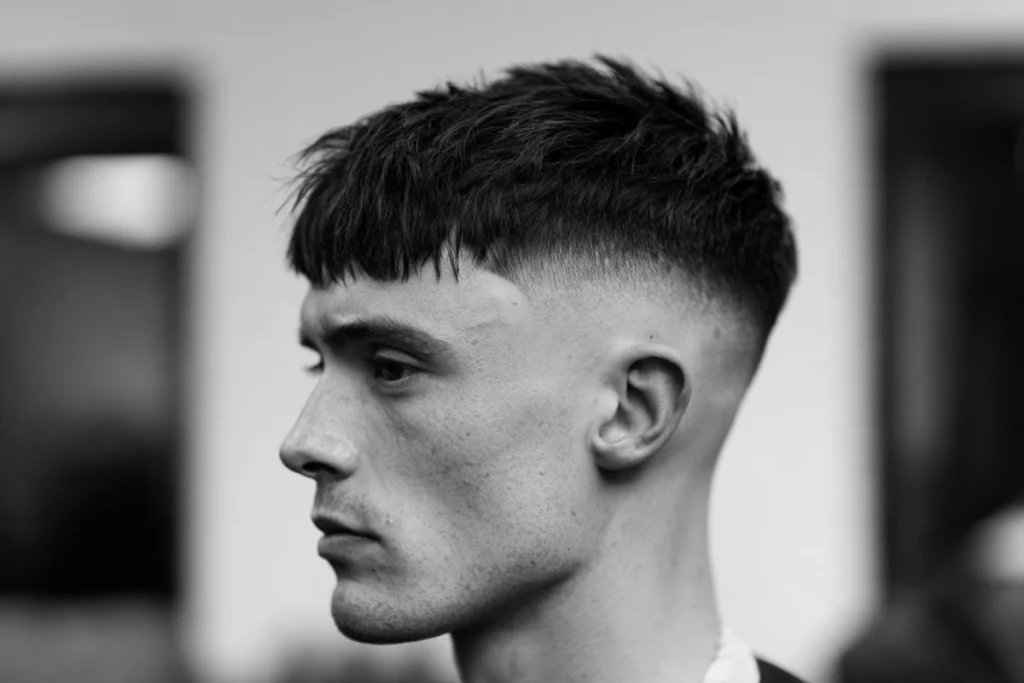
The fade might catch your eye, but it’s the hair on top that can make or break the haircut. A crew cut, a blunt fringe, and short curls can all have a mid fade, yet each gives you a completely different look.
That’s why I’d choose the style on top before getting too attached to a particular fade height.
Here are 30 short fade haircuts worth considering, from close buzz cuts to crops, waves, and curls with more texture and shape.
In this article
30 Short Fade Haircuts Worth a Closer Look
Two haircuts can look surprisingly similar from the front but quite different from the side or back. When comparing the photos, pay attention to where the fade travels and how the longer hair connects to it.
The styles below start with closely cropped tops before moving into fringes, curls, waves, and more defined textures.
1. Low Fade Buzz Cut

A low fade buzz cut keeps the top clipped close while the fade stays near the ears and neckline. The darker hair through the upper sides makes the contrast less dramatic than a high skin fade, although you’ll still get that closely cropped appearance.
I’d recommend this if you want something you can leave alone in the morning. Just think about how short you’re comfortable going on top. With so little hair to work with, even a small difference in clipper length can noticeably change the result.
2. Buzz Cut with Mid Skin Fade and Lineup

This takes the basic buzz cut in a different direction. The mid skin fade exposes more of the sides, while the lineup gives the forehead and temples a defined shape.
The lineup is what I’d pay particular attention to. It can make the haircut look sharp, but there’s a difference between tidying your natural hairline and pushing it back to create perfectly straight corners. If your temples are receding, I’d work with their existing shape rather than sacrifice more hair just to get a square finish.
3. Butch Cut with High Fade

A butch cut is part of the buzz-cut family, with the hair clipped to a fairly even length across the top. It often leaves a little more coverage than a very close buzz, although the exact length is up to you. Unlike a crew cut, there’s usually no longer front section to brush upward or sweep across.
The high fade creates a clear contrast between that uniform top and the shorter sides. If you want the difference to be visible, leave enough length on top for it to look distinct from the faded hair beneath it. Taking everything extremely close can make the butch cut look more like an ordinary buzz cut.
4. Crew Cut with Mid Fade

The crew cut has a little more shape than a buzz or butch cut. Hair is generally longer toward the front and gradually shorter toward the crown, giving you enough length to brush the front up slightly. A mid fade keeps the sides closely trimmed without taking them as high as a high and tight.
I prefer this option for guys who want a short haircut with a bit of height at the front. You get something to style without needing much length, and it can work particularly well when your hair naturally grows upward.
5. High and Tight Skin Fade

With a high and tight, the shaved sides reach much farther up the head, leaving a relatively narrow section of short hair on top. That’s what separates it from an ordinary crew cut with a high fade. There’s very little hair left around the upper sides.
Most of the haircut’s character comes from those close proportions rather than styling. Your scalp and head shape become more exposed, particularly around the temples, and the narrow top gives the haircut its distinctive profile. If you prefer having some fullness around that area, I’d choose a crew cut with a lower fade instead.
6. Ivy League Haircut with Low Fade

Think of the Ivy League as a longer crew cut, with enough hair toward the front to sweep across into a side part. The low fade keeps the upper sides fuller, giving that side-swept section a more gradual connection to the shorter hair below.
You can comb the front across for a neat finish or leave it more relaxed. It’s a good choice if you want the convenience of short hair but still enjoy changing how you style it.
The extra length is what makes the difference. Ask for too little at the front, and you’ll end up closer to a traditional crew cut.
7. Short Side Part with Mid Fade

A short side part can look similar to an Ivy League, but this version puts more emphasis on a clearly visible part and stronger contrast around the sides. The mid fade creates a closer finish beneath the combed section, making the part more prominent when viewed from the side.
You don’t need a shaved hard part to achieve it. Enough length to comb the top across and a natural separation can give you the shape you’re after. It’s worth checking how your hair grows near the part, though, because a stubborn cowlick can make a neat finish harder to maintain.
8. Short Brush Up with High Fade

With a short brush up, the hair is lifted upright rather than swept back into the fuller shape of a quiff. The top stays relatively short, and the high fade removes much of the hair around the sides, creating a narrow profile beneath the lifted front.
Your hair’s natural growth makes a difference here. Hair that already stands upright may need very little help, while softer hair that falls forward can take more effort to lift. A blow dryer can help create the shape before you add any product.
I’d ask for a little texture through the front rather than cutting it into one heavy, even section. That gives the strands some separation when you lift them and keeps the result looking more relaxed.
9. Textured Crop with Low Fade

A textured crop gets its character from the hair on top. Instead of forming one smooth section, the shorter strands have visible separation and a slightly irregular finish. Keeping the fade low preserves some weight above the ears, giving the textured top a fuller connection to the sides.
With thick hair, I’d favor this over a uniform crew cut if you want something a little more relaxed. Breaking up some of that bulk can create movement, especially with a small amount of matte styling product.
Fine hair needs a more careful approach. Removing too much weight can leave the scalp showing through, so I’d rather keep some fullness than chase an extremely choppy finish.
10. French Crop with Mid Skin Fade

The French crop puts more emphasis on a defined fringe than the looser textured crop. The hair is directed forward toward the forehead, with a front that can be cut fairly straight or softened with some texture. A mid skin fade gives the shorter sides a much stronger contrast.
The fringe is the detail to concentrate on when choosing this cut. Decide how far forward you want it to fall and whether you prefer a straighter finish or something less uniform.
If your hair naturally grows upward at the front, getting that fringe to stay forward may take more effort than the photograph suggests.
11. Caesar Cut with High Fade

The Caesar cut keeps the hair fairly short and even across the top, brushed forward into a small fringe. Compared with the French crop earlier in the gallery, the top is typically shorter and less textured, although the two styles can overlap. A high fade clears much of the hair around the temples, giving the short, forward-combed top a stronger frame.
This is worth considering if you want a small fringe that generally falls into place with minimal styling. I’d keep the front relatively soft, especially if your natural hairline is uneven. A slightly broken fringe still has the recognizable Caesar shape and can look more natural than a perfectly straight line.
12. Edgar Cut with Mid Fade

Before choosing an Edgar cut, decide how blunt you want the fringe. That’s the part everyone notices first. The hair is pushed forward into a thick, straight front line, with a mid fade keeping the sides closely cropped.
Leave the fringe lower and the haircut takes on a heavier, boxier appearance. Take it higher and more of your forehead shows.
I’d spend more time choosing that front line than worrying about moving the fade slightly higher or lower. The Edgar relies on having enough hair at the front to create its recognizable shape, so if your hair is naturally thin around the forehead, a thick, solid fringe will be harder to achieve.
13. Choppy Fringe with Low Fade

A choppy fringe gives you a less uniform front than the Edgar or Caesar. Instead of one solid line, the hair falls forward in uneven sections, with individual pieces creating movement across your forehead.
The low fade leaves more hair above the ears, giving the uneven fringe a softer frame than you’d get with very closely shaved upper sides. It’s a good option if you like styling your hair forward but prefer something less structured than a blunt fringe.
Getting that separation starts with the haircut itself. The front needs enough length and variation for the individual sections to show. Styling product can help bring out the texture, but it won’t do much if the fringe has been cut into one very short, even line.
14. Short Disconnected Crop with High Skin Fade

A disconnected crop has a clear break between the hair on top and the shorter sides. The high skin fade can still be smoothly blended through the sides, but there’s a sudden change in length where it meets the crop.
That’s an important distinction. A regular high fade crop can have plenty of contrast without being disconnected. Here, the abrupt transition is part of the haircut, not necessarily a poorly blended fade.
I’d pay particular attention to the side-view photograph before choosing this one. With thick hair, the longer top can create a pronounced shelf above the fade. That can look great when it’s the effect you’re after, but if you prefer everything to blend together naturally, I’d stick with a connected crop.
15. Short Spiky Hair with High Fade

Short spiky hair is all about the individual strands. You want small sections pointing upward across the top, rather than one large section lifted at the front. The high fade gives those spikes a closely cropped base, and a little matte styling product can help you pinch the strands into shape.
I’d let the spikes vary in height and direction. Perfectly identical points can look stiff, while using too much product can make the hair clump together instead of creating better separation. Start with a small amount of matte clay like 18.21 hair clay, work it through with your fingers, and see how your hair naturally responds.
16. Short Quiff with Mid Fade

A short quiff gives you some height at the front, with the hair lifted and swept backward. Unlike a brush up, which has a more upright shape, the quiff curves back into the rest of the top.
A mid fade gives you visible contrast while keeping some hair through the upper sides, which can help the quiff flow naturally into the rest of the haircut. You can keep the front fairly modest and still get a noticeable change in shape.
The appeal is having a little volume with most of your hair still short. Just be realistic about the styling involved. Hair that naturally falls forward may need blow-drying and some product to keep that lifted shape throughout the day.
17. Short Brushed-Back Hair with Low Fade

Short brushed-back hair follows one direction from the hairline toward the crown, staying flatter than a quiff. A low fade leaves some fullness through the upper sides, helping the top flow backward in one continuous shape.
You can comb it smooth for a neater finish or use your fingers to leave more texture between the strands. The part I’d check is the crown. If your hair naturally changes direction there, keeping a little extra length toward the back of the top can help it settle rather than spring upright.
18. Short Faux Hawk with Mid Fade

The short faux hawk creates a raised ridge through the middle of the head, running from the front toward the crown. Hair on either side stays shorter, while the mid fade reduces the length farther down the sides.
Unlike a traditional mohawk, where the longer central strip is clearly separated from shaved sides, a faux hawk generally keeps a softer connection with the surrounding hair. Much of its shape comes from bringing the top inward and upward.
The important thing is making the center stand out. You can get that effect with a fairly modest amount of height, and the hair doesn’t need to form a row of sharp spikes. When styled flatter, the same haircut can look closer to an ordinary short textured style.
19. Short Wavy Crop with Low Fade

Some naturally wavy hair looks almost straight when it’s clipped too close. If that’s how yours behaves, I’d decide how much length to leave on top before focusing on the fade. Keeping enough hair for the natural bends to show, with a low fade near the ears, gives you a short haircut that still looks wavy.
The waves provide much of the texture themselves, so heavily cutting into the top isn’t always necessary. Letting the hair fall in slightly different directions creates a more relaxed appearance than trying to comb every section into the same pattern.
Pay attention to the crown as well as the front. If your waves lie flatter at the back, your barber may need to adjust the shape through that area rather than simply cutting every section to the same length.
20. Short Wavy Fringe with Drop Fade

Here, the waves fall forward into a loose fringe across the forehead, rather than staying mainly on top as they do with the wavy crop. It’s a good choice if you want your natural texture to be visible from the front.
The drop fade changes the shape around the sides and back. It curves downward behind the ears instead of following a more level path, often leaving more length above the fade toward the back. That curve is worth checking in a side or rear photograph, because you won’t see much of it from straight ahead.
Your natural wave direction also affects the fringe. If the hair parts near the middle or naturally sweeps to one side, I’d work with that movement rather than force every section straight down. A slightly uneven fringe can look better than trying to arrange your waves into a perfectly level line.
21. Short Curly Top with Mid Fade

With a mid fade taking some width from the temples, short curls can form a rounded top or fall into looser, uneven sections. The exact shape depends on your curl pattern and how much length you leave. I’d rather work with the way your curls naturally form than try to force them into a shape that needs constant rearranging.
This is a good choice when you want to keep your curls visible while having the sides cut closer. Pay attention to how the hair spreads immediately above the fade, though. If that area grows outward, shortening the entire top can reduce curl definition without solving the bulk. Adjusting the upper-side weight while keeping some length through the crown may give you a better result.
22. Short Curly Fringe with Low Skin Fade

Rather than keeping the curls mainly above your forehead, this version lets them fall forward into a fringe. The low skin fade brings the hair down to the scalp near the bottom of the sides, while preserving more fullness higher up.
The fringe changes how the haircut looks from the front. It can soften a prominent forehead and give you a less upright shape than the curly top above, although you’ll need enough length for the curls to actually fall forward.
Check where the fringe finishes once it’s dry. Curly hair can shrink considerably, so a fringe that reaches your eyebrows when stretched may finish much higher. Ask your barber to judge the final length with your natural curl pattern in mind.
Short Fade Haircuts for Black Men
These short fade haircuts for Black men make the most of naturally coily and tightly textured hair. Some keep the fullness of a short Afro, while others focus on defined waves, sponge twists, finger coils, or locs.
The fade itself makes a big difference. A high fade creates a more compact shape on top, while a low fade preserves more width and natural texture around the sides. The right choice depends on your hair texture, how you like to style it, and how much of its natural shape you want to keep.
23. Tight Curls with High Fade

For Black men with tightly coiled hair, a high fade can noticeably change the overall shape of the haircut. With much of the upper sides clipped away, the coils form a narrower, compact section on top, rather than continuing into the fuller shape of a short Afro.
These two styles can overlap, so I wouldn’t choose based on the name alone. Look at how the haircut appears from the front, particularly around the temples.
If you like having closely framed coils, the high fade is worth considering. If you’d rather keep some width through the sides, I’d use the short Afro with a low fade as your reference instead.
24. Short Afro with Low Fade

A short Afro keeps more of the natural fullness of tightly coiled hair, shaped into a rounded or slightly squared silhouette. The low fade tidies up the area around the ears and neckline while leaving much of that shape intact.
I’d judge this haircut from the front as much as the side. You can have a well-blended low fade and still end up with an uneven shape if one side of the Afro is left noticeably fuller than the other. Getting the overall silhouette balanced matters more than making the fade especially close.
The shape itself deserves some thought. A rounded Afro and a more squared finish can look quite different, even at similar lengths. Decide which one you prefer before asking for the fade, because removing too much hair from the upper sides can change the silhouette you’re trying to keep.
25. Short Flat Top with High Fade

The flat top is defined by its upper shape. Instead of following the rounded silhouette of an Afro, the hair is cut to create a relatively level surface, often with straighter sides and more pronounced corners.
A high fade makes that squared shape more pronounced by removing much of the hair underneath it. Tightly coiled hair is particularly suitable because its natural structure helps support the top, although other hair types can achieve a flat top with the right cutting and styling.
The squared appearance is the reason to choose this haircut, and it’s also the part that shows uneven growth most clearly. As the hair grows, the flat surface and corners can lose their definition. I’d keep that in mind if you’re someone who prefers leaving a long gap between haircuts.
26. Short Waves with Low Fade

A classic in Black barbering, short waves are different from the loose, naturally wavy styles earlier in the gallery. They’re repeating ripple patterns developed by training short, tightly textured hair to lie in a consistent direction. When that pattern extends around the head, it’s commonly called 360 waves.
The low fade keeps the hair closely trimmed near the ears and neckline without removing too much of the wave pattern farther up the sides.
What makes this style interesting is that the texture comes from the wave pattern rather than having much height on top. But the haircut alone won’t create it. Regular brushing along your natural growth pattern, suitable conditioning, and compression with a durag or wave cap can all play a part.
If you’re already developing waves, tell your barber before they start cutting. Taking the top too short can make the pattern much less visible, even when you’ve spent plenty of time working on it.
27. Short Sponge Twists with Mid Fade

Sponge twists give tightly coiled hair a more separated appearance by gathering small sections into defined coils or twist-like formations. A textured sponge is moved in circles across slightly damp hair, helping those sections form without having to twist each one individually.
The mid fade creates a closely cropped section beneath the textured top. Compared with a picked-out short Afro, the hair has more visible groups of coils, which can form a fairly even pattern or a more irregular arrangement depending on your texture and the sponge used.
The amount of hair left on top affects the result. If it’s clipped extremely close, the sponge may struggle to gather visible sections. Use gentle circular movements rather than pressing harder or repeatedly rubbing the same area, which adds friction without guaranteeing better definition.
28. Short Finger Coils with Drop Fade

Finger coils are made by taking small sections of damp hair and winding them around a finger to form individual coils. Unlike sponge twists, which develop through circular movement across a larger area, each finger coil is formed separately.
That gives you more control over the size and placement of the sections, although the finished styles can look surprisingly similar. You can’t always tell which technique was used just by looking at a photograph.
The drop fade curves downward behind the ears rather than following a more level path around the back. That curved shape is a separate choice from fade height, so a drop fade can also be low, mid, or high.
I’d go for finger coils if you want the extra control of forming each section individually and don’t mind spending more time on your hair. They take patience, and preserving the definition means being reasonably gentle when washing, drying, and handling the coils.
29. Short Locs with Temple Fade

Short locs give you established sections of locked hair, while the temple fade keeps a small area around the temples and sideburns closely trimmed. Unlike a full fade across the sides, the temple fade can leave much more of the surrounding hair intact.
This matters particularly if you’ve already got locs. Taking the fade farther back or higher than intended could mean cutting into their bases, so I’d be very clear about exactly where you want the faded area to stop.
Locs can begin as coils, twists, or through other starting methods, but they change as the hair develops and locks over time. If you’re starting from scratch, don’t expect your hair to look immediately like a photograph of mature short locs.
At later appointments, keep that fade boundary consistent rather than gradually taking it higher into the surrounding hair. Otherwise, a small temple fade can slowly become a much larger faded area than you originally wanted.
30. Short Mohawk with Burst Fade

A short mohawk keeps a central section of longer hair running from the front toward the back of the head. The burst fade curves in a rounded shape around each ear, removing hair through the sides while preserving more length behind them.
On tightly coiled hair, that central section can hold a fuller, more textured shape without needing much length. Its width makes a difference, too. A broader strip gives the haircut more volume when viewed from the front and back, while a narrow strip creates a more obvious separation from the faded sides.
You don’t need a tall row of spikes to make it work. Even a relatively short, textured top can create the mohawk shape when the sides are cut appropriately.
Before choosing a reference photo, check how the haircut looks from behind. A burst fade mohawk should retain that central length toward the nape rather than disappearing into a conventional short fade. Otherwise, you could end up with a different haircut from the one you intended.
Where the Fade Meets the Hair on Top
Low, mid, and high describe how far up the sides the fade rises. A skin fade describes how close the shortest hair is cut, right down to bare scalp. That means you can have a low skin fade as well as a high skin fade.
The height of your fade changes how the hair on top looks, even when you keep exactly the same length. Imagine two buzz cuts with identical top lengths. The low fade leaves more dark hair around the upper sides, while the high fade removes more of that coverage and exposes more of your head shape.
What I’d pay particular attention to is where the fade blends into the longer hair. Thick hair that naturally grows outward can leave a bulky ridge above the fade. Taking the fade higher isn’t always the answer. Sometimes it’s that extra weight above the blend that needs adjusting, especially if you want a smooth transition rather than a disconnected look.
Curly hair brings another consideration. A fade can look smoothly connected while the top is damp, only for the curls to spring outward as they dry and create a heavier section above the blend. If you want a connected finish, it’s worth judging that upper-side shape with your curls in their natural dry state before taking more length away.
When you’re comparing photographs, look closely at the hair immediately above the fade. Does it blend smoothly into the top, or is there a clear change in length? That detail will tell your barber more about the shape you want than simply asking for a mid fade and leaving the rest open to interpretation.
What the Photos Won’t Tell You
A photograph can hide as much as it shows. Strong lighting can exaggerate the contrast of a skin fade, while a front-facing shot may conceal how much bulk is left around the crown or behind the ears. I’d want to see a side or rear view before copying a haircut with a particularly distinctive fade shape.
An especially close fade also changes as it grows out. Once stubble appears in areas shaved to the skin, that sharp contrast starts to soften. And a low skin fade isn’t automatically easier to maintain just because it sits lower. If you don’t want frequent barber visits, I’d consider keeping a little length at the shortest point rather than going right down to the scalp.
Styling effort varies considerably: a buzz cut needs almost nothing in the morning, while a short quiff may need a blow dryer and product to resemble the photo. Waves and finger coils involve maintaining their patterns, too. I’d rather recommend a haircut you can realistically manage yourself than one that only looks right after someone else has styled it.
When you’ve found a style you like, show your barber the front and side views, and the back if you’re considering a drop or burst fade. Point out the length you want on top, the fringe shape, and how much fullness you’d like to keep around the upper sides. Tell them how your hair naturally grows, too. The aim is to get the look you like without assuming your hair will behave exactly like the model’s.
Beard Beasts Verdict
If I had to recommend one short fade haircut to start with, it would be the crew cut with a mid fade. You get enough length at the front to give your hair some shape without needing to spend much time styling it. It’s a sensible middle ground between a very close buzz cut and something that needs more attention.
That said, your natural hair texture matters. A textured crop with a low fade would be my pick for thick hair that you prefer wearing forward, while a short curly top with a mid fade makes more sense if you want to keep your natural curls visible.
I also wouldn’t automatically choose a skin fade just because it looks sharper in a photo. Unless you specifically want that exposed, high-contrast finish, I’d lean toward keeping a little more coverage around the sides. You can still get a great short fade without taking everything down to the scalp.